Tag: Transparency

  • Before You Vote For Him: The Wes Streeting File

    Before You Vote For Him: The Wes Streeting File

    Earlier this week, Wes Streeting’s parliamentary aide resigned and told the Prime Minister to set a timetable for his exit. By the end of the next day, dozens more MPs had joined the call, and the Telegraph was reporting that Streeting’s team had drafted a leadership campaign built on five “pillars” and pitched on the idea that he is the only Labour figure who can see off Reform UK.1 Downing Street found out about the existence of these five pillars when someone in Streeting’s operation accidentally texted the plan to a Number 10 staffer.31 The Times is reporting that allies of Angela Rayner have started warning, on the record, that he would be “ruined” by future disclosures of his messages with Peter Mandelson.2 Al Jazeera is reporting that he may already have the 20% of Labour MPs needed to trigger a contest.3

    So this is the moment, I think, to put what’s actually on the public record in one place. Not opinion. Not vibes. The donor list, the contract decisions, the Freedom of Information disclosures, the WhatsApp messages he himself published. Because if he becomes Labour leader, and possibly Prime Minister, the version of him we’ll be offered in the campaign won’t include most of it.

    I’m going to be honest about my view, and I’m going to be very careful with the facts. Everything below is sourced. Every link goes to the underlying document or the journalism that uncovered it. If a claim is opinion, I’ll say so. If a thing was reported by The Times and not yet confirmed, I’ll say that too.
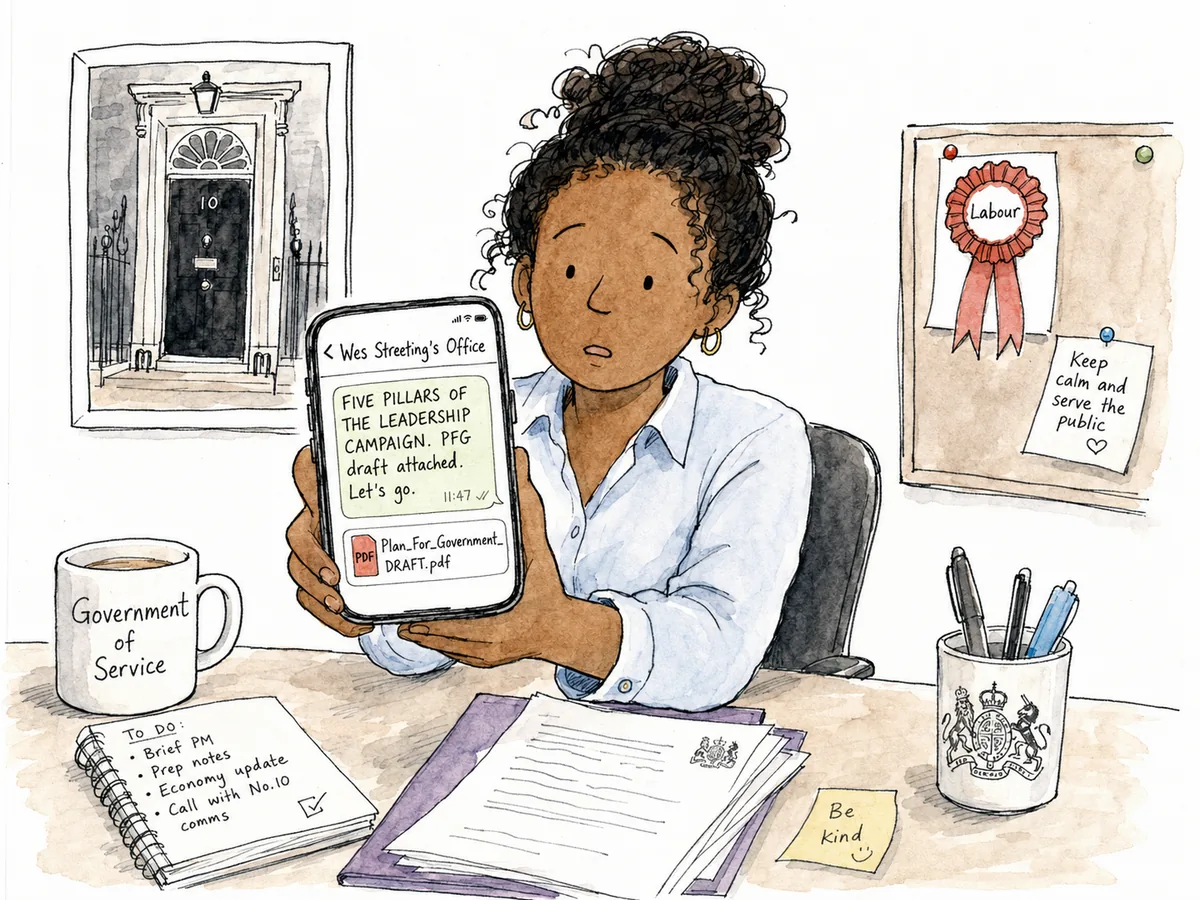
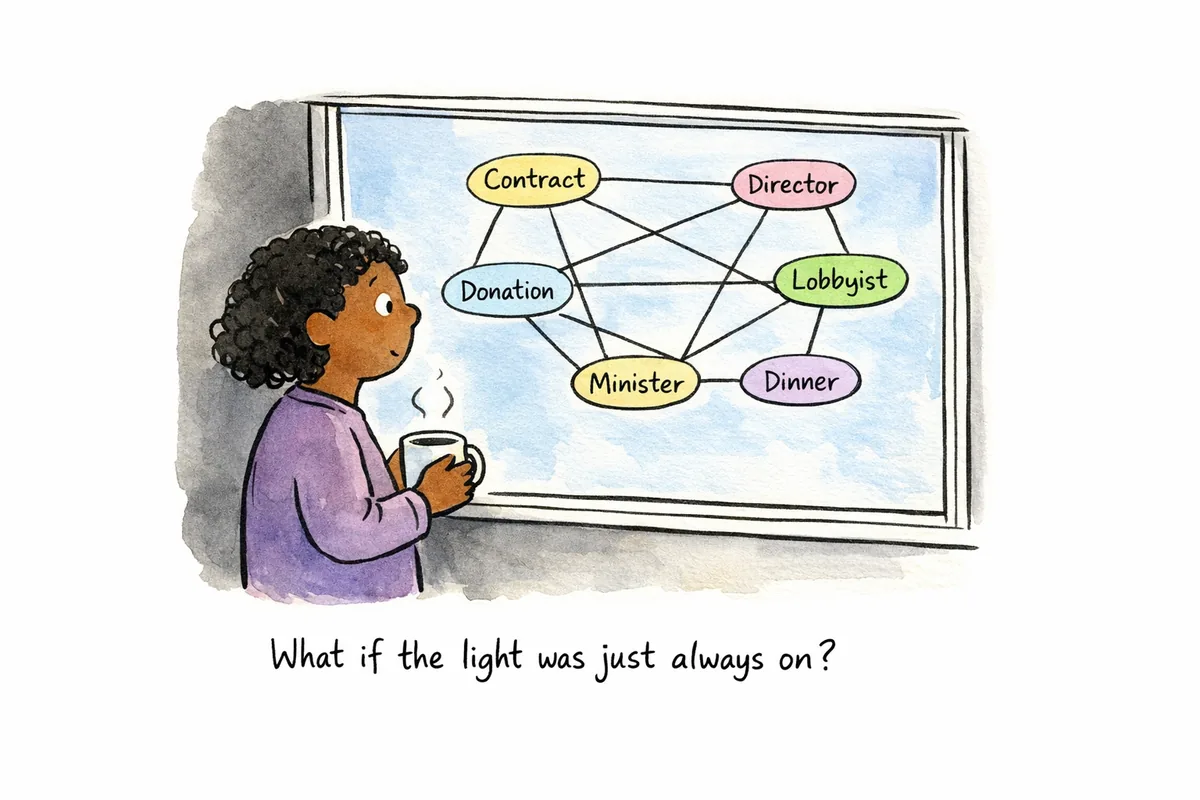
    A young Downing Street staffer sits at a desk holding a phone, looking at the screen with a quiet, dazed expression. The phone screen shows a WhatsApp message from 'Wes Streeting's Office' reading 'FIVE PILLARS OF THE LEADERSHIP CAMPAIGN. PFG draft attached. Let's go.' On the wall behind the staffer is a framed photograph of the black door of 10 Downing Street.

    I should be clear upfront. I am not writing this from a place of broken faith. I never had it. In my view Wes Streeting is misguided. He has been Health Secretary for under two years, and the things he has done in that time, the things this article is about, are not the things I want a Prime Minister to have done. That is the case I am going to make. None of what follows is about whether he’s a bad person. It is about whether the structural picture, the donors, the decisions, the relationships, is the picture you want at the top of the country. That’s a different question, and one that does not depend on whether you share my view of him personally. The facts below stand on their own. Read them and decide.

    The facts spine, part one: who is paying for Wes Streeting

    The headline number, calculated by the Good Law Project from the public register, is this: more than 60% of all the donations Wes Streeting has accepted since entering Parliament in 2015 come from companies and individuals with links to private healthcare.4 The total as of April 2025 is around £372,000.5

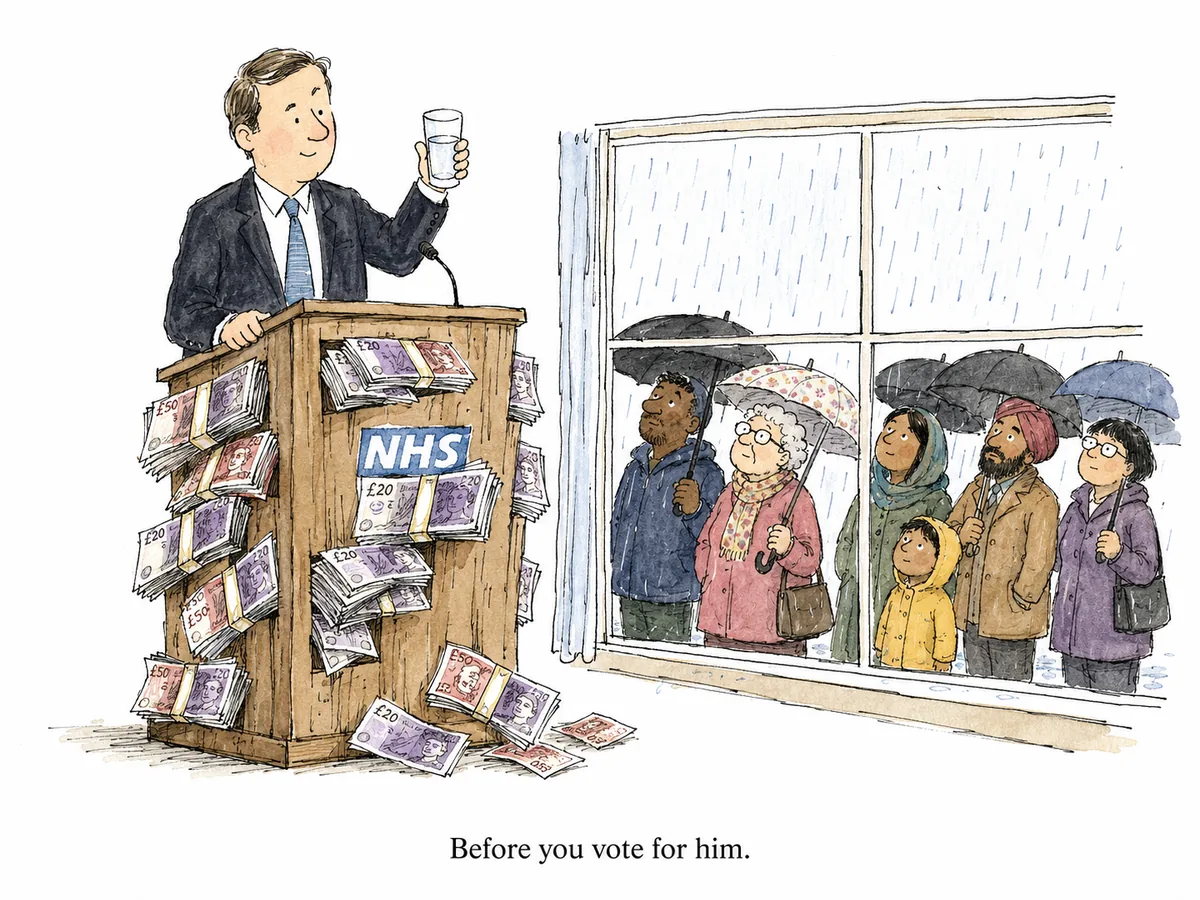
    Since he became Health Secretary in July 2024, the donations have not slowed. They’ve accelerated. £58,000 of office support from private healthcare-linked sources between July 2024 and April 2025 alone, which works out at roughly £10,000 a month.5 The largest single funder is Peter Hearn, a recruitment millionaire whose companies place senior executives in the NHS. He has put in £260,304 through two companies he ultimately owns, including £144,900 to Streeting personally.6 The runner-up is John Armitage, a hedge fund manager reported to have $500 million in United Health, the largest healthcare insurer in the United States. He has given Streeting £95,000 since 2022.4
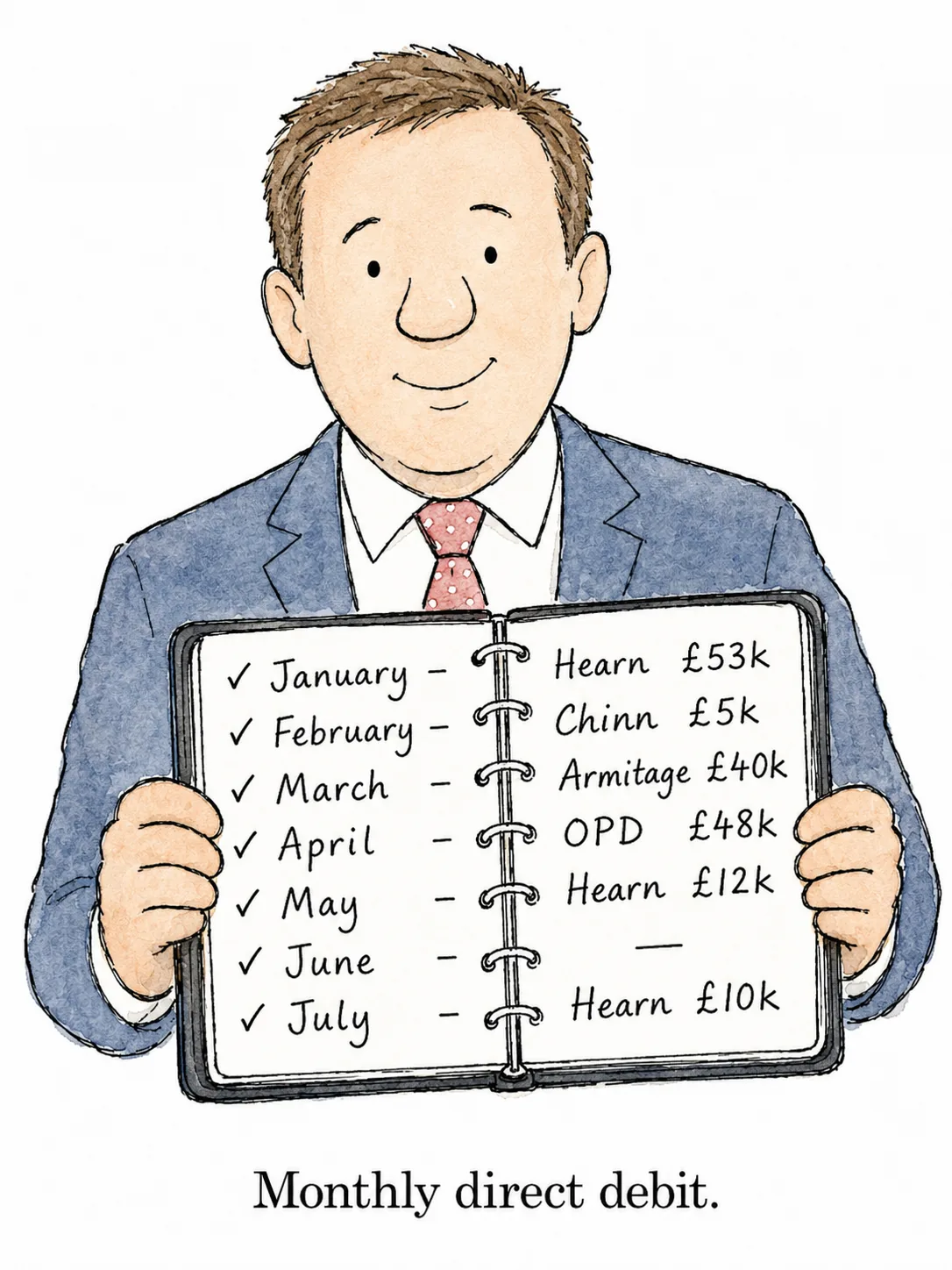
    A neutral-faced politician holds open a ring-bound diary. Each visible month has a handwritten note: January Hearn £53k, February Chinn £5k, March Armitage £40k, April OPD £48k, May Hearn £12k, June dash, July Hearn £10k.
    Monthly direct debit.

    Here’s the bit I keep going back to. On 3 February 2025, Streeting accepted £53,000 from Hearn’s OPD Group Ltd, to be paid in four installments through the year, like a phone contract.7 On 13 March 2025, five and a half weeks later, the Prime Minister stood up in Hull and announced that NHS England would be abolished, with 9,000 jobs to be cut. Streeting, as Health Secretary, is the man delivering the cuts.3 Those two things are separately on the public record. I’m not telling you they’re causally connected. I’m telling you that the executive recruitment millionaire who profits from senior NHS placements made a payment to the Health Secretary, and five and a half weeks later, the largest senior NHS recruitment movement of the decade got announced. You can decide what you want to do with that.

    Streeting’s own framing on private sector involvement in the NHS is that it is, in his words, “principled, not just pragmatic”.8 The October 2025 government press release celebrating the independent sector delivering 10% of all NHS elective activity quotes him saying “wealth shouldn’t determine health”.8 The Good Law Project’s Jo Maugham put the obvious question more bluntly: “The private healthcare market is worth about £13 billion in the UK, a fraction of 1% of GDP. Yet Wes Streeting’s financial backing comes overwhelmingly from those with interests in private healthcare. Those backers are not stupid and this is not a remarkable coincidence. What do those backers think they are getting for their money?”5

    That’s not me asking. That’s a campaigning lawyer asking on the record. I think it deserves an answer.

    The other donor pile

    Alongside the private healthcare funding, Streeting has also received, by Declassified UK’s count, around £30,000 from the pro-Israel lobby. That includes £15,000 from Sir Trevor Chinn, the former motor industry tycoon who was awarded the Israeli Presidential Medal of Honour in November 2024, and donations from Lord Mendelsohn and David Menton.9 In 2022, Labour Friends of Israel paid £4,700 to fly Streeting to Israel on what they called a “fact finding mission” focused on Israeli health tech, after which he wrote that Israel was “10 years ahead of the NHS”.9

    The European Leadership Network, a pro-Israel lobby group, also paid for one of Streeting’s parliamentary staffers to visit Israel. A parliamentary adviser who went on the delegation told openDemocracy: “There was a clear and obvious agenda to make sure people had a pro-Israel stance going into government.” After they returned, a senior figure at the Israeli embassy in London asked: “Did you enjoy the trip we sent you on?”10

    None of this is illegal. All of it is declared. The point is just that when we talk about “Streeting’s network”, this is what the network looks like on paper.

    The facts spine, part two: the Palantir decisions

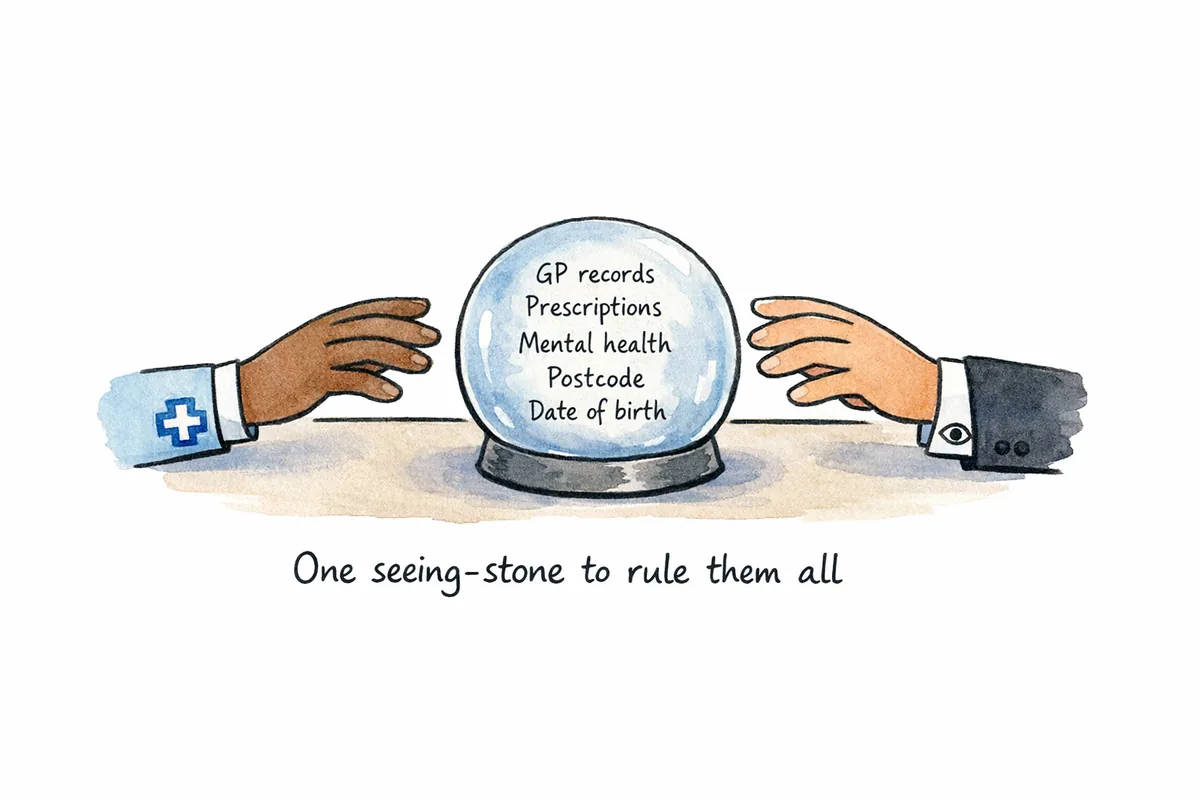
    I’ve written about Palantir in some detail already, including the Seeing Stones piece on how a CIA-funded surveillance company ended up running the NHS’s data, and the Louis Mosley piece on the man who sold it to us. I won’t repeat the whole story. The summary, for anyone joining late, is that Palantir holds a £330 million contract to run the NHS Federated Data Platform, which sits across all NHS trusts in England and joins up their data.11 The contract was signed under the Conservative government in November 2023. It has a break clause in February 2027.12

    Streeting inherited the contract. What he’s done with it since is the question.

    The unminuted Washington meeting

    On 27 February 2025, Keir Starmer and Peter Mandelson, then UK Ambassador to Washington, visited Palantir’s headquarters in DC and met Alex Karp, Palantir’s CEO. It was the Prime Minister’s first major stop after meeting Donald Trump. Byline Times reported that the visit was arranged by Mandelson, whose lobbying firm Global Counsel had Palantir as a client and from which Mandelson retained a roughly 21% shareholding while ambassador.13

    When a Conservative MP asked in Parliament whether minutes had been taken, the Cabinet Office minister Nick Thomas-Symonds answered: “This was not a formal meeting, therefore we do not hold any minutes.”14 The Ministry of Defence officials who were also present recorded it as a “meeting” in their own internal documentation. The Prime Minister’s office said it was an “informal visit”. So the same room, at the same time, with the same people in it, was a meeting, a not-meeting, and an informal visit, depending on which government department you asked. Within months of this unminuted multi-genre encounter, the Ministry of Defence awarded Palantir a £240 million contract without competitive tender.13
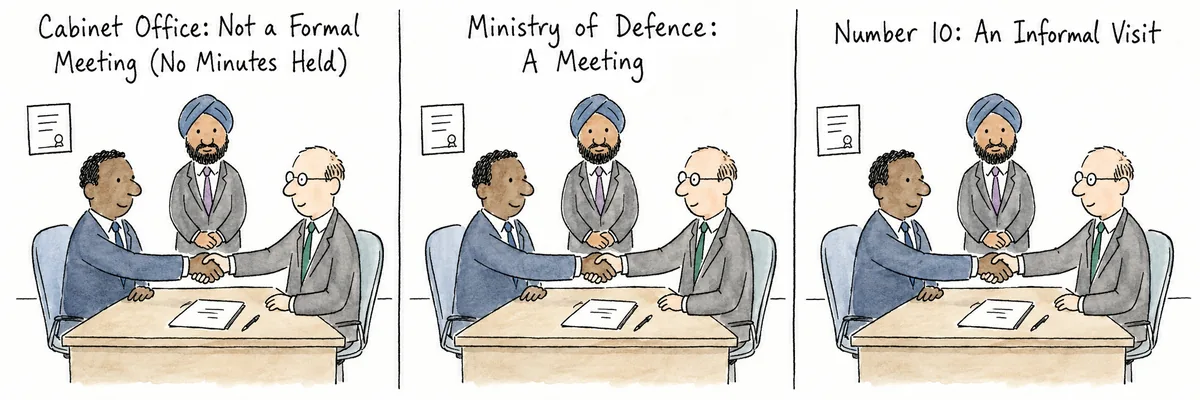
    Three identical panels showing the same scene: two men shaking hands across a desk with a third man behind them. Each panel has a different label above it: Cabinet Office: Not a Formal Meeting (No Minutes Held); Ministry of Defence: A Meeting; Number 10: An Informal Visit.

    Streeting wasn’t at the Washington visit. But he was the Health Secretary running the department that holds Palantir’s biggest UK contract. And he had his own meeting four months later.

    The June 2025 meeting his own officials warned him about

    In June 2025, Streeting met privately with Palantir. We know this because Foxglove obtained the briefing materials through a Freedom of Information request. The Department of Health and Social Care’s own briefing note for the meeting, written by his own officials, warned: “Palantir may raise issues with IG [information governance] in the NHS as presenting obstacles.” It also noted: “The public perception of the [Federated Data Platform] during the procurement, and then in delivery, has been affected by the profile of Palantir. We do not know the extent to which this is impacting on delivery. It is, however, likely to make it harder to go further with the FDP, and to encourage the inclusion of GP data locally.”15

    Read that again. His own officials, in his own briefing, told him that Palantir’s reputation was hampering delivery, and that going further with the platform was going to be harder because of it.

    He pressed on.
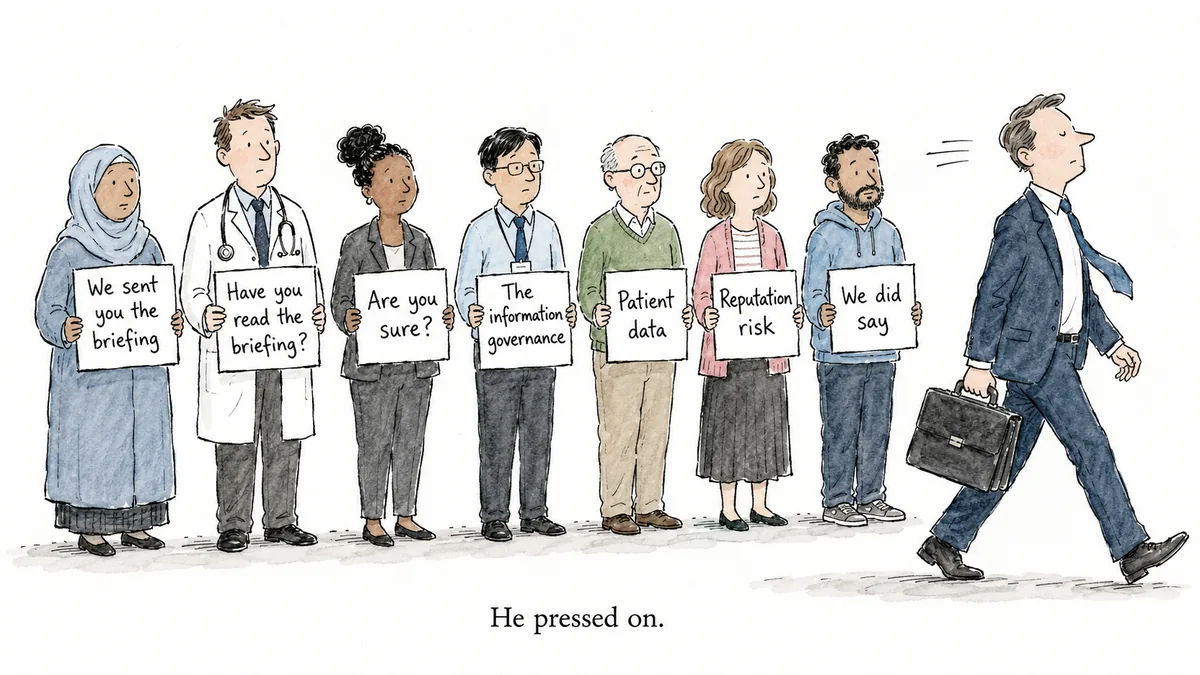
    A man in a smart suit walks confidently from left to right past a long queue of diverse people holding handwritten signs that read: We sent you the briefing; Have you read the briefing; Are you sure; The information governance; Patient data; Reputation risk; We did say. The man does not look at any of them.
    He pressed on.

    He has also refused to publish the full ministerial submissions on Palantir, on the grounds that they were used for “policy development”. The Good Law Project is supporting Democracy for Sale’s challenge to the Information Commissioner’s decision to back this refusal.16 The same Health Secretary who voluntarily released his personal WhatsApp messages with Peter Mandelson, because he had “nothing to hide”, is also fighting to keep his official Palantir briefings secret. Different kind of nothing, presumably.

    The May 2026 access expansion

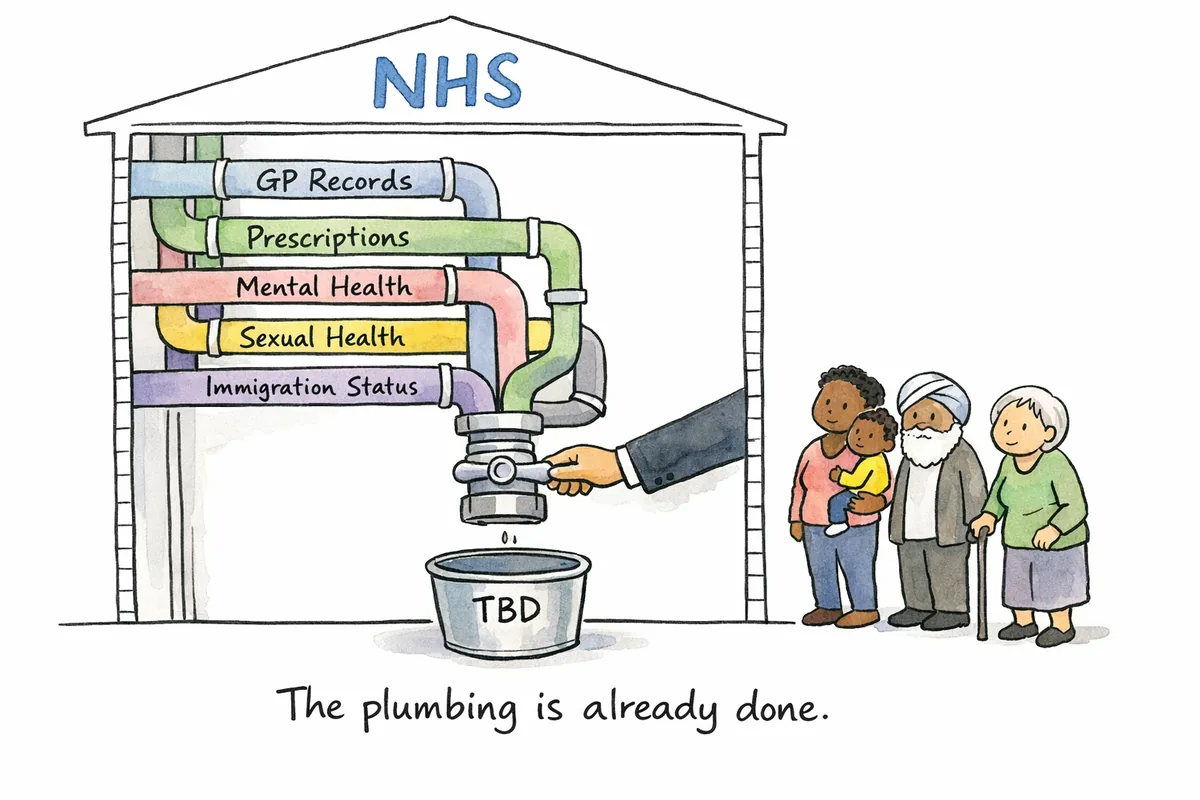
    Just last week, an internal NHS England briefing note was published by the Financial Times showing the department had created a new “admin” role that “permits unlimited access to non-NHS England staff” to the National Data Integration Tenant.17 The NDIT is the part of the system that holds identifiable patient data before it gets pseudonymised. Previously, anyone external requiring access to specific datasets had to apply for permission case by case. The new role bundles that approval. The briefing acknowledges this carries a “risk of loss of public confidence” for “safeguarding patient data”.18

    The Health Secretary has made no public statement on it. The British Medical Association formally called for the entire contract to end in February 2026. Streeting has pressed on.11

    The decision he has to make this year

    The Federated Data Platform contract has a break clause that can be triggered to end the contract in February 2027. The Financial Times has reported that “UK ministers have sought advice on triggering” it.12 Junior health minister Zubir Ahmed has said in the British Medical Journal that the government will decide “later this year” whether to do it.19

    Later this year. Which is to say, almost certainly while Wes Streeting is running for leader of the Labour Party, or has just become it.

    If you wanted to lock the contract in beyond the reach of whoever comes next, you would not need to do anything dramatic. You would just need to not trigger the break clause. Quietly. Without announcement. Citing “patient care” and “operational continuity”. The default is that the contract continues. The active decision is to end it. And the active decision is his.
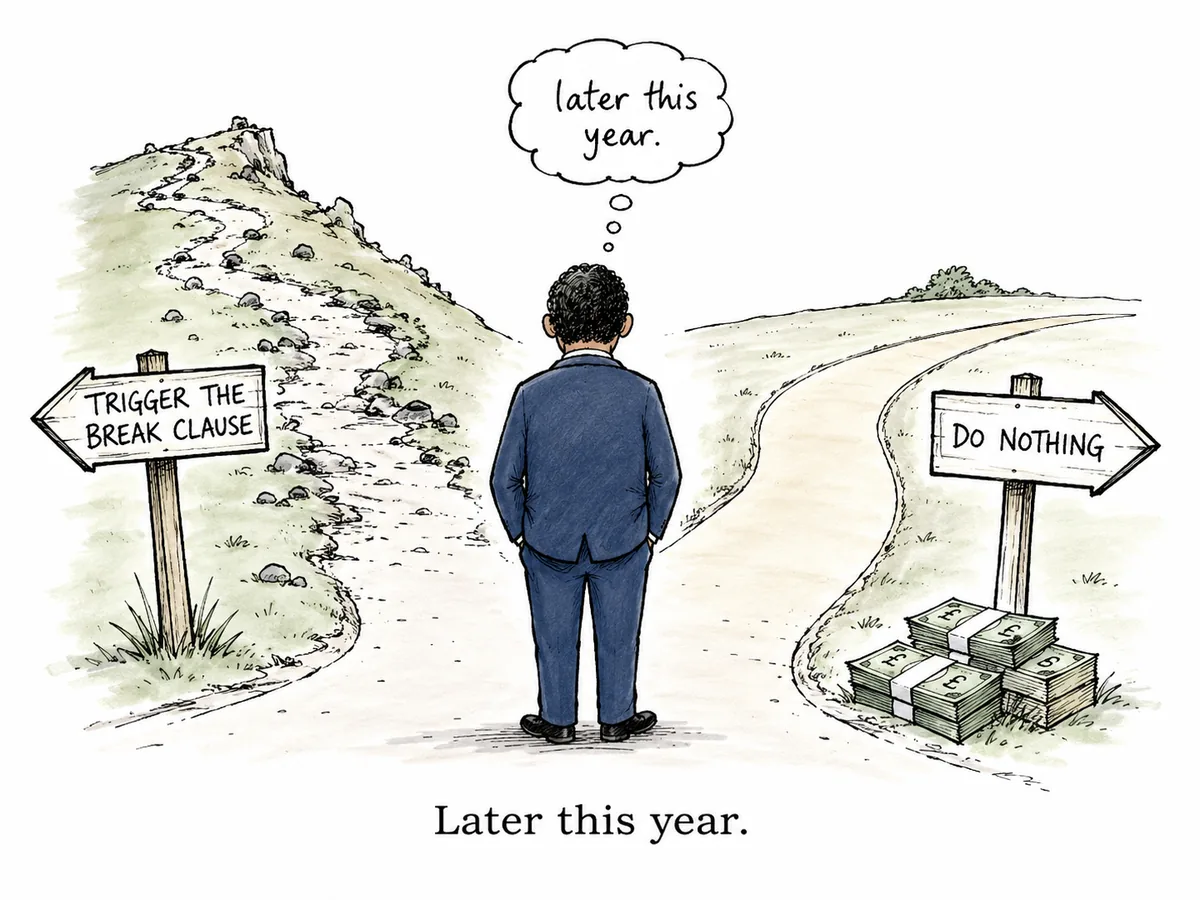
    A figure in a suit viewed from behind, hands in pockets, standing at a fork in the road. Two wooden signposts: the left reads TRIGGER THE BREAK CLAUSE and points up a rocky uphill path with nothing at its base. The right reads DO NOTHING and points down a smooth path with a small pile of banknotes at its base. A thought bubble above the figure reads 'later this year.'
    Later this year.

    The facts spine, part three: the Mandelson WhatsApps

    On 9 February 2026, Streeting voluntarily released to Sky News the text and WhatsApp messages he had exchanged with Peter Mandelson between August 2024 and October 2025. He said he had “nothing to hide” and was acting to stop “the innuendo” about their relationship. He told reporters he had had dinner with Mandelson “on average once a year”, which is technically true of a relationship that produced sixteen months of frequent late-night political WhatsApps.20

    The messages contain two things worth noting.

    The first is on Gaza. In July 2025, two months before the UK officially recognised Palestine, Streeting wrote to Mandelson: “Israel is committing war crimes before our eyes. Their government talks the language of ethnic cleansing and I have met with our own medics out there who describe the most chilling and distressing scenes of calculated brutality against women and children.” He went on: “This is rogue state behaviour. Let them pay the price as pariahs with sanctions applied to the state, not just a few ministers.”21

    There’s a question worth holding about the messages themselves before we go further. They were not leaked. They were not obtained under Freedom of Information. They were handed by Streeting to Sky News, with framing attached, at a moment when the political value of appearing to be a private dissenter on Gaza was very high. He chose the outlet. He chose the tranche. He chose the timing. His own cabinet rivals are publicly saying further disclosure would “ruin” him, which suggests the released set is the flattering subset. I am not saying the messages aren’t real. I am saying they are the curated version, presented by their author, at a moment of his choosing. What we are looking at is not a private view that was caught. It is a private view that was sent out.

    The proximate trigger was specific. Over the weekend before the release, briefings appeared suggesting Streeting was “close friends” with Mandelson and that “very embarrassing or damaging messages” might be about to come out.30 Streeting told Sky News political editor Beth Rigby he was releasing the messages in response to that “smear”, and wanted “sunlight” rather than “innuendo”. When Rigby suggested the messages showed an “intimate friendship”, he explicitly disagreed.30 But the messages he chose to release don’t refute the closeness. They confirm it. They show Mandelson and Streeting in regular correspondence over more than a year, exchanging political analysis at speed: on 28 March 2025 at 11.36am, Streeting telling Mandelson he is “toast at the next election” and that the government has “no growth strategy at all”; Mandelson replying that the government “doesn’t have an economic philosophy”; the pair debating, in a late-night exchange on 24 July 2025, the recognition of Palestine and what to do about Israel.30 If the goal had been to show distance from Mandelson, you would not release this tranche. It proves the closeness rather than refuting it. But the release does something else, something more useful. It shifts the story. The weekend before, the story was “Health Secretary too close to disgraced ambassador”. After the release, the story was “Health Secretary privately accused Israel of war crimes”. Same man, different story. The release was framed as transparency. Functionally it was a rebrand. From Mandelson’s friend to private Gaza dissenter. That isn’t sunlight. It’s news management.

    Two newspaper front pages side by side on a wooden table. Left page headline: HEALTH SECRETARY TOO CLOSE TO DISGRACED AMBASSADOR. Right page headline: HEALTH SECRETARY PRIVATELY ACCUSED ISRAEL OF WAR CRIMES. Same man's photograph in both. A hand holding a marker pen is visible at the bottom, with a small dustpan and brush nearby.
    Sunlight is the best disinfectant.

    These are extraordinary admissions from a sitting Cabinet minister, made in private. In public, while writing those private words, Streeting continued to accept donations from pro-Israel donors. Novara Media noted that the most recent of those donations was in 2024.22 He also reminded Mandelson in the same exchange: “I’ve never been a shrinking violet on Israel,” referencing his 20-year support for Labour Friends of Israel.21

    There’s a second contradiction in the published messages that I think matters more than the donor question, and that the coverage of the WhatsApps mostly missed. While Streeting was privately calling Israel’s conduct war crimes, the company whose £330 million NHS contract he was continuing to defend had, in January 2024, signed a formal “strategic partnership” with the Israeli Defence Ministry to support, in Palantir’s own Executive Vice President’s words, “war-related missions”.28 Palantir’s CEO Alex Karp has described his company as “proud to support allies in their defense operations”, and Palantir’s own products including the Gotham platform are reported to be used by the Israeli military for target management.29

    So this is the picture. Streeting writes privately, to a former Labour ambassador whose own lobbying firm had Palantir as a client, that Israel’s government is committing war crimes and talking the language of ethnic cleansing. He uses the phrase “calculated brutality against women and children”. And in the same period, in his public role as Health Secretary, he is keeping alive a £330 million contract with the American company that signed a strategic partnership to provide that same Israeli military with technology for “war-related missions”. His own department’s officials are warning him about the platform’s reputation. His own party’s medical body is calling for the contract to end. He’s pressing on.

    I don’t think it’s possible to reconcile those two positions honestly. You can hold the private view, or you can keep the public contract. Holding both at once is what the cabinet rivals appear to mean when they say there’s more in the file.

    The second thing the messages contain, more useful for understanding the lay of the land, is a picture of the political conversation between Streeting and the man whose lobbying firm had Palantir as a client. The pair discussed the government’s strategic problems, the lack of an economic philosophy, Starmer’s communication failures. Mandelson advised. Streeting agreed with the diagnosis. The Jewish Chronicle reported the headline framing: allies of Angela Rayner have briefed The Times that Streeting “would be ruined” by mass disclosure of all his communications with Mandelson in the coming months.2 That is a public, on-the-record warning from inside the cabinet that there’s more in the file than what’s already been published.

    I don’t know what’s in the rest. But I think when you have voluntarily released a curated selection of messages to demonstrate transparency, and your own cabinet rivals are publicly saying further disclosure would destroy you, that is something a leadership contest should be made aware of. Not buried.

    The facts spine, part four: the wider record

    Abolishing NHS England

    On 13 March 2025, Keir Starmer announced from Hull that NHS England would be abolished. Streeting is the implementing minister. The decision is set to result in around 9,000 redundancies.3 Streeting has since said he faced “extraordinary vested interests” from within the health sector opposing the move, which is one way to describe a 9,000-strong workforce whose jobs are being cut.23 The detail worth holding onto is the timing: the announcement came five and a half weeks after Streeting accepted £53,000 from Peter Hearn, whose business model includes placing senior executives in the NHS.7

    I am not telling you the donation caused the decision. I am telling you that the man who profits from senior NHS recruitment movement gave the Health Secretary £53,000, and then the Government announced the largest senior NHS recruitment movement of the decade. The two facts sit next to each other. If they don’t sit comfortably, that’s worth examining.

    PFI 2.0

    Streeting has signalled support for using Private Finance Initiative arrangements to build 200 neighbourhood health centres. The proposal, pitched to him by the Independent Healthcare Providers Network’s David Hare, would have private companies build the centres and rent them back to the NHS over long-term contracts.24 The economist Richard Murphy has been blunt about what this means: PFI 1.0 saddled NHS Trusts with around £80 billion in debt for around £13 billion in assets. The Conservative government banned new PFI contracts in 2018 because of how badly the model had performed. Streeting wants to revive it.25

    The Sun, the shrine, and the begging bowl

    In opposition, Streeting wrote in The Sun that the NHS was “a service, not a shrine” and refused to be put off by “middle-class lefties” who accused him of betrayal for wanting more private sector involvement.26 He has described the NHS’s relationship with funding as a “begging bowl culture” and called its workforce “obstacles” to reform.26 This is the rhetorical register the Telegraph has spent a year praising. It also matches the priorities of his donors quite closely. The senior NHS workforce are “obstacles to reform” in Streeting’s framing. They are also recruitment pipeline in Peter Hearn’s.

    Puberty blockers

    In December 2024, Streeting indefinitely extended a temporary ban on puberty blockers for under-18s, including in the private sector, citing the Cass Review. The Royal College of Paediatrics and Child Health protested that the ban disregarded “Gillick competence” and “placed young people at risk”.3 I’m including this here not to relitigate the substantive debate, which is sincere and difficult on every side, but because the pattern, deciding against the named professional medical bodies and pressing on, recurs across his record. It’s the same shape as the Palantir decision. Officials warn. Professional bodies object. He proceeds.

    Why this matters now

    This week, Streeting’s own Parliamentary Private Secretary Joe Morris resigned, calling on the Prime Minister to set a timetable for an orderly transition. Jas Athwal, Labour MP for Ilford South and a close Streeting ally whose constituency neighbours Streeting’s own, joined him in calling for Starmer to go.27 The wider collapse is happening across factions: Tom Rutland (PPS at Defra), Sally Jameson (PPS at the Home Office), and several others have also resigned, and by Tuesday afternoon close to 100 Labour MPs were publicly calling on Starmer to quit or set a date.27 Many are not Streeting allies. But the Streeting operation is the one with the readymade campaign drafted on five “pillars”. The Telegraph reports he already has the 81 MPs needed to formally trigger a contest under the 20% threshold.1

    If he becomes leader, the Palantir break clause decision is his. The wider NHS direction is his. The PFI 2.0 plan is his. The donor relationships are his. And the things in the unreleased Mandelson messages, which his own party rivals say will “ruin” him, are also his.

    This is not a hypothetical. The local elections on 7 May were a Labour bloodbath. The party lost control of 38 councils and more than a thousand councillors.32 A leadership contest is now likely within weeks. The window for the public to actually consider what the public record on the leading candidate says is right now, before the spin operation gets going.

    I think when a politician’s largest single donor profile overlaps with a sector that politician regulates, and that politician’s policy direction tracks the interests of that sector, that is not in itself proof of corruption. But it is, at minimum, a structural problem that voters are entitled to weigh. We do this with bankers who move to the Treasury. We do this with oil executives who become energy ministers. Doing it with private healthcare donors and a Health Secretary who wants to be Prime Minister isn’t unfair. It’s the job.

    What you can do

    This is the bit where I refuse to leave you feeling like the only available emotion is despair, because I genuinely don’t think it is.

    The Palantir break clause is the most concrete thing. The decision is being made later this year, by Streeting. The petition is here and takes one minute: Foxglove’s open letter to Wes Streeting.12 If you only do one thing, do that one.

    If you want to push further, write to your MP. The ask is specific: trigger the break clause in the Palantir Federated Data Platform contract, and publish the full ministerial briefings the Health Secretary is currently fighting to keep secret. Specific asks land better than general anger.

    Support the journalism that is actually doing the work: openDemocracy, Declassified UK, the Good Law Project, Foxglove, Medact, Byline Times, Democracy for Sale. Every link in this article is somebody else’s months of work. Independent investigative journalism is the only reason any of this is on the public record in the first place. If you can spare £3 a month for one of them, that’s a real act of resistance.

    And, if you live in Ilford North, you already know. Streeting’s majority is 528. That’s not a margin. That’s a rounding error.

    The bigger thing

    I keep coming back to this. Every single fact in this article comes from a publicly available source. Companies House, the Electoral Commission, Hansard, the lobbying register, FOI responses, journalism built on those records. There is nothing here that anyone with a laptop and a few weeks couldn’t piece together themselves.

    That’s the problem and the opportunity at the same time. The problem is that “a few weeks” is what stops most of us from doing it. We have jobs and kids and energy bills and ageing relatives. The investigation is theoretically open to all and practically open to almost none. So accountability ends up being a thing done by a small number of professionals, on shoestring budgets, against people with bottomless ones.

    The opportunity is that this is fixable. The records exist. They’re just scattered. A tool that connected Companies House with Contracts Finder with Hansard with the lobbying register, and let you type in a politician’s name to see who has paid them, what contracts their department has issued, and who lobbied for them, would not require new data. It would require somebody to do the connecting. That’s the Power to the Minions project I keep banging on about, and it’s why I’m building it.

    Until that exists, this article will have to do.

    I want Labour to be a serious party of government. I voted for it. I want a Health Secretary who knows what he’s doing. I want a Prime Minister who can keep Reform UK out of Downing Street. I genuinely don’t believe Wes Streeting is the worst-case version of any of those things. But I also think that what’s on the public record is the public record, and the leadership contest about to happen will not put it there for you. Somebody has to.

    If you’ve read this far, you now have it.

    You can decide what to do with it.

    References

    1. GB News: live coverage of Labour leadership pressure, Streeting “five pillars” campaign drafting (May 2026). https://www.gbnews.com/politics/politics-news-keir-starmer-labour-leadership-challenge-angela-rayner-wes-streeting-andy-burnham
    2. The Jewish Chronicle: “Wes Streeting accused Israel of ‘talking the language of ethnic cleansing’ in texts to Lord Mandelson”, February 2026 (includes Times briefing that Rayner allies expect Streeting to be “ruined” by future disclosures). https://www.thejc.com/news/politics/wes-streeting-israel-ethnic-cleansing-mandelson-texts-jshfuulx
    3. Al Jazeera: “Who could challenge Keir Starmer for the UK PM’s job? Meet the candidates”, 11 May 2026 (Streeting 20% threshold, leadership contest details, local election losses, puberty blockers). https://www.aljazeera.com/news/2026/5/11/who-could-challenge-keir-starmer-for-the-uk-pms-job-meet-the-candidates
    4. Good Law Project: “How private health has invested in Wes Streeting”, October 2024 (60% figure, John Armitage United Health interests, Hearn £144,900). https://goodlawproject.org/how-private-health-has-invested-in-wes-streeting/
    5. Good Law Project: “Health secretary keeps taking donations linked to private health”, April 2025 (£58,000 since July 2024, ~£10k/month, OPD £53k February 2025, Jo Maugham quote). https://goodlawproject.org/health-secretary-keeps-taking-donations-linked-to-private-health/
    6. EveryDoctor: MPs’ Interests Report on private healthcare donations, April 2025 (Hearn £260,304 total via two companies). https://privatisation.everydoctor.org.uk/wp-content/uploads/2025/04/MPs-Interests-Report-Formatv1.4.pdf
    7. The Canary: “Wes Streeting took £53,000 from a private healthcare recruiter and then announced 9,000 NHS redundancies”, April 2025. https://www.thecanary.co/uk/analysis/2025/04/01/wes-streeting-nhs-reform-private-donations/
    8. GOV.UK: “Faster care for thousands thanks to NHS use of independent sector”, Department of Health and Social Care, October 2025 (Streeting “principled, progressive position” quote, 10% NHS elective activity from private sector). https://www.gov.uk/government/news/faster-care-for-thousands-thanks-to-nhs-use-of-independent-sector
    9. Declassified UK: “‘Our friend’: How the Israel lobby spent £30,000 on Wes Streeting”, June 2024 (£15,000 from Trevor Chinn, £4,700 LFI trip, “10 years ahead” quote). https://www.declassifieduk.org/our-friend-how-the-israel-lobby-spent-30000-on-wes-streeting/
    10. Declassified UK: “Israel lobby funded half of Keir Starmer’s cabinet”, September 2024 (ELNET staffer trip, “clear and obvious agenda” quote, Israeli embassy question). https://www.declassifieduk.org/israel-lobby-funded-half-of-keir-starmers-cabinet/
    11. chloegeorge.co.uk: “The Seeing Stones: How a CIA-Funded Surveillance Company Ended Up Running the NHS”, March 2026 (full background on the £330m FDP contract, BMA position, KPMG adoption campaign). https://chloegeorge.co.uk/palantir-nhs-seeing-stones/
    12. Foxglove: “Wes Streeting: Trigger the break clause and get Palantir out of the NHS” (break clause 15 February 2027, FT reporting that ministers have sought advice on triggering, open letter campaign). https://www.foxglove.org.uk/campaigns/wes-streeting-trigger-the-break-clause-and-get-palantir-out-of-the-nhs/
    13. Byline Times: “Peter Mandelson’s Fixing of Keir Starmer’s Visit to Spytech Firm Palantir Raises Serious Questions”, April 2025 (Mandelson arranged visit, Global Counsel Palantir client, no minutes, subsequent MoD £240m direct award). https://bylinetimes.com/2025/04/25/peter-mandelsons-fixing-of-keir-starmers-visit-to-spytech-firm-palantir-raises-serious-questions/
    14. Parallel Parliament: Written question to Cabinet Office on Palantir visit minutes, answered by Nick Thomas-Symonds 13 October 2025. https://www.parallelparliament.co.uk/question/77563/palantir
    15. Medact: “Briefing: Concerns Regarding Palantir Technologies and NHS Data Systems”, March 2026 (direct quotes from the June 2025 DHSC briefing note obtained via FOI by Foxglove). https://www.medact.org/2026/resources/briefings/briefing-palantir-fdp/
    16. Good Law Project: “Streeting refuses to publish secret Palantir NHS briefings”, April 2026 (“policy development” defence, Democracy for Sale ICO challenge). https://goodlawproject.org/streeting-refuses-to-publish-secret-palantir-nhs-briefings/
    17. Morning Star: “Campaigners and union reps demand NHS ‘cease all contracts with Palantir’”, May 2026 (NDIT admin role, unlimited access language). https://morningstaronline.co.uk/article/campaigners-and-union-reps-demand-nhs-cease-all-contracts-palantir
    18. The Next Web: “NHS England gives Palantir contractors broader access to patient data”, May 2026 (NDIT detail, “haven” data environment, Streeting no public statement). https://thenextweb.com/news/palantir-nhs-england-patient-data-access
    19. TechRadar: “Palantir could be forced to exit NHS after pushback from staff, MPs, unions, and pressure groups over Federated Data Platform” (Zubir Ahmed MP quote on break clause “being weighed up” later this year). https://www.techradar.com/pro/security/nhs-users-report-that-it-is-awful-to-use-palantir-could-be-forced-to-exit-nhs-after-pushback-from-staff-mps-unions-and-pressure-groups-over-federated-data-platform
    20. The Jewish Chronicle: Streeting voluntarily released WhatsApp and text messages with Mandelson to Sky News, 9 February 2026 (covered in same article as Israel “ethnic cleansing” texts). https://www.thejc.com/news/politics/wes-streeting-israel-ethnic-cleansing-mandelson-texts-jshfuulx
    21. Middle East Eye: “Wes Streeting has utterly exposed the UK’s complicity in Israel’s crimes”, February 2026 (full text of Streeting “rogue state” and “war crimes” quotes, “shrinking violet” reference). https://www.middleeasteye.net/opinion/wes-streeting-has-utterly-exposed-uks-complicity-israels-crimes
    22. Novara Media: “Streeting Admitted ‘Israel Is Committing War Crimes Before Our Eyes’”, February 2026 (continued pro-Israel donations as recently as 2024, £30k total). https://novaramedia.com/2026/02/10/streeting-admitted-israel-is-committing-war-crimes-before-our-eyes/
    23. Health Service Journal: “Streeting: ‘Extraordinary vested interests’ resisted NHSE abolition”, April 2026. https://www.hsj.co.uk/integrated-care/streeting-extraordinary-vested-interests-resisted-nhse-abolition/7041484.article
    24. We Own It: “Wes Streeting is considering PFI 2.0: here’s why it could end the NHS as you know it”, October 2024 (David Hare/IHPN proposal, £1bn private investment for guaranteed contracts). https://weownit.org.uk/blog/wes-streeting-considering-pfi-heres-why-it-could-end-nhs-you-know-it
    25. Tax Research UK: “The curse of PFI”, Richard Murphy, September 2025 (200 health centres via PFI, £80bn debt for £13bn assets under PFI 1.0). https://www.taxresearch.org.uk/Blog/2025/09/11/the-curse-of-pfi/
    26. The Big Issue: “‘Fund the NHS properly’: Private sector is not the answer, Wes Streeting told, amid funding row”, April 2024 (“service not a shrine”, “middle-class lefties”, “begging bowl culture”). https://www.bigissue.com/life/health/wes-streeting-nhs-funding-private-sector-backlash/
    27. AOL/PA Media: “Joe Morris statement in full after resigning as Wes Streeting ministerial aide”, May 2026 (verbatim resignation statement, Tom Rutland and Sally Jameson resignations). https://www.aol.com/articles/joe-morris-statement-full-resigning-180148221.html
    28. Bloomberg: “Peter Thiel: Palantir, Israel Agree Strategic Partnership for Battle Tech”, 12 January 2024 (formal strategic partnership with Israeli Defense Ministry, Josh Harris “war-related missions” quote, signed at Tel Aviv meeting). https://www.bloomberg.com/news/articles/2024-01-12/palantir-israel-agree-to-strategic-partnership-for-battle-tech
    29. Liberation News: “Mass surveillance under Palantir: The tech company’s ties to US military, ICE, and the IDF”, June 2025 (Karp “proud to support allies” quote, Gotham platform use for “target management” by militaries). https://liberationnews.org/mass-surveillance-palantir-ice-law-enforcement-idf/
    30. Sky News (via Coast FM): “Streeting shares his Mandelson texts with Sky News”, 9 February 2026 (Beth Rigby “intimate friendship” framing, “close friends” weekend smear, “sunlight is the best disinfectant”, verbatim 28 March 2025 exchange between Streeting and Mandelson on Ilford North electoral fears and economic philosophy). https://www.coastfm.co.uk/news/uk/streeting-shares-his-mandelson-texts-with-sky
    31. GB News (citing The Telegraph): “Wes Streeting has backing of enough MPs to launch leadership challenge against Keir Starmer in just days” (Downing Street staff member accidentally sent details of Streeting’s campaign strategy including “five pillars” and “PFG” plan for government). https://www.gbnews.com/politics/wes-streeting-backing-mps-leadership-challenge-against-keir-starmer
    32. Wikipedia: 2026 United Kingdom local elections (Labour lost control of 38 councils; Reform UK gained 1,451 seats and 14 councils; complete results across 136 English local authorities). https://en.wikipedia.org/wiki/2026_United_Kingdom_local_elections
  • Nothing to See Here: The NHS, Mythos, and the Closing of the Code

    Nothing to See Here: The NHS, Mythos, and the Closing of the Code

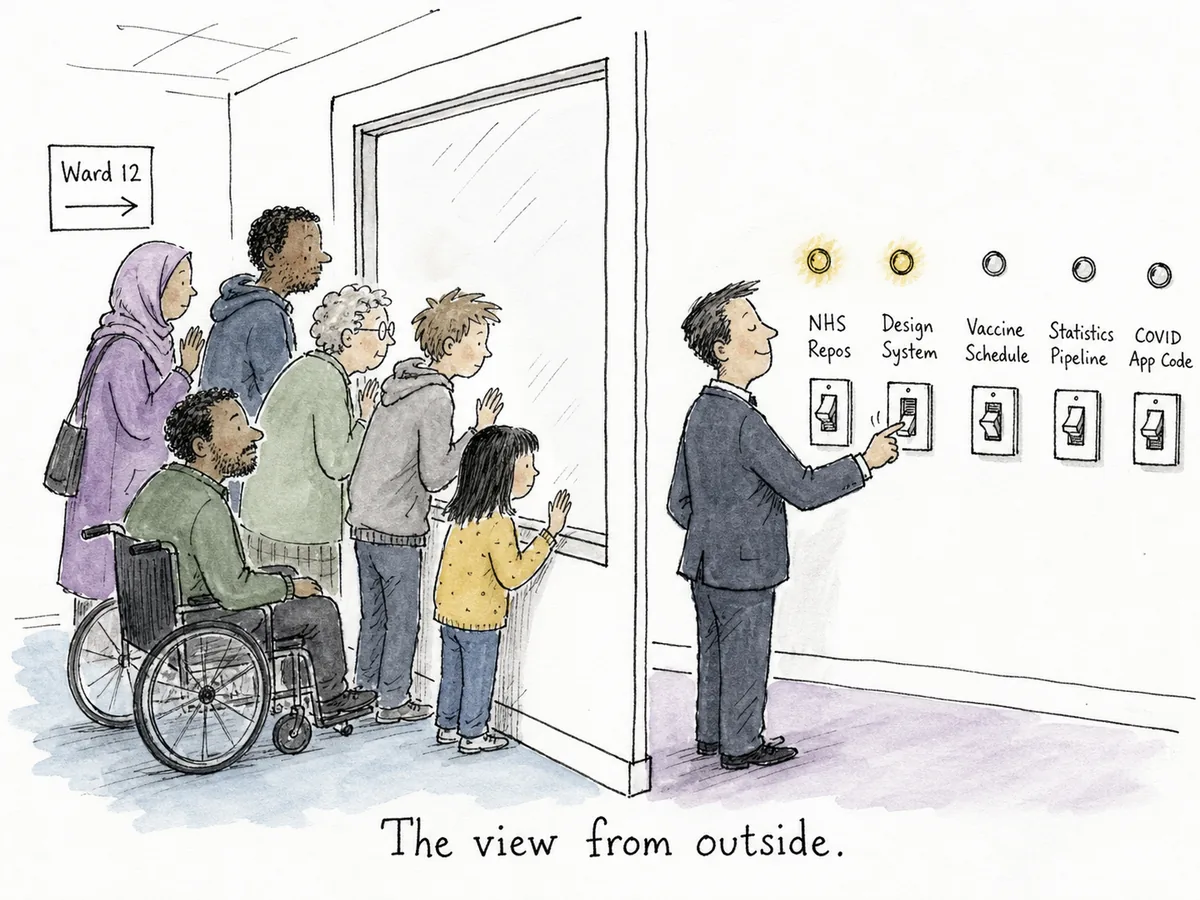
    On Monday 11 May 2026, hundreds of NHS computer code projects will go dark. Not deleted. Just hidden. The repositories will still exist, the same engineers will still maintain them, but the public will no longer be able to see them.

    The deadline is in seven days. Teams that want to apply for an exemption have until close of play tomorrow to make their case to the Engineering Board. Most won’t make it.

    The reason given, in an internal memo dated 29 April 2026 and leaked to the former head of open technology at NHSX, is that an artificial intelligence model called Mythos can read code very fast.1 Mythos was announced by an American AI company called Anthropic about a week before the memo was issued.2

    I want to talk about this. Not because I expect you to care about NHS code repositories specifically, but because what this story is actually about is much bigger than that. It’s about whether the public is allowed to see what’s being built with public money. And the timing, which I’ll get to, is suspicious enough that I think it’s worth a few minutes of your day.

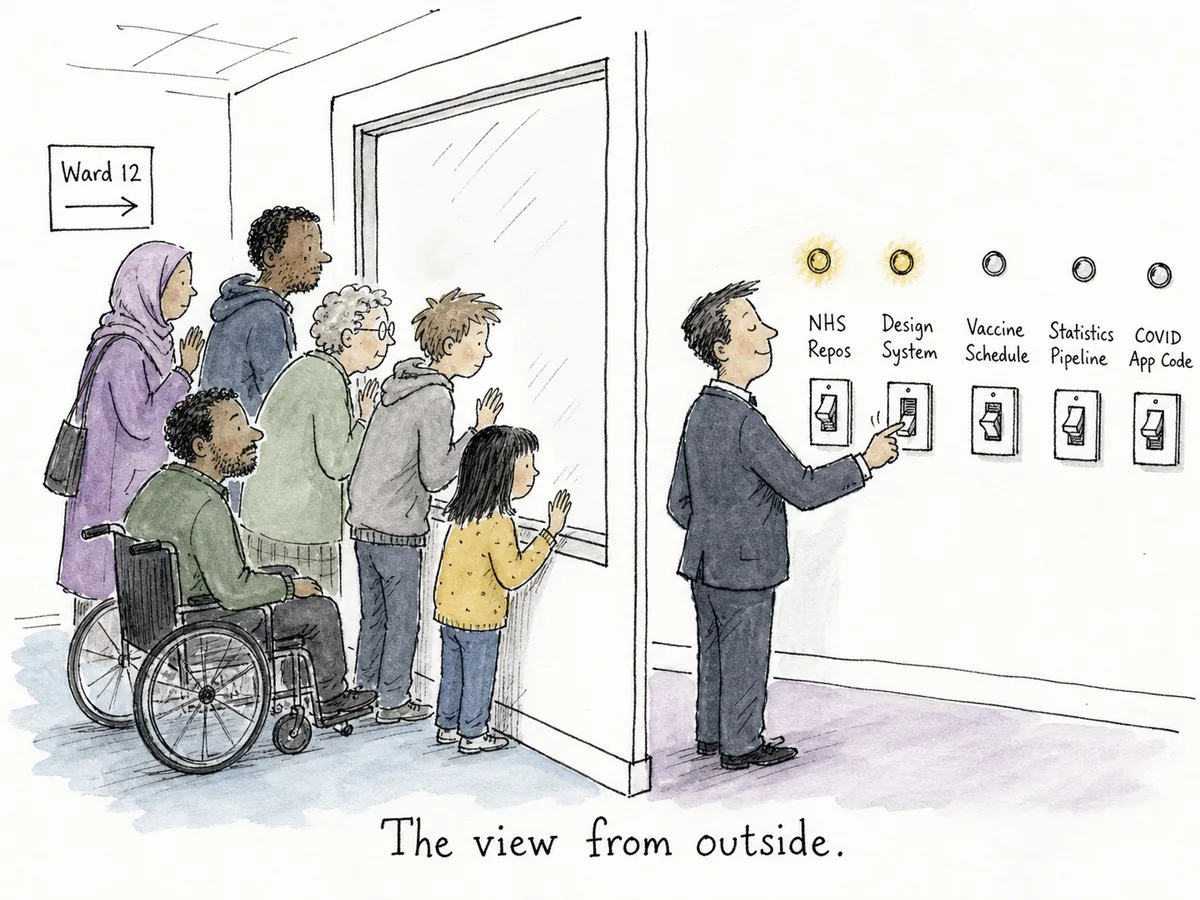
    Editorial cartoon of a hospital corridor with a large bank of light switches on the wall labelled NHS REPOS. A figure in a suit is flipping the switches off one by one. Behind them, smaller figures are crowding in to watch through a small window before each light goes out.
    The view from outside.

    What’s actually happening, in plain English

    Open source code is code that anyone can read. The author publishes it on a website like GitHub, and anyone in the world can look at it, copy it, learn from it, or check whether it does what its authors say it does.

    The NHS publishes hundreds of code projects this way. Most of it is genuinely boring: design templates for NHS websites, code that publishes statistics, tools that help with vaccination schedules, the standard way the NHS labels and structures its own data. Some of it is more interesting: research code, tools developed during the pandemic, frontends for patient services. None of it, on the public’s view, is the kind of secret that would let a hacker bring down a hospital.

    For more than a decade, UK government policy has been that code paid for with public money should be available for the public to see. This isn’t an opinion that a couple of tech enthusiasts hold. It’s written into the Technology Code of Practice3, the government Service Manual4, the NHS Service Standard5, and the Department of Health’s Data Saves Lives6 strategy.

    The reasons for this policy are simple. Public money funded the work, so the public has a right to see it. Other NHS teams, other government departments, other countries can reuse the code, which saves money. And, crucially, the code being public is one of the few ways that ordinary people, journalists, and MPs can actually check what the NHS has built and how. Without it, everything is “trust us, it works.”

    Editorial cartoon of a large featureless black box sitting on a desk. There are no buttons, no screen, no labels. A small brass plaque on the front simply reads TRUST US, IT WORKS. Three people stand around the box looking at it: an NHS nurse, a journalist holding a notebook, and a member of the public holding a tax return. They all have identical baffled expressions. Behind the box, partly visible through a small gap, a tangle of colourful wires snakes out of the back of the box and disappears off the edge of the desk.
    The new transparency.

    What was issued on 29 April was an internal memo, formally numbered SDLC-8, telling every NHS England engineering team that all public code repositories must go private by Monday 11 May 2026. Teams must declare any need for an exemption to the Engineering mailbox by close of play 6 May. The memo overrides every one of the policies I just mentioned by internal decree.

    The story they’re telling

    The reason given in the memo is rapid advancements in AI models capable of large-scale code ingestion, inference, and reasoning. The memo specifically names Mythos, an AI model from Anthropic that the company announced in April 2026 with much fanfare and a partner programme called Project Glasswing2.

    Anthropic’s own framing is that Mythos is so good at finding software vulnerabilities that the company isn’t releasing it to the general public. They’re partnering with major tech firms (Amazon, Google, Microsoft, Apple, JPMorgan, the Linux Foundation, and around 40 others) to use it defensively, and they’re giving away $100 million in usage credits and $4 million in cash to open source security organisations.

    The press coverage was breathless. The cybersecurity industry obsessed. The American security writer Bruce Schneier, who is generally considered one of the most measured voices in the field, said in his initial commentary7: “This is very much a PR play by Anthropic, and it worked. Lots of reporters are breathlessly repeating Anthropic’s talking points, without engaging with them critically.”

    Whether or not Mythos is genuinely as scary as Anthropic says, this is what NHS England has cited as the reason for closing its repositories.

    Why the Mythos story doesn’t hold up

    I am not a cybersecurity expert. I am, however, capable of reading. So is Terence Eden, the former head of open technology at NHSX, who wrote about this in late April. His first post8 on the Mythos question, written before the SDLC-8 memo dropped, made the points that any honest analysis would make.

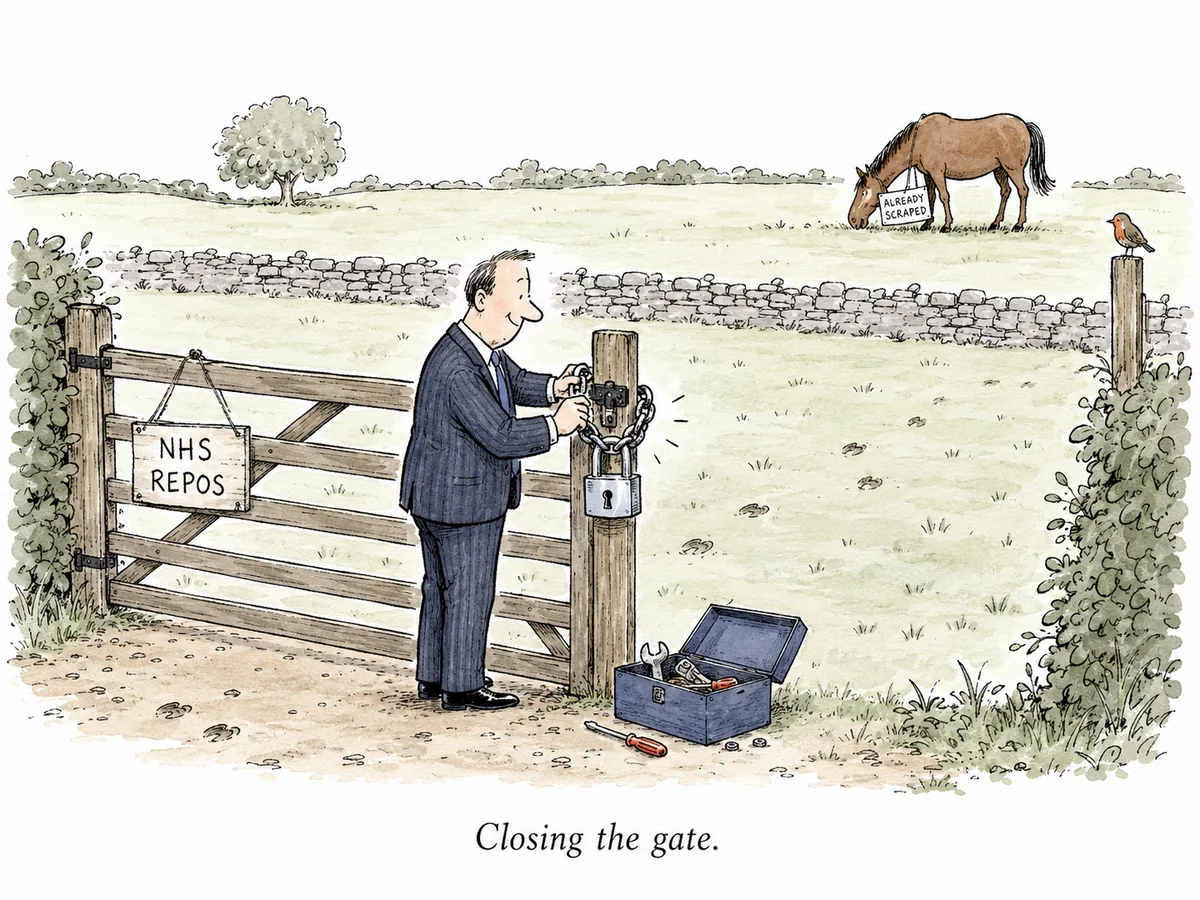
    The code has already been read. Anthropic, which trained Mythos, has been hoovering up open source code for years. So has every other AI company. So have hundreds of digital archives and individual hoarders. If Mythos can find vulnerabilities in the NHS code by reading it, Mythos has already read it. Closing the door now does nothing about a horse that left the field years ago.

    Editorial cartoon of a wide open farm gate with a small wooden sign hanging on it that reads NHS REPOS. The field beyond the gate is completely empty. A figure in a smart suit is carefully attaching a brand new heavy-duty padlock to the gate with a slightly proud expression. In the far distance, a horse is grazing happily in someone else's field, wearing a small label that reads ALREADY SCRAPED.
    Closing the gate.

    The code being closed source is not actually safer. The same AI tools work just as well on closed source software. They can analyse the binaries that run on a server. They can probe a live website. The premise that “if our code is private, AI can’t find bugs in it” is, on its face, not how any of this works.

    Neither the UK’s AI Safety Institute9 nor the NCSC10 has recommended that organisations close their open source code in response to Mythos. NHS England has done it on its own initiative, citing a threat that the country’s actual security experts have not endorsed.

    The biggest piece of evidence sits in living memory. The NHS COVID Contact Tracing app, the most scrutinised piece of NHS software in living memory, used by tens of millions of people, the target of every hostile cyber actor on the planet, was open sourced the day it launched. It produced exactly zero security incidents from the code being public. NHS England’s own engineers know this because they made that decision deliberately at the time.

    Eden has filed a Freedom of Information request11 asking NHSE for the technical reasoning behind SDLC-8. We will see what comes back.

    In the meantime, the simplest version of where we are: the official reason makes no technical sense, contradicts the country’s actual security expertise, and overrides at least five existing pieces of UK government policy on the open web. So the question isn’t “is Mythos really that scary?” The question is what story actually fits the facts.

    The story that actually fits

    On 22 December 2025, Digital Health News reported that NHS England had quietly deleted its open source policy pages12 from its website. No announcement. No consultation. The pages just disappeared. The clinician Marcus Baw, who has been writing about NHS digital policy for years, raised the alarm.

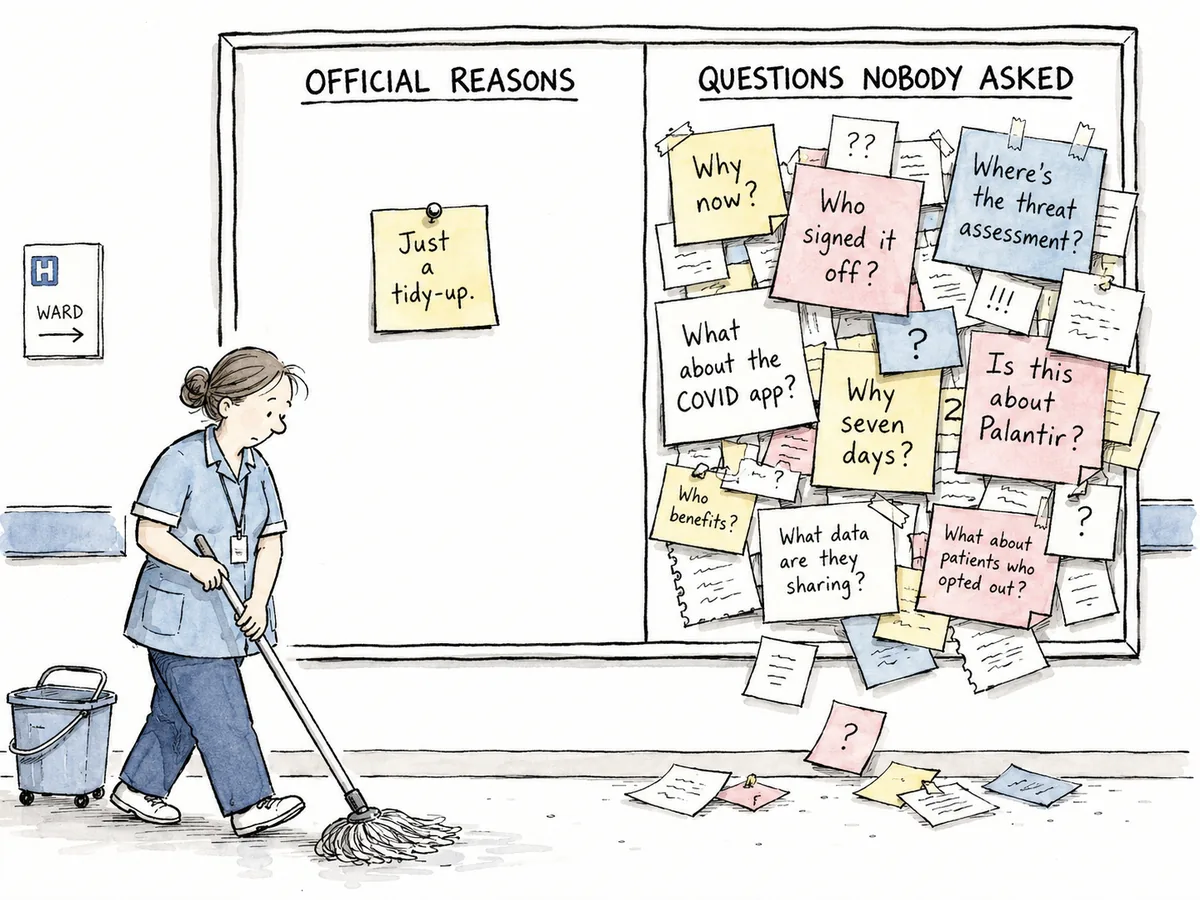
    NHS England’s official line was that the deletion was a routine clean-up exercise from the 2021 reorganisation when NHSX was folded into NHSE. A different NHSE source told the same journalist the real reasons were “security concerns and because NHSE does not believe it has the capacity to maintain” open source software. Note the date: 22 December 2025. Mythos didn’t exist yet. It would be announced four months later.

    Editorial cartoon of a hospital noticeboard. One side is labelled OFFICIAL REASONS and pinned with a small note saying Just a tidy-up. The other side is labelled QUESTIONS NOBODY ASKED and is overflowing with notes pointing in every direction. A cleaner walks past pretending not to notice.
    Just a tidy-up.

    The same week the policy pages came down, three other things happened. The Guardian published an investigation into UK Palantir contracts after MPs raised security concerns. Health Service Journal reported that Palantir’s £330 million NHS Federated Data Platform was reaching only a handful of trusts. And Health Service Journal reported that an AI tool inside that same platform was at the centre of a regulatory row.

    I want to be careful here. I cannot prove these are connected. I have no document showing “we are removing the open source policy because the Palantir contract is in trouble.” That kind of paper trail rarely exists, and when it does, it doesn’t survive long.

    What I can say is that the December 2025 retreat from open source policy preceded Mythos by four months. Mythos is the public justification for what NHS England is doing in May 2026. It is not the reason the direction of travel changed. The direction had already changed, in the same week as a Palantir story.

    And Mythos arrived just in time to provide an excuse that sounded better than “we don’t think we can keep up the policy.”

    Why this connects to Palantir

    I have written a few times about Palantir. The first time was the Seeing Stones piece13, on how a CIA-funded surveillance company ended up running the NHS’s data. The second was Land and Expand14, on how the same company moved from the NHS into the Financial Conduct Authority. The third was The Man Who Sold England’s Data15, on the man doing all the dinners and handshakes that made it happen. If any of this is new to you, those pieces are the background.

    The Federated Data Platform is the thing in the NHS that Palantir runs. It is a £330 million contract, signed in November 2023, designed to pull NHS data from across hospitals and other services into one system that helps with things like waiting lists, theatre scheduling, and discharge planning. The contract is controversial for many reasons: the company’s other clients (US Immigration and Customs Enforcement, the Pentagon, the Israeli Defence Forces, various intelligence agencies), the contract structure (which Liberal Democrat MP Martin Wrigley described in Parliament as “a permanent lock-in” with “no software, not one line”16 remaining with the NHS at the end), and the question of whether NHS data opt-outs even apply to it.

    Palantir’s own code was never on NHS GitHub. It was never going to be. Palantir is a private US company and its software is proprietary. You can’t see it.

    What was on NHS GitHub was the surrounding infrastructure: the data pipelines feeding the FDP, the integration code, the ways the NHS has had to bend its own systems to plug into Palantir’s. That code is what tells you, if you read it carefully, what’s actually being shared, with whom, and how. It’s the wiring diagram.

    Closing the repos doesn’t change the data Palantir gets. It changes what the public can see about how the wiring works.

    The Palantir contract is at its weakest point right now

    This bit matters because it explains why the timing isn’t just suspicious in the abstract. It’s suspicious in a very specific way.

    The Federated Data Platform is in trouble. By February 2025, NHS England was claiming 96 trusts (about 40%) had “signed up” to the platform. When Corporate Watch FOI’d them17, it turned out that only 34 trusts (about 15%) were actually using it. The other 62 had just “signalled their intent.”

    The reason most trusts haven’t adopted it is not technical mystery. The trusts have explained, repeatedly and on the record. Leeds Teaching Hospitals wrote to NHS England saying: “From the descriptions we have of these FDP products we believe we would lose functionality rather than gain it by adopting them.” Greater Manchester’s health authority wrote that there was nothing in the FDP that “exceeds the NHS Greater Manchester local capability.” NHS staff at multiple trusts have refused to use the system on ethical grounds, given Palantir’s other clients.

    The British Medical Association passed a motion against the FDP at its 2025 AGM. In February 202618 it went further and told doctors to limit their engagement with the platform, citing concerns about Palantir’s role in providing software to ICE.

    The Good Law Project’s “Say No to Palantir” campaign has had around 50,000 patients19 write to their local trust boards opposing the platform. A coalition of public interest groups, including the Good Law Project, Privacy International, Just Treatment, Corporate Watch, and Amnesty International, published a briefing through Medact20 in March 2026 urging trust boards not to adopt.

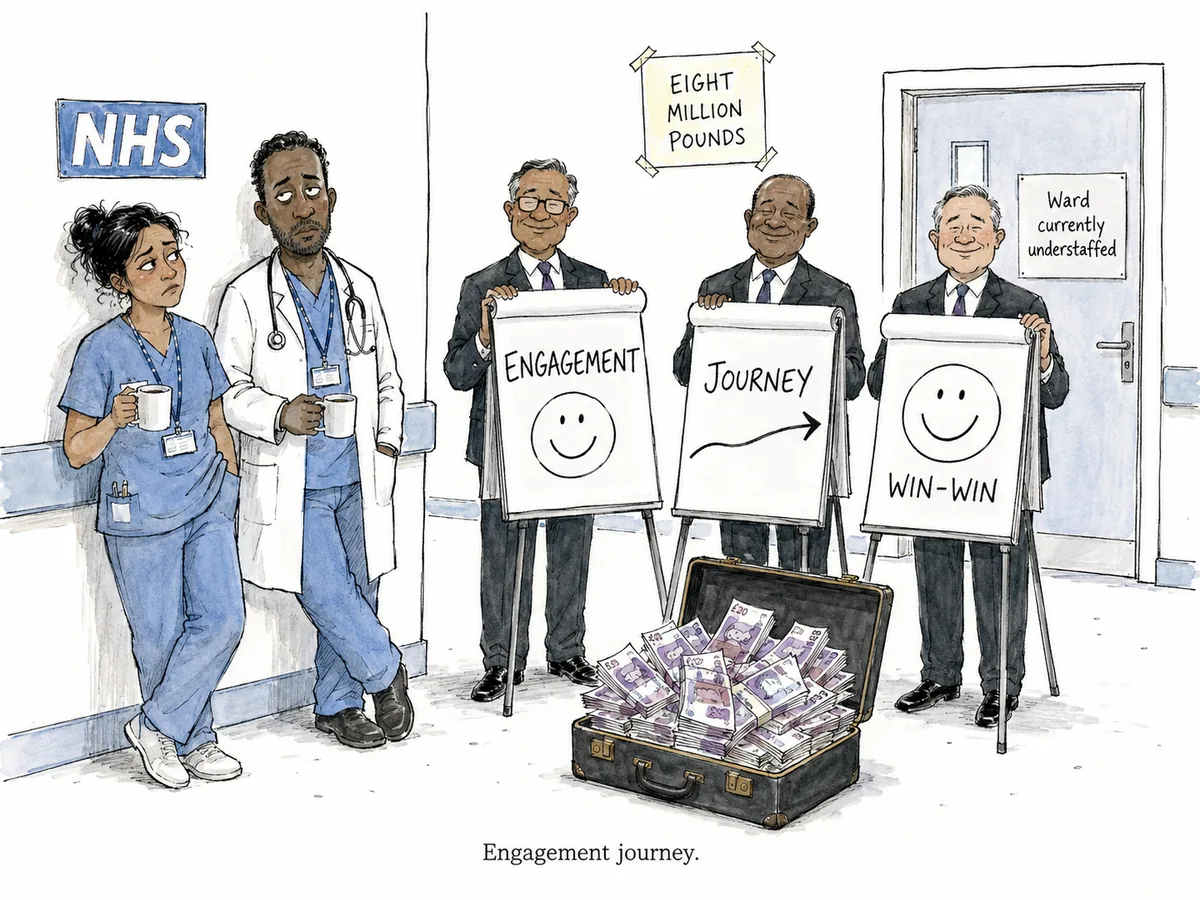
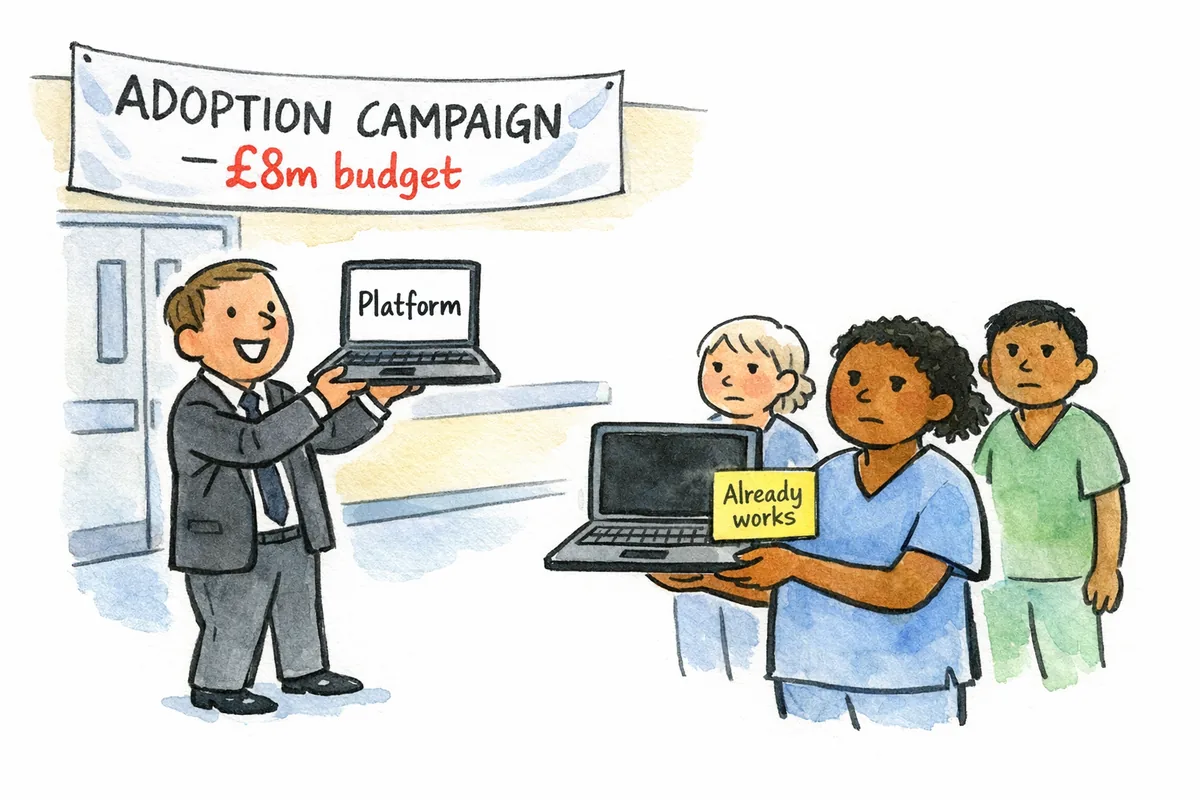
    The Department of Health quietly gave KPMG an £8 million contract to “promote adoption” of the platform. Take a moment with that. Eight million pounds of consultancy money to convince frontline NHS staff to use software the NHS has already paid £330 million for.

    Editorial cartoon of an NHS hospital corridor. On the left, a tired-looking nurse and doctor are leaning against a wall holding cups of tea. In front of them, three smartly dressed consultants in identical suits are standing in a row, holding flipchart easels. Each easel has a different bright marker drawing on it. The first reads ENGAGEMENT, the second reads JOURNEY, and the third just has a smiley face. A briefcase open on the floor between the consultants is overflowing with banknotes. Above the consultants is a small handwritten note pinned to the wall reading EIGHT MILLION POUNDS. The nurse is looking at the doctor with one raised eyebrow. The doctor is staring directly at the viewer.
    Engagement journey.

    And the break clause in the Palantir contract is live. Health Minister Zubir Ahmed has confirmed that the option to terminate the seven-year contract in early 2027 is, as he put it, “being weighed up as a possible option.”21

    So a contract that was sold to the public as transformative is, in fact, being rejected by the people who use it, the people whose data goes into it, and the trusts being told to adopt it. The political pressure is at its highest point ever. The break clause is being seriously considered. And right at this moment, the public’s main tool for scrutinising the NHS data architecture, the open source repositories, is being switched off.

    I am not going to sit here and tell you that’s definitely the reason. I genuinely don’t know what the reason is. What I’d say is: if you wanted to reduce public scrutiny of a specific contract at a specific moment, this is what doing that would look like.

    And there’s the small matter of NHS England being abolished

    Speaking of timing. On 13 March 2025, in a speech in the House of Commons22, the Health Secretary Wes Streeting announced that NHS England, the arms-length body that has run the NHS in England since 2013, would be abolished. The workforce is being halved from around 13,000 to 6,500. Functions are being absorbed back into the Department of Health and Social Care, which Streeting runs directly. The Institute for Government23 has been tracking the chaos of the transition for over a year.

    What this means in practice is that political accountability for NHS data decisions, including everything Palantir does, is shifting from an arms-length body to a politician. Wes Streeting personally, in due course, becomes the joint data controller for everything in the FDP. Decisions that used to sit with NHS England’s board now sit with the Secretary of State.

    This is the institutional context in which a memo overriding fifteen years of open source policy gets issued with seven days’ notice. NHS England is half-shut. Its leadership has been replaced. Its workforce is being cut. The Engineering Board issuing SDLC-8 is doing so during the most disorganised period in NHS England’s existence.

    If you wanted to make a major policy change with as little scrutiny as possible, this is when you’d do it.

    Why this matters even if you don’t care about code

    Most people don’t care about code. Most people shouldn’t have to. The reason this matters to people who don’t write software for a living is that open source is one of the few mechanisms that lets ordinary people see what’s been built with their money.

    If a small charity wants to know how the NHS records something. If a journalist wants to check whether a contract is actually doing what was promised. If an MP’s office wants to understand whether a system exists at all. If a researcher wants to study the digital infrastructure of British healthcare. If another country wants to learn from what works. All of that has, until now, been possible because the code was visible.

    When you turn it off, you don’t just affect developers. You blind everyone who funds the NHS. You also break the mechanism that prevents lock-in to a single supplier, because once nobody outside the NHS knows how the integration works, replacing the supplier becomes an act of archaeology rather than engineering.

    The Palantir contract is the textbook case for why open source matters in public infrastructure. Martin Wrigley made the point in Parliament in April: “All the specially written software and intellectual property rights belong to the supplier. The contract delivers no software, not one line, just a subscribed service; a permanent lock-in; a single point of failure.” The opposite of that, structurally, is open source. NHS open source has been one of the few practical bulwarks against the kind of contract that leaves the NHS owning nothing at the end. That bulwark is what’s being switched off on Monday.

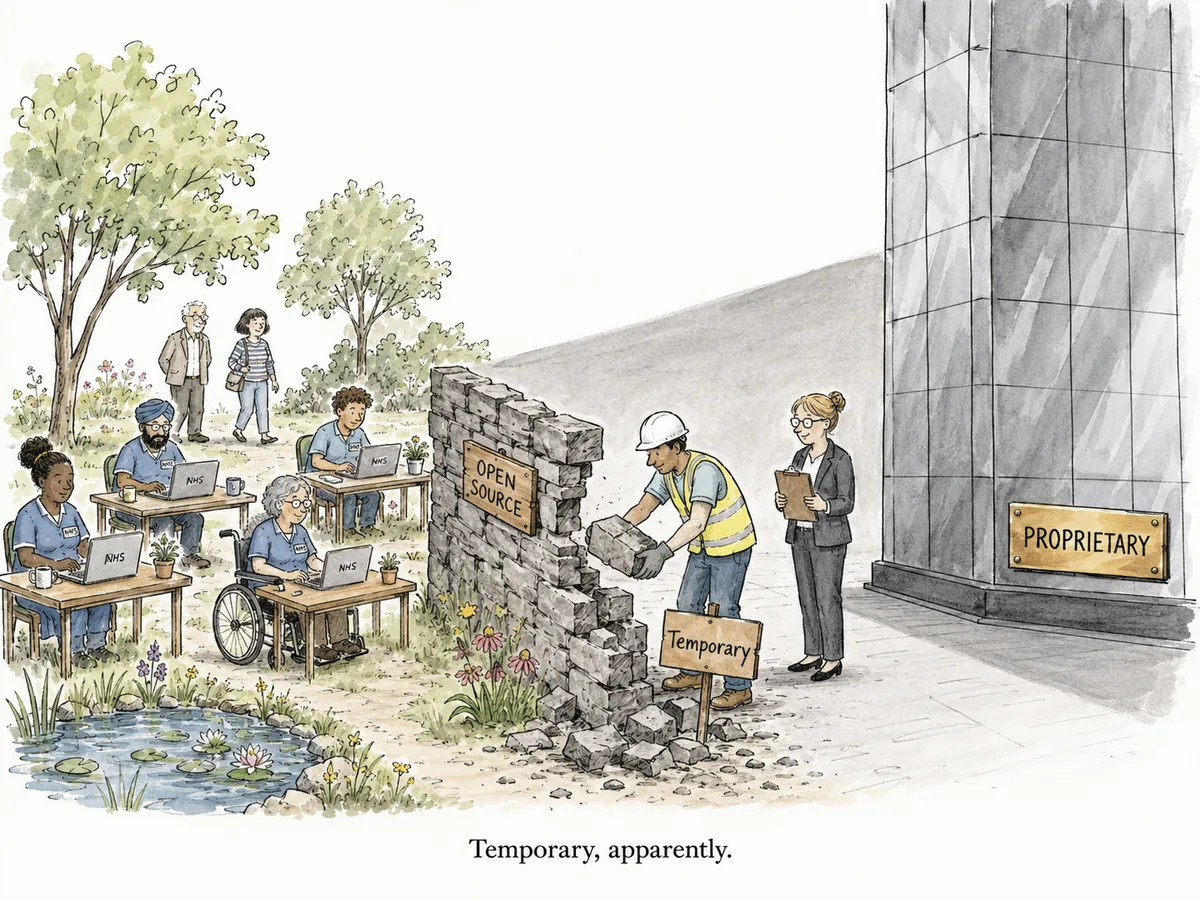
    Editorial cartoon of a low stone wall labelled OPEN SOURCE separating two areas. On one side is a tidy garden with NHS staff working at desks, public visitors strolling around. On the other side is a polished glass tower marked PROPRIETARY with no windows. A figure in a hard hat is removing the wall stone by stone. A small sign next to them reads Temporary.
    Temporary, apparently.

    What’s going right (because there’s quite a lot)

    I always promise to leave readers with something to be hopeful about, and on this one there’s a lot to be hopeful about.

    The trusts have already been refusing the FDP. This is the most important thing in the story and it should be celebrated. Greater Manchester. Leeds. Guy’s and St Thomas’. UCLH. Royal Free. Sheffield Teaching Hospitals. Nottingham. Birmingham. Frimley. The biggest and best-resourced digital teams in the NHS have looked at the platform, looked at the company, looked at the contract, and said no. They are why the contract is in trouble. Their refusal has done more to protect the NHS data architecture than any minister.

    NHS staff are leaking. The SDLC-8 memo got to Eden because multiple people inside NHS England independently sent it to him. That’s not one disgruntled engineer. That’s a workforce. The institution is half-shut down, but the conscience of the people inside it is wide awake.

    The doctors are organising. The BMA’s February 2026 motion telling doctors to limit FDP engagement is a serious institutional act. So is the Medact briefing. So is the open letter. So is the Hansard debate.

    The patients are organising. Fifty thousand letters to trust boards is a real number. The Good Law Project’s “Say No to Palantir” campaign has built a coalition with Foxglove, Privacy International, Just Treatment, Corporate Watch, the United Tech and Allied Workers Union, Amnesty International and Keep Our NHS Public.

    The break clause is live. The Health Minister has confirmed it. Whether the government activates it is up to the political pressure between now and early 2027, and the political pressure is what gets generated by exactly this sort of public attention.

    The code is backed up. Eden and a network of volunteers have already mirrored every NHS open source repository. The licences allow it. If the originals go private on Monday, the public version persists somewhere on the open internet.

    And the petition exists. keepthingsopen.com is the campaign asking NHS England to reverse SDLC-8.

    Useful resources

    What you can do today

    If you have ten minutes:

    Sign the keepthingsopen.com petition. Email your MP through writetothem.com and tell them that you don’t want your NHS code closed off, especially given who’s now sitting inside it. Forward this article, or one of Eden’s two24 on the same subject, to anyone you know who works in tech, government, or healthcare. They will recognise what’s happening.

    If you have an hour, read the Palantir series on this site, beginning with The Seeing Stones13. The pieces about the FCA and Louis Mosley sit alongside it. None of this story is in isolation. It is a piece of a much bigger picture about what’s happened to British public infrastructure in the last few years.

    If you have actual power inside the NHS or DHSC and you’re reading this: you can refuse. The trusts already are. The doctors already are. The data analysts already are. You’re allowed to be one of them.

    Closing

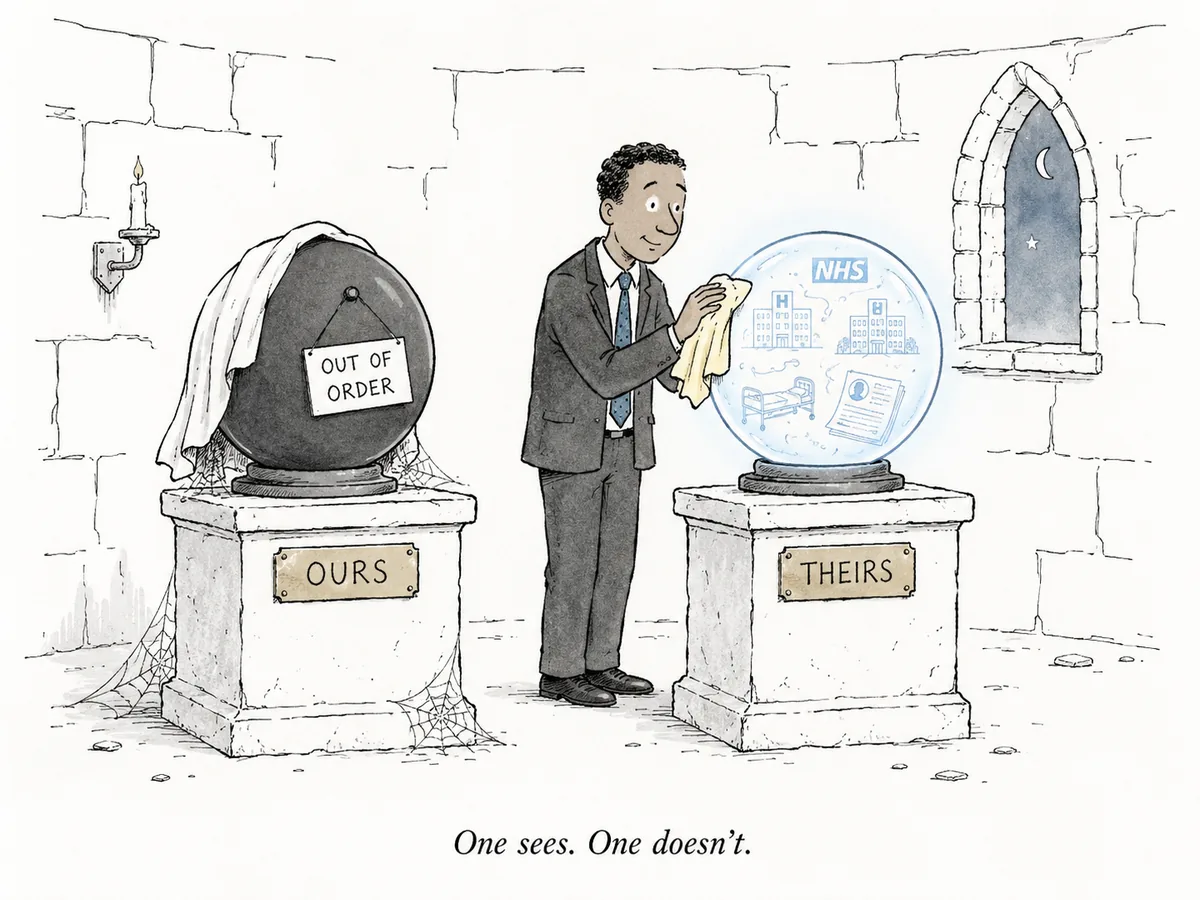
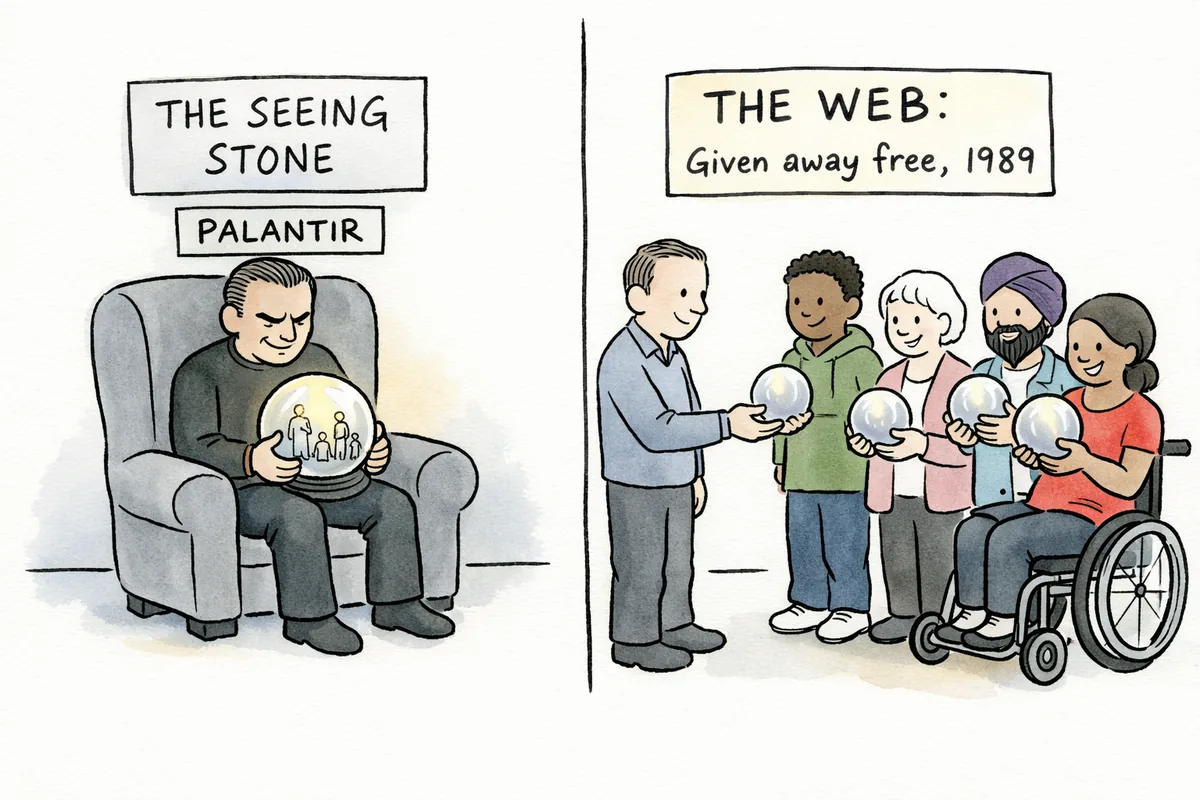
    The reason Palantir is called Palantir is that the founders are Lord of the Rings fans. In Tolkien, a palantir is a seeing stone, an object that lets its holder see distant places and watch from afar. The dark joke of the company name has been pointed out for years: a surveillance company named after a magical surveillance object. Their seeing stones watch us.

    What’s been happening, less remarked on, is that the public had its own seeing stone. The open source policy was a way for ordinary people to look back. To see how the systems we paid for actually worked. To check the wiring. To watch the watchers, in a small but real way.

    On Monday, the public seeing stone goes dark. Theirs stays on. That isn’t, in my view, an accident of timing. And it certainly isn’t temporary in any meaningful sense, regardless of what the press release says, because the policies it overrides are not coming back without a fight.

    Editorial cartoon of two crystal-ball-like seeing stones sitting on plinths in a dim, slightly mystical-looking room with stone walls. The stone on the left is labelled OURS on a brass plaque on its plinth. It is dark and unlit, with a small dust sheet half-draped over it and a sign hanging from it that reads OUT OF ORDER. The stone on the right is labelled THEIRS on its plaque. It is glowing brightly with a soft inner light, and faint outlines of NHS hospital buildings, hospital beds, and a person's medical chart can be seen swirling inside it. A figure in a smart suit stands between the two stones, polishing the glowing one with a soft cloth and looking pleased. The dark stone behind them is gathering cobwebs.
    One sees. One doesn’t.

    The fight, fortunately, is already happening. It’s happening in the trusts that refuse to plug in. In the doctors saying no. In the engineers leaking memos. In the patients writing letters. In the MPs reading Hansard speeches. In a former NHS open source lead with an FOI form and a website. In the people who have already mirrored every single repository before the deadline.

    The view from outside might be about to go dark. The people inside aren’t going anywhere.

    References

    1. Terence Eden’s blog: NHS Goes To War Against Open Source, with leaked SDLC-8 memo image, 1 May 2026. https://shkspr.mobi/blog/2026/05/nhs-goes-to-war-against-open-source/
    2. Anthropic: Project Glasswing, official launch page, April 2026. https://www.anthropic.com/glasswing
    3. Gov.uk: Technology Code of Practice, point 3 “Be open and use open source”. https://www.gov.uk/guidance/the-technology-code-of-practice
    4. Gov.uk Service Manual: Making source code open and reusable. https://www.gov.uk/service-manual/technology/making-source-code-open-and-reusable
    5. NHS Service Manual: Service Standard point 12, Make new source code open. https://service-manual.nhs.uk/standards-and-technology/service-standard-points/12-make-new-source-code-open
    6. Department of Health and Social Care: Data Saves Lives strategy, commitment 601. https://www.gov.uk/government/publications/data-saves-lives-reshaping-health-and-social-care-with-data/data-saves-lives-reshaping-health-and-social-care-with-data
    7. Bruce Schneier: On Anthropic’s Mythos Preview and Project Glasswing, 13 April 2026. https://www.schneier.com/blog/archives/2026/04/on-anthropics-mythos-preview-and-project-glasswing.html
    8. Terence Eden’s blog: Does Mythos mean you need to shut down your Open Source repositories?, 24 April 2026. https://shkspr.mobi/blog/2026/04/does-mythos-mean-you-need-to-shut-down-your-open-source-repos/
    9. UK AI Safety Institute: Evaluation of Claude Mythos Preview’s cyber capabilities, April 2026. https://www.aisi.gov.uk/blog/our-evaluation-of-claude-mythos-previews-cyber-capabilities
    10. NCSC: Why cyber defenders need to be ready for frontier AI, 2026. https://www.ncsc.gov.uk/blogs/why-cyber-defenders-need-to-be-ready-for-frontier-ai
    11. WhatDoTheyKnow: Eden FOI request to NHS England re SDLC-8 guidance. https://www.whatdotheyknow.com/request/information_relating_to_guidance_2
    12. Digital Health News: NHS England quietly removes open source policy web pages, 22 December 2025. https://www.digitalhealth.net/2025/12/nhs-england-quietly-removes-open-source-policy-web-pages/
    13. chloegeorge.co.uk: The Seeing Stones: How a CIA-Funded Surveillance Company Ended Up Running the NHS, March 2026. https://chloegeorge.co.uk/palantir-nhs-seeing-stones/
    14. chloegeorge.co.uk: Land and Expand: How Palantir Swam Into the FCA’s Data Lake, March 2026. https://chloegeorge.co.uk/palantir-fca-data-lake/
    15. chloegeorge.co.uk: The Man Who Sold England’s Data (And Got a Seat on the Board), April 2026. https://chloegeorge.co.uk/louis-mosley-palantir-uk/
    16. Hansard: NHS Federated Data Platform debate, 16 April 2026, including Martin Wrigley MP intervention. https://hansard.parliament.uk/commons/2026-04-16/debates/2FDCA71C-D0C1-4738-BEE8-A4BDA311DB99/NHSFederatedDataPlatform
    17. Corporate Watch: FOI requests reveal Palantir’s NHS FDP rollout failures, August 2025. https://corporatewatch.org/foi-requests-reveal-palantirs-nhs-fdp-rollout-failures/
    18. Digital Health News: BMA calls for NHS doctors to reject using the FDP, February 2026. https://www.digitalhealth.net/2026/02/bma-calls-for-nhs-doctors-to-reject-using-the-fdp/
    19. The Lowdown NHS: Palantir, the controversy, the contracts and the campaign, April 2026. https://lowdownnhs.info/topics/accountablility/palantir-the-controversy-the-contracts-and-the-campaign/
    20. Medact: Briefing on Palantir Technologies and NHS Data Systems, March 2026. https://www.medact.org/2026/resources/briefings/briefing-palantir-fdp/
    21. TechRadar: Palantir could be forced to exit NHS after pushback from staff, MPs, unions and pressure groups, April 2026. https://www.techradar.com/pro/security/nhs-users-report-that-it-is-awful-to-use-palantir-could-be-forced-to-exit-nhs-after-pushback-from-staff-mps-unions-and-pressure-groups-over-federated-data-platform
    22. Gov.uk: NHS England, Health and Social Care Secretary’s statement, 13 March 2025. https://www.gov.uk/government/speeches/nhs-england-health-and-social-care-secretarys-statement
    23. Institute for Government: One year on from the decision to abolish NHS England, 26 March 2026. https://www.instituteforgovernment.org.uk/comment/one-year-abolish-nhs-england
    24. Terence Eden’s blog: collected coverage on the NHS open source closure. https://shkspr.mobi/blog/tag/open-source/
  • The Seeing Stones: How a CIA-Funded Surveillance Company Ended Up Running the NHS

    The Seeing Stones: How a CIA-Funded Surveillance Company Ended Up Running the NHS

    Coming up in today’s show and tell…

    • Palantir, a surveillance company co-founded by Peter Thiel with CIA seed money, now holds over £500 million in UK government contracts, including a £330 million deal to run an NHS data platform covering tens of millions of patients.
    • The contract grew from a £1 pandemic “freebie” to £60 million without any competitive tender. When the £330 million contract was finally published, 71% of it was blacked out because the data protection terms hadn’t been agreed yet.
    • Palantir’s lobbyist was Peter Mandelson’s firm Global Counsel. Mandelson held a ~21% shareholding while arranging meetings between Palantir’s CEO and the Prime Minister. He has since been sacked as ambassador and is under police investigation. Palantir still has all its contracts.
    • The NHS’s own chief data officers said their existing tools were better than what Palantir was offering. Scotland kept Palantir out entirely. The government is paying KPMG £8 million to persuade hospitals to use software they don’t want.
    • Tim Berners-Lee’s Solid project offers an alternative model where data stays under the control of the people it belongs to. The NHS chose the opposite approach. The contract comes up for review in February 2027.

    Update, 23 March 2026

    Four days after this article was published, the Guardian reported that Palantir has been awarded a contract by the Financial Conduct Authority to analyse its internal intelligence data, including case files, emails, call recordings, and reports of suspected financial crime across 42,000 firms. Palantir now holds contracts covering NHS patient data, Ministry of Defence operations, police systems, and financial regulation. The cross-departmental infrastructure this article warns about isn’t a future risk. It’s being built right now, one contract at a time. A full investigation into the FCA deal is coming.

    I fell down a rabbit hole this week. It started with a question about what Tim Berners-Lee thinks of Palantir, and it ended with me staring at a Hansard transcript at midnight going “no, but seriously, WHAT?” I need to tell you about it, because it’s one of those stories where the more you find out, the more unbelievable it gets, and I think more people should know.

    Fair warning: this starts with Tolkien, takes a detour through watermelon cocktails, and ends with your medical records. Stay with me. I promise it’s worth it.

    A quick word about seeing-stones

    In Tolkien’s Lord of the Rings, a palantír is a seeing-stone. Think crystal ball, but instead of a fortune teller at a village fete telling you you’ll meet a tall stranger, it lets you spy on people across vast distances. The Elves made them for good reasons. Then the bad guys got hold of them, and it all went sideways. Saruman used one and thought he was gaining power. He was actually being controlled. Denethor used one and it drove him to despair. The palantír is Tolkien’s cautionary tale about what happens when surveillance technology ends up in the wrong hands.

    In 2003, the billionaire investor Peter Thiel co-founded a data analytics company. He named it Palantir. He also named his offices after Middle-earth locations: Gondor, Rivendell, the Shire. His venture fund Founders Fund bankrolled a weapons company called Anduril (Aragorn’s sword), founded by former Palantir executives. He co-founded a separate venture fund called Mithril (the magic armour metal). You have to admire the commitment to the theme, if nothing else.

    Now, I want to believe he just really liked the books and thought “seeing-stone” sounded cool. But Thiel studied philosophy at Stanford. He’s not a man who picks names carelessly. And I think if you name your surveillance company after a fictional device whose entire literary purpose is to warn you about the dangers of surveillance, you probably understood the assignment. You just disagreed with the conclusion.

    That company now holds over £500 million in UK government contracts, including a £330 million deal to run a data platform for the NHS. Your NHS. Your data. And the story of how that happened is genuinely one of the most extraordinary things I’ve ever tried to write down.

    The £1 contract (or: how to buy the NHS with watermelon cocktails)

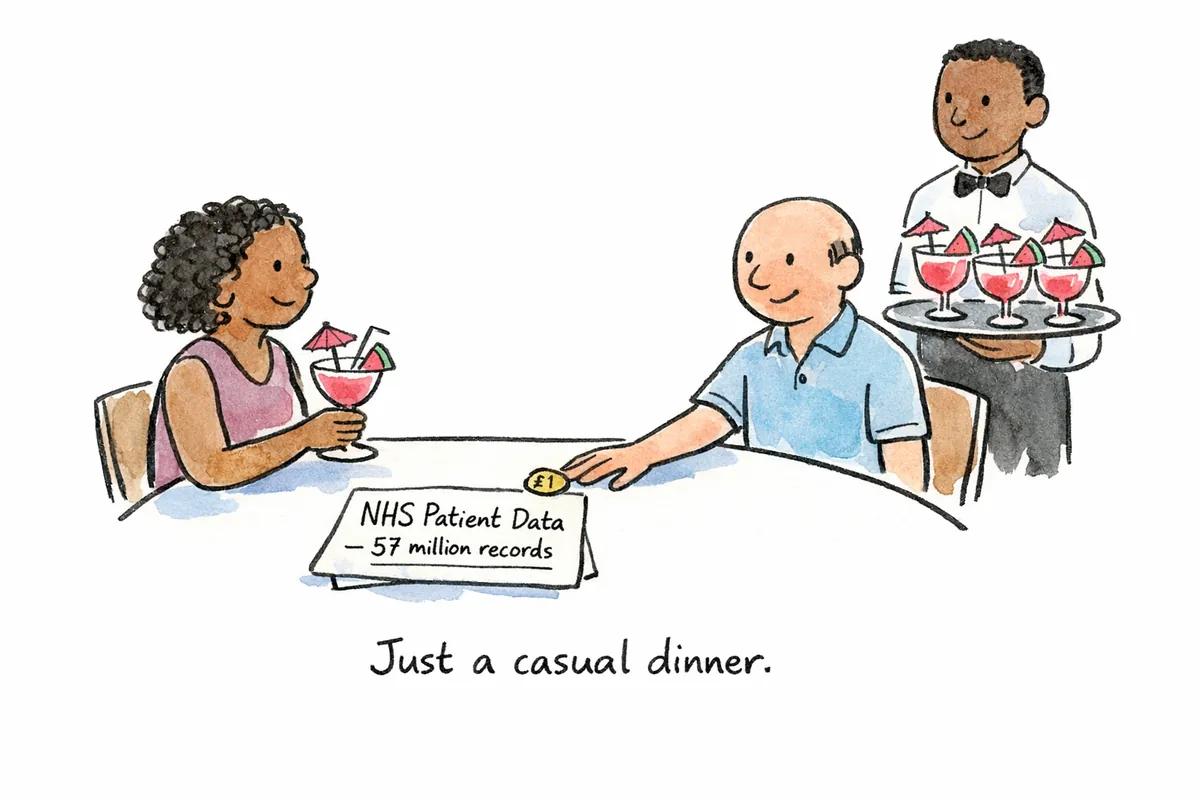
    Cartoon of two people at a dinner table with watermelon cocktails, a napkin reading NHS Patient Data 57 million records, and a £1 coin being slid across the table. Caption: Just a casual dinner.

    The version of this story most people know goes like this: pandemic hits, NHS needs help, generous tech company steps in for £1, everyone claps. It’s a lovely story. It’s also not quite what happened.

    The Bureau of Investigative Journalism found that Palantir had been courting the NHS for months before Covid was a thing. In July 2019, Palantir’s UK boss Louis Mosley hosted a dinner with the chair of NHS England. The email chain, which I have read more times than is probably healthy, mentions “exotic drinks” and “watermelon cocktails.” Over these watermelon cocktails, they discussed potential uses of NHS data. The chair emailed afterwards: “If you can see ways where you could help us structure and curate our data… do be in touch.”

    Just a nice dinner. Just some cocktails. Just the beginning of what would become half a billion pounds in government contracts. As you do.

    By January 2020, two months before the pandemic, Palantir’s London team were already building a product “exclusively focused” on the UK healthcare market. So when Covid arrived and they offered to help for £1, that wasn’t a random act of kindness. That was the free sample outside a shop. The first one’s always free.

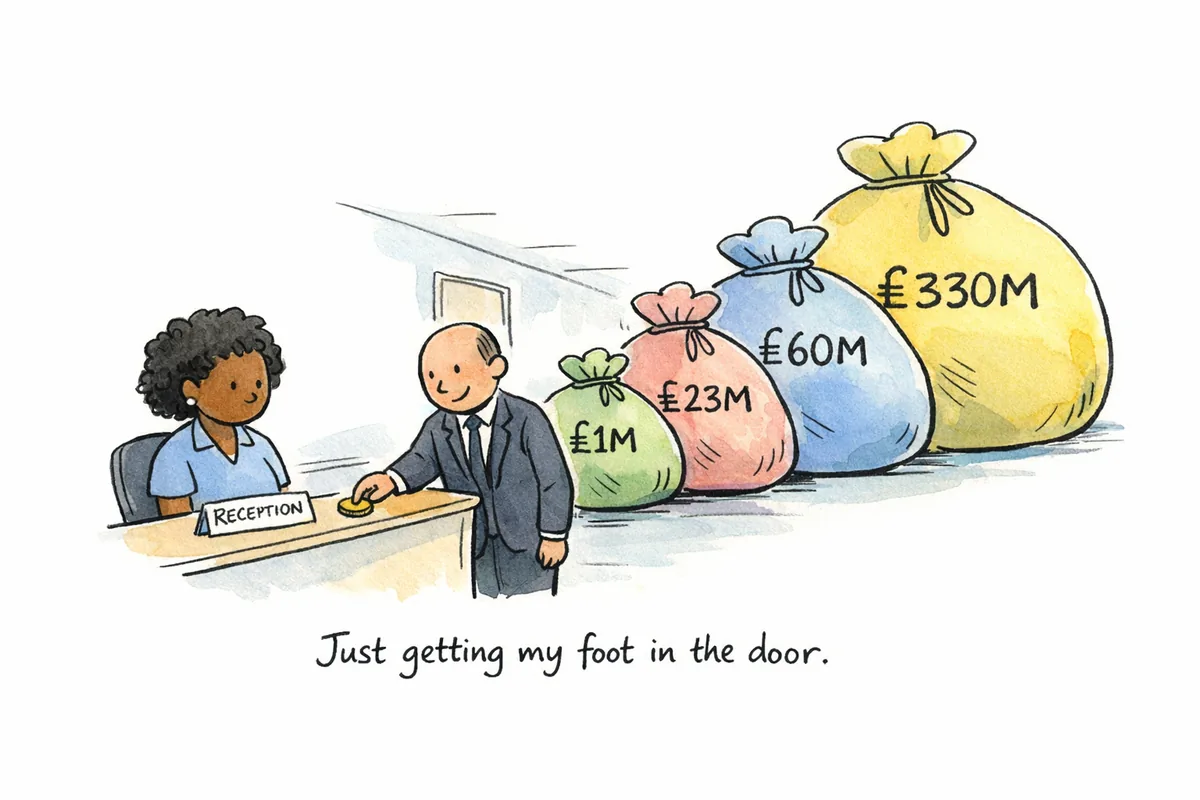
    And oh, did it work. £1 became £1 million by July 2020. Then £23 million by December. That £23 million contract was awarded without competition. Through various extensions, Palantir won £60 million from the NHS without ever competing against another company. Sixty million quid and not a single tender. I once had to fill in a 12-page form to get a £500 council grant for a community project, so apparently there are different processes depending on how many zeros are involved.

    Cartoon of a man sliding a £1 coin across an NHS reception desk while behind him sit increasingly enormous money bags labelled £1M, £23M, £60M, and £330M. Caption: Just getting my foot in the door.

    In 2021, openDemocracy and the legal campaign group Foxglove sued the government over it. The government’s legal position was, and I am not making this up, that “citizens have no right to a say in major NHS contracts” with big tech firms. Your health data. No say. They actually argued that. In a court. With lawyers and everything. Faced with a judicial review, they caved and promised not to extend Palantir’s role without consulting the public.

    They broke that promise two years later. In March 2023, leaked documents showed NHS bosses had quietly ordered hospitals to upload patient data to a new Palantir-run database, without the public consultation they’d committed to. Their own internal documents acknowledged this was “likely to be perceived by some privacy campaigners as contentious.” I admire the understatement.

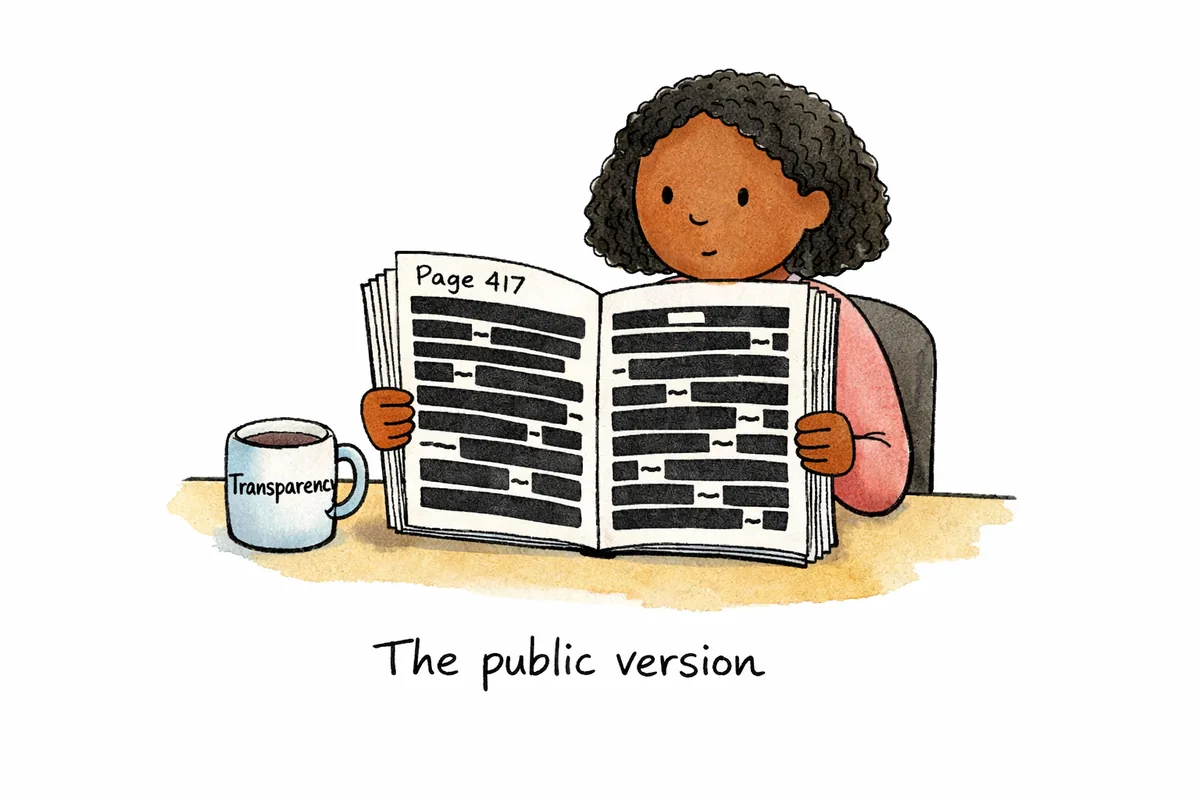
    Then came the big one. November 2023: a £330 million, seven-year contract to build something called the Federated Data Platform (which is the kind of name that sounds important enough that most people stop asking questions, which I suspect is the point). When the contract was made public, it was released on the last working day before Christmas, and 417 of its 586 pages were completely blanked out.

    I should explain what “blanked out” means here, because it’s actually worse than it sounds. “Redacted” means the pages existed but their contents were hidden with black boxes on the version published for the public to see. So journalists, MPs, campaign groups, your GP, you: none of us could read what was in 71% of the contract. Government policy says public bodies have to give reasons when they redact contracts. No reasons were given.

    The Good Law Project launched legal proceedings to find out what was underneath all that black ink. And what they discovered was, if anything, more alarming than what anyone had guessed. The pages weren’t redacted for national security reasons or commercial sensitivity in the usual sense. They were blanked out because those sections, including the data protection clauses, hadn’t actually been agreed yet. NHS England’s own lawyers admitted the provisions were still “subject to commercial negotiation.”

    Let me just make sure that’s landed. NHS England awarded Palantir a £330 million contract to handle the health data of tens of millions of people. They signed it. Then they continued negotiating the terms afterwards. Including the bit about how your medical records would be protected. And when they published the contract, they hid the unfinished bits by blacking them out and releasing it on the day everyone was wrapping presents. The Good Law Project said this was potentially unlawful, not least because once you’ve signed, you’ve given away your negotiating power. Palantir already had the deal. What incentive did they have to agree to stronger privacy terms at that point?

    I’ll just leave that there for a moment while we all process it together.

    Cartoon of a woman reading a thick document where every page is covered in black redaction bars. She has reached page 417. A mug on the desk reads Transparency. Caption: The public version.

    Then, within weeks of signing, Palantir secretly hired a Tory-linked PR agency to pay social media influencers to promote the platform. The briefing asked the influencers not to mention Palantir by name. The NHS investigated it as a potential contract breach. It’s like watching someone trip over their own shoelaces at a job interview. Except the job is running the health data of everyone in England.

    Wait, but what does the NHS actually need this for?

    Before I go any further, I want to be fair about something. The NHS has a real problem, and Palantir offered a real solution to it. If I don’t explain that, this whole piece sounds like conspiracy thinking, and it isn’t. The problem is genuine. It’s who we chose to fix it that’s the issue.

    Here’s the thing about the NHS: it’s enormous, and it’s fragmented. There are around 200 hospital trusts in England, plus integrated care boards, GP practices, mental health trusts, ambulance services, and community health providers. Each one has its own IT systems. Many of those systems are, to put it diplomatically, not new. Some of them can’t talk to each other at all. Your GP records are in one system. Your hospital records are in another. Your outpatient appointments might be in a third. Your prescription history could be somewhere else entirely.

    If you’ve ever turned up at A&E and the doctor has asked you questions that you know are already in your medical records somewhere, you’ve experienced this problem personally. If you’ve ever been referred to a specialist and had to explain your entire history from scratch because they couldn’t see your GP notes, that’s the same problem. It means duplicated tests, missed information, delayed discharges, and longer waiting lists. People genuinely suffer because NHS data systems don’t join up. Better data integration could genuinely save lives. Nobody disputes this.

    The Federated Data Platform was supposed to fix it. The idea was to link up all that fragmented data so the NHS could see, in real time, how many beds are available across a region, where waiting lists are longest, where ambulances are being held up, and where discharge bottlenecks are causing problems. At a trust level, it would help hospitals manage patient flow and theatre scheduling. Perfectly reasonable goals. Genuinely useful. The kind of thing you’d want your health service to be doing.

    So the question isn’t: did the NHS need better data infrastructure? It did. The question is: did the NHS need this company to build it? A company founded with CIA money, whose main clients are military and intelligence agencies, whose co-founder has documented ties to a convicted sex offender, and whose lobbyist is under criminal investigation? When the NHS’s own chief data officers wrote an open letter saying they already had tools that exceeded what the FDP was offering? When Leeds Teaching Hospitals said adopting it would mean losing functionality? When the contract was awarded through a process involving £60 million in uncontested deals, broken consultation promises, and privacy clauses that weren’t finished when the thing was signed?

    The NHS needed a better filing system. What it got was a surveillance platform with a lobbying operation, a Tolkien fixation, and a founder who thinks democracy is overrated. Which, as solutions go, is a bit like calling a plumber and getting a submarine. Technically it involves pipes, but it’s not quite what you had in mind.

    If the product isn’t better, what’s actually going on?

    This is the bit where I need to be really careful, because I’m going to lay out a set of documented facts and then ask an open question, and I want to be clear about which is which.

    Here are the facts. Scotland kept Palantir out of NHS Scotland entirely. Their data systems work. Their patients are being treated. The sky did not fall in. The NHS’s own chief data officers said their existing tools were better than what Palantir was offering. Leeds Teaching Hospitals said adopting the platform would mean losing functionality. Most trusts don’t want it. The government is paying KPMG £8 million to persuade hospitals to adopt it. If you’re paying a consultancy firm eight million pounds to convince your own customers to use your product, the product is not selling itself.

    So why is it still happening? Let me show you what the public record says about who benefits.

    Palantir paid Global Counsel, Mandelson’s lobbying firm, from 2018 onwards. The fee has never been publicly disclosed. Mandelson retained a roughly 21% shareholding in Global Counsel while simultaneously facilitating meetings between Palantir and the Prime Minister. That means he had a direct financial interest in Palantir winning UK government contracts. That’s not speculation. That’s Companies House filings and Hansard.

    The Good Law Project noted that the head of Palantir’s UK operation made a donation to a Conservative minister. The revolving door between the NHS and Palantir is documented too: openDemocracy found that at least three former NHS data experts left the health service and joined Palantir, including Indra Joshi, who was the NHS’s head of AI and helped launch the Covid-19 datastore, the first NHS project to use Palantir’s software, before leaving the health service and joining the company in 2022. Imagine being the person responsible for introducing a company’s product into your workplace, then going to work for that company. It’s technically legal. It doesn’t look great.

    Cartoon showing a revolving door between three buildings labelled NHS, Palantir, and Government, with people carrying boxes of belongings walking calmly between them in a circular pattern while a cleaner mops the floor unbothered.

    On the political side, the Good Law Project found that Health Secretary Wes Streeting has accepted up to £372,000 from companies and individuals with links to private healthcare since entering parliament in 2015, representing more than 60% of his total registered donations. Nobody is suggesting that money was specifically in exchange for the Palantir contract. But when a Health Secretary who has received hundreds of thousands of pounds from private health interests is privately briefed that a private health contractor’s reputation is damaging delivery, and his response is to press on with the contract anyway, it’s reasonable to ask what’s shaping his priorities.

    I want to be honest: nobody has produced a smoking gun showing someone received a brown envelope in exchange for this contract. That’s not how it works at this level, and expecting it to look like that is how it keeps working. What the public record shows is lobbying fees, shareholdings, political donations, a revolving door of staff, dinner party networks, and the kind of access that money buys but never explicitly pays for. It’s structural, not transactional. The money doesn’t flow in a straight line from A to B. It flows in a circle, where relationships become contracts become jobs become donations become access become relationships again.

    I don’t know exactly who benefits from this arrangement or by how much. But I know that when a product the customers don’t want is being sold to them with £8 million of public money, by a company whose lobbyist had a financial stake in the outcome, whose staff are recruited from the very organisation they’re supposed to be serving, and whose contract was signed before the privacy terms were even agreed… “sorting out the NHS’s data” probably isn’t the whole story.

    The man behind the seeing-stone

    To understand how we got here, you need to know a bit about Peter Thiel. He studied philosophy at Stanford, which I mention because his philosophy is genuinely built into Palantir’s DNA, and it’s… well. It’s a lot.

    He co-founded PayPal. He was the first outside investor in Facebook. He created Palantir with seed funding from In-Q-Tel, which is the CIA’s venture capital arm (the CIA has a venture capital arm! I didn’t know that either, and I sort of wish I still didn’t). His biographer Max Chafkin describes his thinking as “bordering on fascism”. He’s written openly that he no longer believes freedom and democracy are compatible. In his book Zero to One, he argues companies are better run than governments because they have a single decision-maker. A dictator, essentially, though he’s too polished to use that word.

    His political network is vast. JD Vance, the current US Vice President, is Thiel’s protégé: mentored by him, employed by him, and bankrolled with $10 million for his Senate run. More than a dozen people with ties to Thiel sit inside the Trump administration, including former Palantir staff in the Department of Health, the Treasury, and DOGE. Stephen Miller, the architect of America’s mass deportation policy, personally owns more than $100,000 of Palantir stock. Palantir makes the software that ICE (Immigration and Customs Enforcement, the US agency currently carrying out mass deportation raids under Trump) uses to find people. I’m not going to draw you a diagram. You can see it.

    And then there’s the Epstein connection. Byline Times documented that Thiel maintained a business relationship with convicted sex offender Jeffrey Epstein through a venture fund called Valar Ventures, from 2014 until Epstein’s final arrest in 2019. Former Israeli PM Ehud Barak described Thiel and Epstein as “co-owners” of the fund. Thiel’s spokesperson denied the “co-owner” bit but confirmed Epstein was a limited partner. The distinction may matter to some people. I will let you decide if you’re one of them.

    The man actually running it

    Thiel is the co-founder and chairman. But the person running Palantir day to day is Alex Karp, and he’s arguably even more interesting, because he’s the contradiction that makes the whole thing work.

    Karp and Thiel met at Stanford Law School. Karp then went off and got a PhD in social theory from Goethe University in Frankfurt. He grew up in a leftist family with activist parents. He describes himself as “progressive but not woke” and has donated to Biden and Kamala Harris. On paper, he’s the political opposite of Thiel. And yet they co-founded the same surveillance company, and they’ve been running it together for over 20 years. Funny how that works.

    In 2024, Karp was the highest-paid CEO of a publicly traded company in the United States, with compensation of almost $6.8 billion. That’s billion with a B. For context, the entire £330 million NHS contract, the one that’s supposed to transform healthcare data for the whole of England, is roughly 3% of what Karp personally earned in a single year. I don’t know what to do with that information. I’m just putting it there.

    He’s also been saying some very interesting things out loud recently. On CNBC last week, he said “what makes America special right now is our lethal capabilities, our ability to fight war.” He’s described himself as “exceedingly proud” of Palantir’s work supporting Israel. And in the same interview, he said that AI technology will reduce the economic power of “highly educated, often female voters, who vote mostly Democrat” while increasing the power of “working-class, often male” voters. Which is, I think, a remarkably candid thing for a self-described progressive to say about his own product. The New Republic described it as a direct pitch to the Republican Party from a CEO whose company is already embedded in the Pentagon.

    So that’s Palantir’s leadership. The co-founder believes democracy is incompatible with freedom. The CEO describes himself as progressive while running a surveillance company that aids deportation raids, supports military operations, and whose product he cheerfully admits will undermine the economic power of educated women. They present as opposites but they built the same machine and it serves the same ends. The difference is that Thiel is honest about his philosophy. Karp wraps the same outcomes in nicer language.

    The Mandelson web (where it gets really wild)

    OK. This is where the story goes from “that’s concerning” to “are you actually serious.” I need you to stay with me because every single thing I’m about to say is documented, sourced, and on the public record, even though it reads like the plot of a thriller that would be rejected for being too far-fetched.

    In 2018, Palantir hired Global Counsel, the lobbying firm co-founded by Peter Mandelson. The goal was to make Palantir look like a respectable partner for the UK government. At this point, both Thiel and Mandelson were connected to Jeffrey Epstein. Thiel through Valar Ventures. Mandelson through a personal relationship that continued after Epstein’s 2008 conviction for sex offences against children. The man hired to make the surveillance company look respectable, and the man who founded the surveillance company, were both connected to the same convicted sex offender.

    I’ve typed that sentence several times now and it still doesn’t feel real. But it is.

    Global Counsel got busy. In February 2023, they hosted a dinner where the NHS’s chief data officer was listed as the “guest of honour”. Nine months later, Palantir won the £330 million contract. I’m sure that’s a coincidence.

    When Mandelson became UK Ambassador to the US, civil servants warned him that his interest in Global Counsel “would have to cease”. He didn’t comply. He kept his roughly 21% shareholding. While still ambassador, still holding those shares, he arranged a meeting between Palantir’s CEO and Keir Starmer at Palantir’s US headquarters. The meeting didn’t appear on the PM’s register of visits.

    Shortly after, the MoD awarded Palantir a contract worth roughly £250 million. Directly. Without competition. MPs asked for the documents from the Starmer-Palantir meeting. The government refused, saying it was “too expensive to find them”. The minutes of a meeting between the Prime Minister and a surveillance company that just received a quarter-billion-pound defence contract. Too expensive to locate. I’ve lost socks that were easier to find.

    Mandelson has since been sacked as ambassador, forced to resign from Labour and the House of Lords, and is under Metropolitan Police investigation. Global Counsel has gone into administration. But Palantir still has every single one of its contracts.

    Byline Times asked the question that I think deserves a proper answer: if Mandelson’s links to Epstein disqualify him from holding power, why does the company controlled by Epstein’s business partner still have access to the UK’s most sensitive infrastructure? Nobody’s answered that yet. I’d genuinely love to hear someone try.

    Why your NHS data matters more than you think

    Here’s where we need to talk about what Palantir’s software actually does, because it’s not just a fancy spreadsheet.

    Palantir’s Foundry platform is designed to link datasets that weren’t previously connected, find patterns between them, and build profiles. That’s the product. That’s what it does for the CIA. That’s what it does for ICE (Immigration and Customs Enforcement, the US agency carrying out mass deportation raids under Trump), combining immigration records with financial data and phone records to track people. That’s what it does for the military, fusing satellite imagery with intercepted communications to generate targets. Palantir’s CEO said last week that “what makes America special right now is our lethal capabilities, our ability to fight war.” Charming.

    That same cross-referencing engine now sits on top of the NHS.

    The NHS holds structured health data on the population of England. Your GP visits, your prescriptions, your mental health records, your sexual health, your pregnancies, your addiction history. Linked to your postcode and date of birth. Ernst & Young estimated in 2019 that this data is worth £9.6 billion a year: about £5 billion to commercial organisations who could profit from the patterns, and £4.6 billion in benefits to patients through better outcomes.

    I want to pause on that framing for a second, because it bothers me. The NHS wasn’t built as a data asset. It was built to look after people. The data exists because doctors and nurses care for patients. The fact that someone put a commercial price tag on it, and bundled “value to pharmaceutical companies” together with “benefits to sick people” into one headline number, tells you something about how this conversation has already been quietly shifted underneath us.

    A report from health justice group Medact, backed by Amnesty International, Privacy International, and the Good Law Project, just laid out why the next shift should worry us. Medact warned that the platform could enable government departments like the Home Office and police to access patient data. Palantir’s own UK executive has argued publicly for a “common operating system” linking NHS, DWP, and other public data. And Reform UK has explicitly pledged to “automatically share data between the Home Office, NHS, HMRC, DVLA, banks and the police” to find and deport people. The infrastructure for that is being built right now. That’s not a conspiracy theory. It’s in their policy document.

    The chilling effect is already measurable. During the pandemic, around 57% of migrants avoided seeking healthcare because they feared being reported to the Home Office. Put a surveillance company’s cross-referencing engine in the middle of that system and people who need medical help will stop asking for it. That’s not hypothetical. That’s maths.

    Meanwhile, fewer than a quarter of England’s 215 hospital trusts were actually using the platform by the end of 2024. Leeds Teaching Hospitals told NHS England it would “lose functionality rather than gain it”. The response from government? They paid KPMG £8 million to “promote the adoption” of software that hospitals don’t want. Eight million pounds of public money on what is essentially a marketing campaign for a product the actual customers are politely declining. That’s a sentence I didn’t expect to write today, and yet here we are.

    Cartoon of a man in a suit enthusiastically presenting a laptop labelled Platform to tired NHS staff in scrubs, one of whom is holding their own laptop with a sticky note reading Already works. A banner behind reads Adoption Campaign £8m budget.

    Tim Berners-Lee and the road not taken

    Right. Here’s the bit that turns this from infuriating to properly heartbreaking. Because there was always another way, and it was right there.

    Tim Berners-Lee invented the World Wide Web in 1989 and gave it away for free. No patent. No licensing fee. Because he believed information should be open and accessible to everyone. I wrote my university dissertation about him in 2002 (specifically about whether Flash animation would be the future of the web, which in hindsight was not my strongest prediction), and I’ve been banging on about his vision ever since. But his recent work is what matters here.

    He’s been building a project called Solid, which does exactly what the NHS needed: it keeps data under the control of the people and institutions it belongs to, with access granted on a permission basis. No centralised platform. No vendor lock-in. No surveillance company required.

    Split panel cartoon. Left side labelled The Seeing Stone, Palantir: a man sits alone in an armchair clutching a glowing orb with tiny people visible inside it. Right side labelled The Web, Given away free 1989: a diverse group of people each hold their own small glowing orb, smiling.

    Speaking in Barcelona on 3 March, he demonstrated an AI assistant called Charlie that pulls from a user’s own data store, not a corporate database. He said: “Claude doesn’t understand anything about you, but Charlie does.” Because Charlie has permission to use your data, on your terms. That’s the model. That’s what was always possible.

    The NHS’s own people knew this. The NHS Chief Data and Analytical Officer Network wrote in an open letter that they “already have similar tools in use that presently exceed the capability” of what the Federated Data Platform was offering. They didn’t need Palantir. They needed investment in what they already had.

    Berners-Lee and Thiel are almost perfect philosophical opposites. One built the web and gave it away because he believed it belonged to everyone. The other built a surveillance company and named it after Tolkien’s cautionary tale about surveillance. One believes you should own your own data. The other believes exceptional individuals should control it. The NHS chose Thiel’s model. Nobody asked us which one we preferred.

    What can actually be done (the hopeful bit)

    I promised myself I wouldn’t write one of those pieces that makes you feel terrible and then stops. So here’s the constructive bit, and I mean it.

    The political picture isn’t great right now. Wes Streeting was privately briefed that Palantir’s reputation was hindering the platform’s delivery and pressed on. In private WhatsApp messages to Mandelson, he conceded Israel was “committing war crimes before our eyes”, while publicly dismissing concerns about Palantir’s NHS involvement. It’s fair to say the political class, across parties, has not covered itself in glory on this one.

    But there are real pressure points, and real people applying real pressure. The contract comes up for review in February 2027. The BMA has formally called for the contract to end. Medact’s report is backed by Amnesty International, Privacy International, and the Good Law Project. Scotland has kept Palantir out of NHS Scotland entirely, which proves it’s possible. Local campaigns are fighting trust by trust, ICB by ICB.

    And here’s the thing I keep coming back to, the thing that actually gives me hope, although I want to be honest about the limits of that hope because I think you deserve that. Every single fact in this article comes from a public source. Companies House filings. Contracts Finder. Hansard. The lobbying register. FOI responses. Investigative journalism built on publicly available records. The information is all there. It’s just scattered across dozens of databases that don’t talk to each other, which means connecting it all up currently requires months of work by specialist journalists and lawyers with resources most of us don’t have. Most of us are trying to get through Tuesday.

    So I’ve been thinking: what if there were a tool where you could type in any company’s name and see, in one place, what public contracts they hold, who their directors are, who lobbied for them, and what political donations are connected? Not opinion. Not editorialising. Just public data, linked up and searchable. The kind of thing that currently takes an investigative team months, available to anyone with a browser and a cup of tea.

    I’m calling the project Power to the Minions, because I’m a mum of four who lives in Frome and I think naming things should be fun, and also because that’s literally what it is: giving ordinary people access to information that currently only well-resourced professionals can piece together.

    Now. Before I get carried away with my own pitch, let me be the first to say: I’m not going to pretend a search tool fixes democracy. If it were that simple, someone would have done it by now, and we’d all be living in a utopia where government contracts were awarded on merit and dinner party invitations had no bearing on procurement decisions. Clearly, we are not living in that utopia. I checked.

    The investigative journalists who broke this story are brilliant. openDemocracy, the Bureau, Byline Times, Foxglove, the Good Law Project: they’ve done extraordinary work over six years. And Palantir still has its contracts. So why would a tool help where journalism hasn’t?

    Here’s my honest answer: journalism produces stories. Stories have news cycles. They peak, they get shared, people are outraged for a week, and then everyone moves on to the next thing. The Palantir-NHS story has been broken repeatedly since 2020. Each time there’s a flurry of attention. Each time it fades. The contracts remain. That’s not a failure of journalism. That’s the nature of how attention works. A story is a photograph of a problem. What doesn’t exist yet is a window.

    The difference between a photograph and a window is that the photograph gets looked at once and then goes in a drawer. The window means anyone can look, any time, for as long as the building stands. A tool that connects Companies House data with Contracts Finder with Hansard with the lobbying register isn’t a photograph. It’s a window. It doesn’t need a news cycle to work. It’s just there, permanently, for anyone who wants to look through it.

    Cartoon of a woman holding a cup of tea, looking through a window at an illuminated web of connections linking nodes labelled Contract, Director, Donation, Lobbyist, Minister, and Dinner. Caption: What if the light was just always on?

    Does it stop Palantir on its own? No. Of course not. A window doesn’t stop a burglar. But it does mean the neighbours can see what’s happening. And it means the next time someone awards a contract to a company whose lobbyist is under criminal investigation and whose founder has documented business ties to a convicted sex offender, the connections are visible within minutes instead of months. That changes who can ask questions, how quickly, and how often. It doesn’t replace the journalists and lawyers. It gives them (and everyone else) a head start. Instead of spending three months finding the web, they can spend three months acting on it.

    Also, and this is the bit that quietly matters most: it changes the calculation for the people doing the dodgy deals. Right now, if you’re awarding a contract to a friend of a friend after a nice dinner, you know it’ll take years for anyone to connect the dots. If the dots connect automatically the moment the contract hits Contracts Finder? You might reconsider whose dinner invitation you accept. Transparency doesn’t just expose problems. It prevents some of them from happening in the first place, because the humans involved are, at bottom, quite keen on not being caught.

    I know what I’m describing sounds like it might already exist. There are good tools out there. OpenCorporates makes Companies House data searchable. They Work For You makes Hansard searchable. But nobody’s built the connective layer between them. You can look up a company. You can search for contracts. You can check the lobbying register. You can search Hansard. What you can’t do, anywhere, is go from “this company got this contract” to “and here’s who lobbied for it, and here’s where the directors sit on other boards, and here’s who donated to which politicians” in one search. That’s the gap. And it’s the gap where the story lives.

    The elephant in the room: they already have our data

    I can hear the question, because I asked it myself: even if we get Palantir out at the 2027 review, haven’t they already had access to our data since 2020? What’s done is done, surely?

    Fair point. And I want to be honest about it rather than do the thing where you pretend there’s a magic undo button and everyone goes home happy. Yes, Palantir has been processing NHS data for over five years. The structural knowledge they’ve gained, the patterns they’ve identified, the architecture they’ve built: that institutional learning doesn’t evaporate when a contract expires. Nobody’s invented Ctrl+Z for corporate knowledge. That’s a real and uncomfortable truth.

    But ending the contract still matters. A lot. It stops the ongoing, daily access to live patient data. It prevents the Federated Data Platform from becoming the permanent infrastructure through which a future government could do cross-departmental surveillance. It breaks the vendor lock-in before it becomes irreversible. And it sends a signal, to Palantir and to every other company watching, that there are consequences for how you behave, who you associate with, and whose data you handle. Consequences are underrated. We should have more of them.

    Scotland proves it’s possible. They kept Palantir out of NHS Scotland entirely. The sky didn’t fall in. Their data systems still work. The patients are still being treated. The lesson is clear: you don’t need a CIA-funded surveillance company to manage healthcare data. You need investment in your own people and your own infrastructure. Which is, funnily enough, what the NHS’s own data chiefs were saying all along, to anyone who was listening, which apparently did not include the people signing the contracts.

    There’s something Tim Berners-Lee said that I think about a lot: the web was designed, which means it can be redesigned. The same is true of the systems that currently protect opacity. They were built. They can be rebuilt. And you don’t need to be an investigative journalist or a lawyer to help. You just need the data to be findable.

    The seeing-stone serves whoever holds it

    Cartoon of a glass orb on a desk with GP records, Prescriptions, Mental health, Postcode, and Date of birth written inside it. Two hands reach for it from opposite sides: one with an NHS cross on the cuff, the other with an eye symbol cufflink. Caption: One seeing-stone to rule them all.

    I keep coming back to Tolkien, because the metaphor really is almost annoyingly perfect.

    The palantír isn’t dangerous because the bad guys built it. The Elves built it, for perfectly good reasons. It’s dangerous because once it exists as a centralised tool of seeing, it serves whoever holds it. The Federated Data Platform is the same. The NHS built it to manage waiting lists. Reasonable goal. But once it exists as a single connected data layer across the entire health system, run by a company whose core business is cross-departmental surveillance, you’ve created something whose potential uses extend well beyond anything the NHS intended.

    A future government that wants to cross-reference your health data with your immigration status, your benefits claims, or police intelligence doesn’t need to build anything new. The pipes are already laid. They just need to turn the taps.

    Cartoon of an NHS building with coloured pipes labelled GP Records, Prescriptions, Mental Health, Sexual Health, and Immigration Status all feeding into a single tap controlled by a suited hand, dripping into a bucket labelled TBD. A diverse group of patients watches from outside. Caption: The plumbing is already done.

    Tim Berners-Lee closed his Barcelona talk with something that I think is worth finishing on: “Imagine apps which are collaborative, which are creative, which are compassionate. Imagine this world, and do whatever you can to get towards that world.”

    I reckon “whatever you can” is the important bit. Not everyone can sue the government or fund a legal challenge. But we can build tools that connect public data. We can support the people doing the hard work: openDemocracy, Foxglove, the Good Law Project, Medact. We can pay attention. We can refuse to let complexity be the thing that shields power from accountability.

    The man who invented the web gave it away because he believed it belonged to everyone. The man who founded Palantir named it after a fictional surveillance device because, I suspect, he understood exactly what he was building.

    I know which vision I’d rather build towards. And if you’ve read this far, I’m guessing you do too.