My son Beau and I were having a couple of pints the other evening and somehow ended up talking about meritocracy. I can’t remember how we got there.It was one of those conversations that starts with “the thing is though” and ends three hours later with neither of you sure who said what first.
His argument was this: even if you could create a genuinely level playing field, which you can’t, you’d get one meritocratic generation at most. Because some of those people on the baseline would be more successful than others. They’d accumulate more. Their children would start with advantages. And within a generation, you’re back to where you started. The whole thing collapses back into the same old inequalities, just wearing a different outfit. “I’m a realist, Mum,” he said.
And the thing is, he’s right. Not in a cynical way. In a clear-eyed, cut-through-the-noise way that made me proud, because he’d just summarised in two minutes what it took a philosopher and a sociologist several hundred pages to explain.
That conversation stuck with me. Because the question underneath it is one I think about a lot: if meritocracy doesn’t work, and probably can’t work, then what are we actually doing? What are we teaching our children when we tell them to work hard and they’ll succeed? And what does it mean that a word invented as a warning became the organising principle of modern life?
It turns out the diagnosis has been done. Quite thoroughly. By a satirist who died disappointed, and a philosopher who fills lecture halls. The harder question is what to do once you’ve seen it clearly. For that, I’ve found myself reaching for a film director who put the cruelty on screen, an author who thinks mushrooms might be the answer, and a spiritual teacher who thinks none of us are who we think we are.
Bear with me.
The satirist’s nightmare
In 1958, a British sociologist called Michael Young wrote a book called The Rise of the Meritocracy. It was a satire. A dystopia. Set in 2034 (which is uncomfortably close), it imagined a society perfectly sorted by merit, defined as IQ plus effort [1]. The clever ones rose. The rest sank. And because the sorting was “fair”, nobody could complain.
Young invented the word “meritocracy” for this book. He meant it as a warning. The whole point was that a society organised entirely around merit would be crueller than the aristocracy it replaced. Under aristocracy, everyone knows the game is rigged, so there’s no shame in losing. But in a meritocracy, if you’re at the bottom, you supposedly deserve it. The system has weighed you and found you wanting, and the verdict is yours to carry. As Young put it: “It is hard indeed in a society that makes so much of merit to be judged as having none” [2].
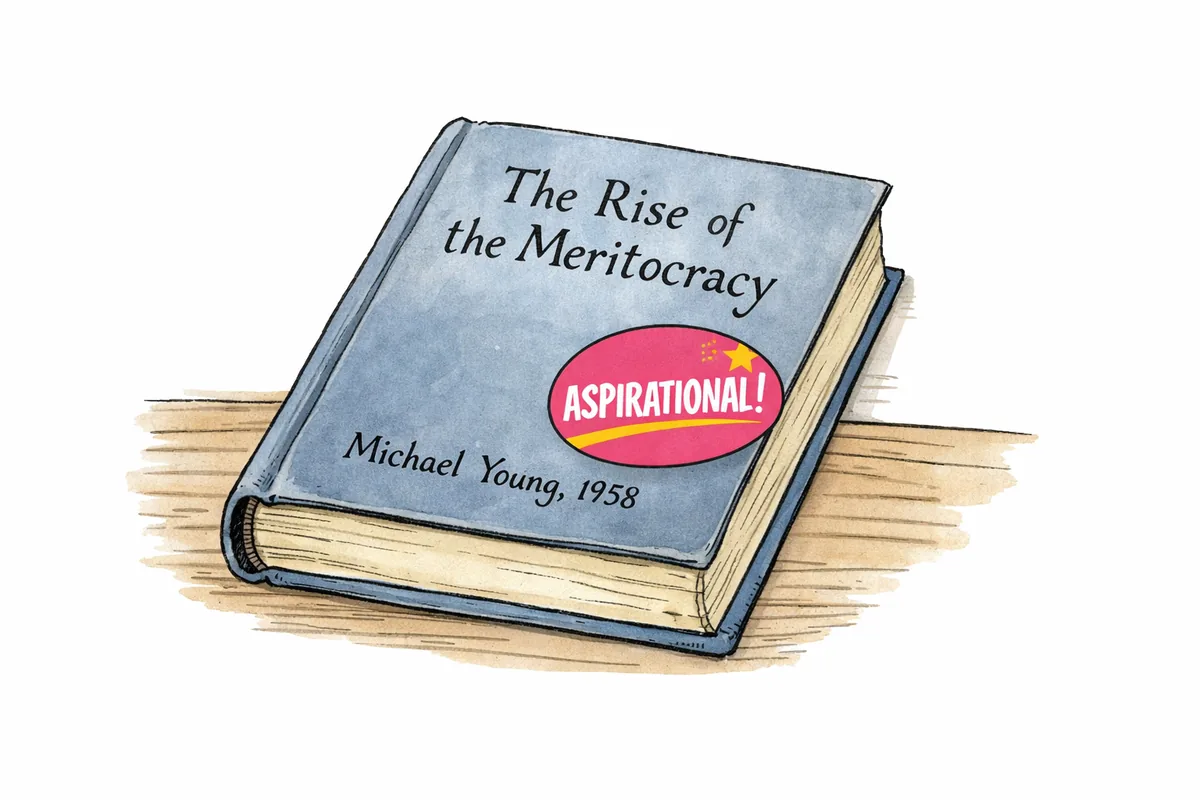
And here’s the thing that made me put my drink down when I read it: Young predicted exactly what Beau described. In the novel, the successful meritocrats accumulate advantage, form a new class, and then reproduce themselves. Young wrote that “the new class has the means at hand, and largely under its control, by which it reproduces itself” [2]. One generation sorted by merit hardens into a new elite. Their children inherit the advantages. The level playing field lasts precisely one go. My son arrived at the same conclusion over a pint in Frome that Young took a whole book to lay out in 1958.
The book was rejected by the Fabian Society and then by 11 publishers [1] before Thames and Hudson finally took it on. And then something extraordinary happened: the word escaped. Politicians started using “meritocracy” as a compliment. Tony Blair built an entire political identity around it. Young watched in horror as the term he’d created as a poison label was rebranded as an aspiration.
In June 2001, seven months before he died, Young wrote a piece in the Guardian called “Down with Meritocracy” [2], in which he essentially said: I wrote a warning and you turned it into a manifesto. He noted it was “highly unlikely the prime minister has read the book, but he has caught on to the word without realising the dangers of what he is advocating” [2]. He pointed out that the meritocratic elite had become “insufferably smug” because, unlike the old aristocracy who knew they’d benefited from nepotism, the new class “can actually believe they have morality on their side” [2].
Young also mourned something specific: the loss of working-class leadership. He contrasted the Attlee cabinet, where the foreign secretary Ernest Bevin had left school at 11 to become a farm boy, kitchen boy, errand boy, van boy, tram conductor and drayman, with Blair’s cabinet “largely filled with members of the meritocracy” [2]. The working class had been stripped of its natural leaders, siphoned off by educational selection, leaving communities without the people who would once have spoken for them.
Young died on 14 January 2002 [3], aged 86. The word kept running.
The philosopher in the lecture hall
Michael Sandel is a political philosopher at Harvard. His undergraduate course “Justice” was the first Harvard course ever filmed and broadcast for free [6], and it’s been watched by millions of people around the world. He has this rare ability to make you feel like you’re in a conversation, not a lecture, which is probably why a philosophy professor has become something close to a public intellectual.
In 2020, he published The Tyranny of Merit [4], and it’s the book Young might have written if Young had lived to see Brexit and Trump.
Sandel’s argument is precise. From the 1980s onwards, centre-left parties on both sides of the Atlantic adopted meritocratic language as their answer to inequality. Instead of challenging the structures that produce it, they said: we’ll give everyone a fair shot through education. Go to university. Work hard. Succeed. The message was aspirational. It was also devastating.
Because if the answer to stagnant wages and disappearing industrial jobs is “you should have gone to university”, you are implicitly telling millions of people that their situation is their own fault. You’re not just saying they have less money. You’re saying they are less. Less intelligent, less hardworking, less deserving. The economic gap becomes a moral gap.
Sandel traces the language. As one analysis of his work notes, Clinton and Bush used the word “smart” around 450 times in their political rhetoric; Obama used it around 900 times [7]. Blair’s target, announced at the Labour Party Conference in September 1999, of 50% of young people going to university [8], wasn’t just policy: it was a statement about which lives count. The rhetoric of rising, as Sandel calls it, turned governance into a technical problem best solved by credentialed experts, not a democratic conversation about how we want to live.
And here’s the contradiction that nobody talks about enough. University education in Britain was effectively free from 1962 until 1998 [24]. The 1962 Education Act established that local authorities would cover tuition fees, and maintenance grants helped with living costs. Then Blair’s government, the same government telling working-class people that university was the route to success, introduced tuition fees of £1,000 a year in 1998 [25]. The reason? Blair believed the expansion of higher education had run far ahead of economic growth [24], and the government didn’t want to raise taxes to fund it. So they shifted the cost onto students. Fees rose to £3,000 in 2006, then to £9,000 under the Coalition Government in 2012 [25]. They’re £9,250 now.
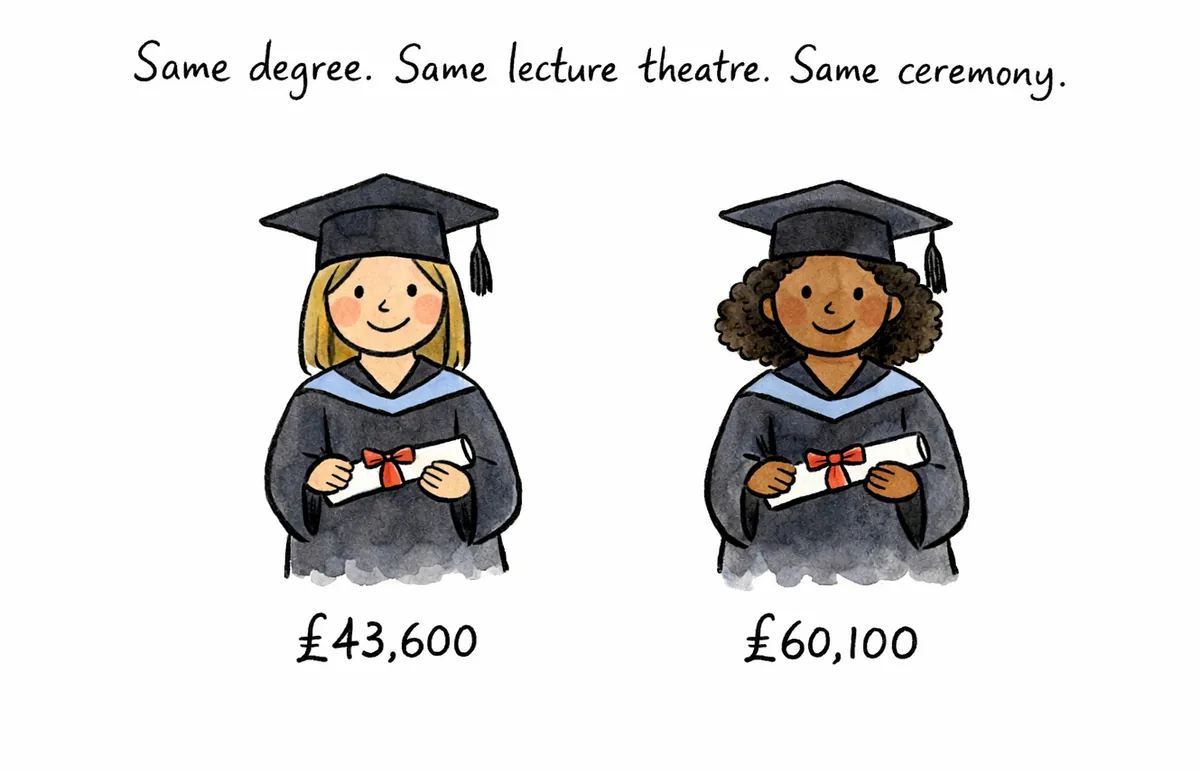
The defenders of the system will tell you that nobody pays upfront, that you only repay once you’re earning above a threshold, and that the debt gets written off eventually. All true. But here’s what the mechanics don’t capture. Everyone pays the same £9,250 in tuition fees. But students whose parents can’t cover their rent and food also borrow the maximum maintenance loan to survive. Students from wealthier families borrow less, or nothing at all, because their parents pick up the living costs. The result, according to analysis by London Economics for the Sutton Trust [26], is that poorer students graduate with around £60,100 of debt, 38% more than the £43,600 for students from wealthier families. Same degree. Same lecture theatre. Same piece of paper at the end. One walks out lighter, the other carries a weight that one academic has called “a tax on social mobility” [27].
There is a counterargument, and it’s worth taking seriously. Economists argue that it would be regressive if costs were shouldered exclusively by the taxpayer, because most taxpayers are not graduates and are financially disadvantaged over their lifetimes compared to graduates [28]. Why should the plumber and the carer and the shop worker subsidise the education of someone who will, on average, go on to outearn them? Students currently pay around 65% of the cost of a degree through fees, while the taxpayer shoulders about 35% [29]. Shifting more of that burden back to general taxation would, in this reading, be a handout to the middle class.
It’s a fair point about the mechanics. But it misses something fundamental. When education was free, it was understood as a public good. The 1963 Robbins Report, issued when higher education was 90% publicly funded, saw individuals and society both benefiting [31]. Robbins explicitly rejected fees and loans, stating “it is a bad thing for young people to emerge with a load of debt” and “the connection between higher education and earning power can be over-stressed” [32]. The report described higher education as “an essential condition for the realisation in the modern age of the ideals of a free and democratic society” [32].
Society invested in its people because an educated population benefits everyone: better doctors, better engineers, better teachers. The moment you introduce fees, even income-contingent ones, you transform the cultural meaning of education. It stops being something society does for itself and becomes something an individual purchases for personal gain. That is exactly what happened. After the 2010 Browne Report turned English higher education into a market, academic researchers at Oxford found that policy commitment to the public good outcomes of higher education was “largely emptied out” [33], leaving only narrow measures like graduate salaries and research impact. England, they concluded, no longer had a policy language for talking about the outcomes of higher education other than economic ones [33]. You’re not learning for the common good. You’re buying a credential to improve your earning potential. That is exactly the market logic Sandel warns about in What Money Can’t Buy: putting a price on something changes what it is. And the Institute for Fiscal Studies has found that the current system is itself “highly regressive, hitting low earners and benefiting high earners” [30]. So the argument that fees protect non-graduates from subsidising the wealthy has, in practice, produced a system where the poorest graduates subsidise the wealthiest ones.
So the meritocratic message was: your worth depends on your education. And the policy was: you’ll have to pay for that education yourself, and you’ll pay more if you’re poor. That’s not a level playing field. That’s telling people to climb a ladder and charging them for each rung. Beau was right: the system was never level, and it was never going to be.
What Brexit was actually about
This is where the meritocratic story stops being about who gets to go to university and starts being about who gets to count. Because once you’ve built a society that decides people’s worth by their credentials, you’ve also built a society where millions of people without credentials know exactly what you think of them. They feel it in the language politicians use, in the assumptions journalists make, in the way their towns get talked about. And eventually, given the chance, they will tell you what they think back. Which brings us to 2016.
The standard explanations for Brexit were economic (left-behind communities, austerity) or cultural (immigration, nostalgia). Sandel doesn’t dismiss these. But he adds a layer underneath: the feeling of being disrespected by a professional class that had come to see its own success as proof of its superiority.
Educational attainment was the single strongest predictor of how someone voted in the referendum. According to Sandel, voters without a degree voted overwhelmingly for Brexit, while the vast majority of those with a postgraduate degree voted to remain [4]. This wasn’t a divide between rich and poor. It was a divide between credentialed and non-credentialed.
And the Remain campaign, in Sandel’s reading, made it worse. It was relentlessly technocratic: treating the question as a technical problem with a correct answer, rather than a democratic choice between different ways of living. Economists, institutions, experts, all lining up to explain why leaving was irrational. The subtext: smart people vote Remain. When Michael Gove said “people have had enough of experts”, he was widely mocked by Remain supporters. But Sandel argues Gove was articulating something real. Not anti-intellectualism. A rejection of the idea that your diploma gives you the right to override someone else’s democratic judgment about how they want to live.
The places that voted most heavily for Leave were towns that had been discussed for decades purely in terms of their deficits. The Joseph Rowntree Foundation’s landmark study [17] found that the strongest Leave support came from “struggling areas where average incomes, education and skill levels are low and there are few opportunities to get ahead”, places like Mansfield, Stoke-on-Trent, and Great Yarmouth. LSE fieldwork in these communities [18] found residents saying their towns had been “overlooked”, with Mansfield’s own MP describing it as “left behind in terms of the government caring about things outside of London.” As the UK in a Changing Europe project [19] documented, people in smaller towns expressed feelings of not getting their “fair share” and being excluded from political decision-making. Nobody asked what those communities valued or what they’d lost. The conversation was always about what they lacked.
Brexit, in Sandel’s reading, was partly millions of people refusing to accept the verdict that they didn’t matter. Not because they had a detailed alternative economic plan, but because they wanted to reassert that their voice, their experience, and their way of life had value that can’t be measured by a credential or a GDP figure. As an academic review in the Political Quarterly [15] puts it, the populist complaint gives voice to resentment fostered by meritocratic belief, serving as a vehicle for resisting the hubris of the meritocratic elite.
Young saw this coming too. In his Guardian piece he wrote that the working class, stripped of their natural leaders by educational selection, had become “partially disfranchised; as time has gone by, more and more of them have been disengaged, and disaffected to the extent of not even bothering to vote” [2]. He wrote that in 2001. Fifteen years before the referendum.
And this is where meritocracy stops being abstract. In 2016, the same year as the referendum, Ken Loach released I, Daniel Blake, a film about a joiner who can’t work because of a heart condition and is destroyed by a benefits system that treats him as a problem to be corrected. Speaking about the film ten years on [34], Loach said he made it because Britain was “in a time of mean-spiritedness. If you were vulnerable or needed support, you were met with punishment, and there was a constant vilifying of people who needed help.” The film’s message, he said, was about “the cruelty of the system that says: poverty is the fault of the poor. You’re not striving enough. You’re not doing enough job interviews.” The most famous scene in the film involves Katie, a young mother who has been moved from London to Newcastle by the housing system, collapsing at a food bank and eating cold baked beans from a tin with her hand because she hasn’t eaten in days. Loach’s screenwriter Paul Laverty based it on a real story from a Glasgow food bank [34]. When the film came out, the Tory minister Damian Green dismissed it as “a work of fiction” [34]. Loach’s reply was that the characters were fictional but the stories were true. Ten years later, as Loach observes, food banks are “an institution in society”, something “simply unimaginable a year or two before we made the film” [34].
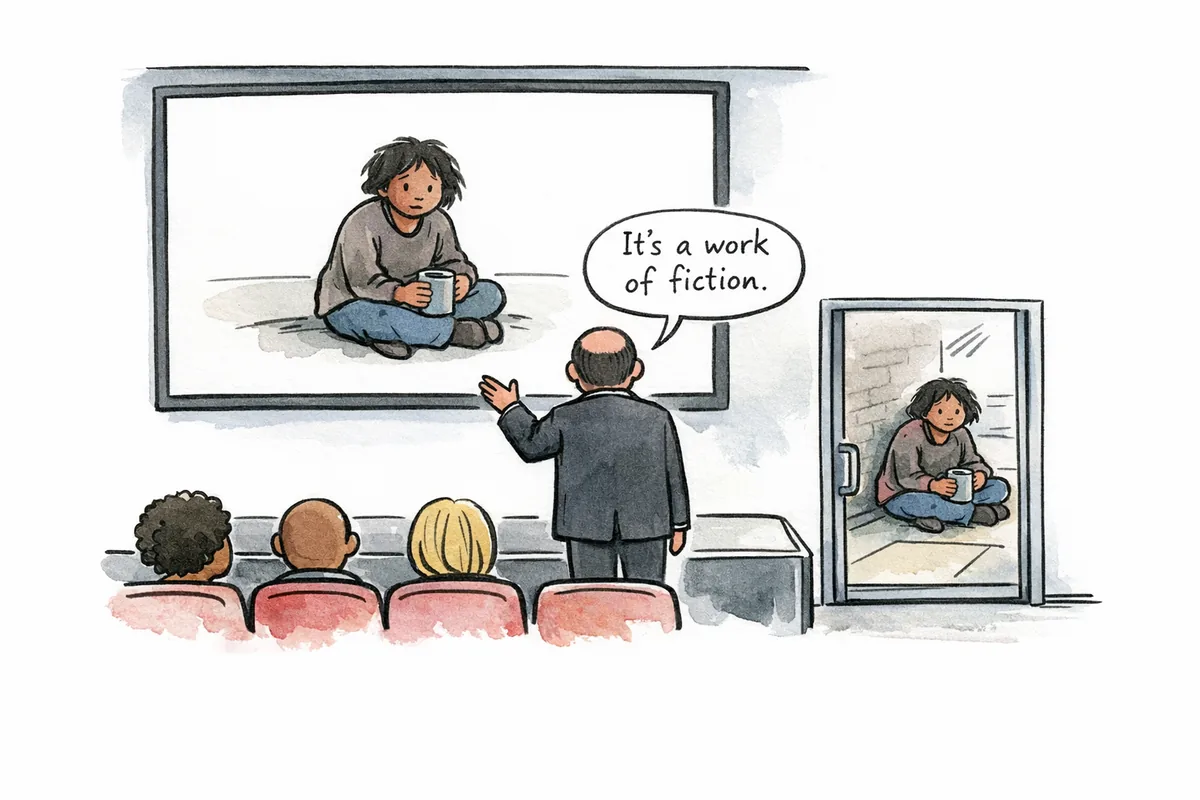
That is what meritocracy looks like on a kitchen floor. Sandel’s argument about the moral logic of merit, about how success becomes evidence of virtue and failure becomes evidence of fault, is exactly what Loach is describing. If merit is everything, then need is shameful. If success is earned, then so, by implication, is hunger. And so a society that believes itself to be meritocratic can watch food banks become permanent and feel, in some deep and unspoken way, that this is a reasonable outcome. Not a failure of the system. A failure of the people who need the food.
What money can’t buy (and what it destroys when it tries)
Sandel’s earlier book, What Money Can’t Buy: The Moral Limits of Markets (2012) [5], is about a different but connected problem. His starting point is simple: over the past few decades, markets have quietly expanded into areas of life where they fundamentally change the nature of what’s being exchanged.
Sandel’s examples are deliberately varied. As he details in a PBS interview about the book [20], lobbyists pay professional line-standing companies [21] thousands of dollars to secure seats at congressional hearings, hiring homeless people and retirees to queue on their behalf. Companies take out life insurance policies on their employees without telling them, collecting the payout when workers die [5]. You can pay to upgrade a prison cell. Schools offer children cash for good grades [5].
Sandel’s argument isn’t that these things are inefficient. It’s that putting a price on certain things corrupts them. A queue works on the principle that everyone’s time is equally valuable. Paying to skip it destroys that principle. Paying a child to read turns reading from something with intrinsic value into a transaction, and the research suggests it actually reduces long-term motivation once the money stops.
He draws a distinction between having a market economy, which is a useful tool, and being a market society, where market logic seeps into friendship, education, health, civic life, and even how we think about our bodies. His worry is that we drifted into the latter without ever having a public conversation about whether we wanted it.
The connecting thread between both books is dignity. What Money Can’t Buy asks what happens when everything is for sale and people with less money are excluded from full participation in civic life. The Tyranny of Merit asks what happens when the winners believe they earned everything and owe nothing. As Sandel writes, a perfect meritocracy “banishes all sense of gift or grace” and reduces our ability to see ourselves as sharing a common fate [6]. Both books end up in the same place: a society where large numbers of people feel the system doesn’t see them as fully human.
The AI question
Which brings me back to my kitchen table. Because here’s the thing about AI and education: there is a version of this story that is genuinely hopeful, and a version that is terrifying, and I appear to be living both simultaneously.
The hopeful version: AI could be the thing that breaks the link between parental wealth and educational quality. Right now, a child with wealthy parents gets tutors, small class sizes, patient one-to-one explanation tailored to how they learn. A child without those things gets an overstretched teacher and 30 or more kids in a room. AI tutoring, genuinely personalised, infinitely patient, available at midnight when the panic sets in, could democratise something that has always been a privilege. It could give every child the kind of support that used to be reserved for the few. As researchers at University College London have argued [12], if correctly designed and deployed, AI tools could provide empowering access to education beyond political, cultural, language, geographical and learning-ability barriers.
My daughter is on the SEN register. She learns differently. The school does its best, and the teachers genuinely care, but the broader system wasn’t designed for the way her brain works. So we use AI tools at the kitchen table to fill the gaps. It works. It also shouldn’t be necessary. The fact that a parent with a laptop and an internet connection can do what an underfunded school can’t is not a triumph of technology. It’s a quiet indictment of how we fund education
The terrifying version: AI becomes another sorting mechanism. Another way to classify, rank, and credential people. Imagine algorithms screening CVs, predicting academic potential, scoring children’s abilities from age five. It looks objective and fair, but it’s just encoding existing assumptions about what “merit” means into systems that are harder to argue with because they feel scientific. Research is already showing that AI learning systems can flag neurodivergent patterns as “abnormal” [14], misidentifying different ways of thinking as deficits. Learning management systems employ algorithms that privilege neurotypical modes of learning and interaction, treating variation from the norm as a problem requiring intervention. And as a 2026 study published in Frontiers in Computer Science [13] found, the benefits of AI in education are unevenly distributed, with algorithmic bias and the digital divide meaning the technology can widen rather than narrow the gap. If we’re not careful, we’ll automate the exact meritocratic machinery that Young warned us about, except this time it will be powered by algorithms instead of IQ tests, and it will be even harder to challenge because the sorting will happen invisibly, inside a system nobody quite understands.
I’m using the master’s tools to give my daughter a fighting chance in the master’s system, while simultaneously wondering if the system itself is the problem. That contradiction is where I live right now. I suspect I’m not the only one.
The Chelsea Manifesto
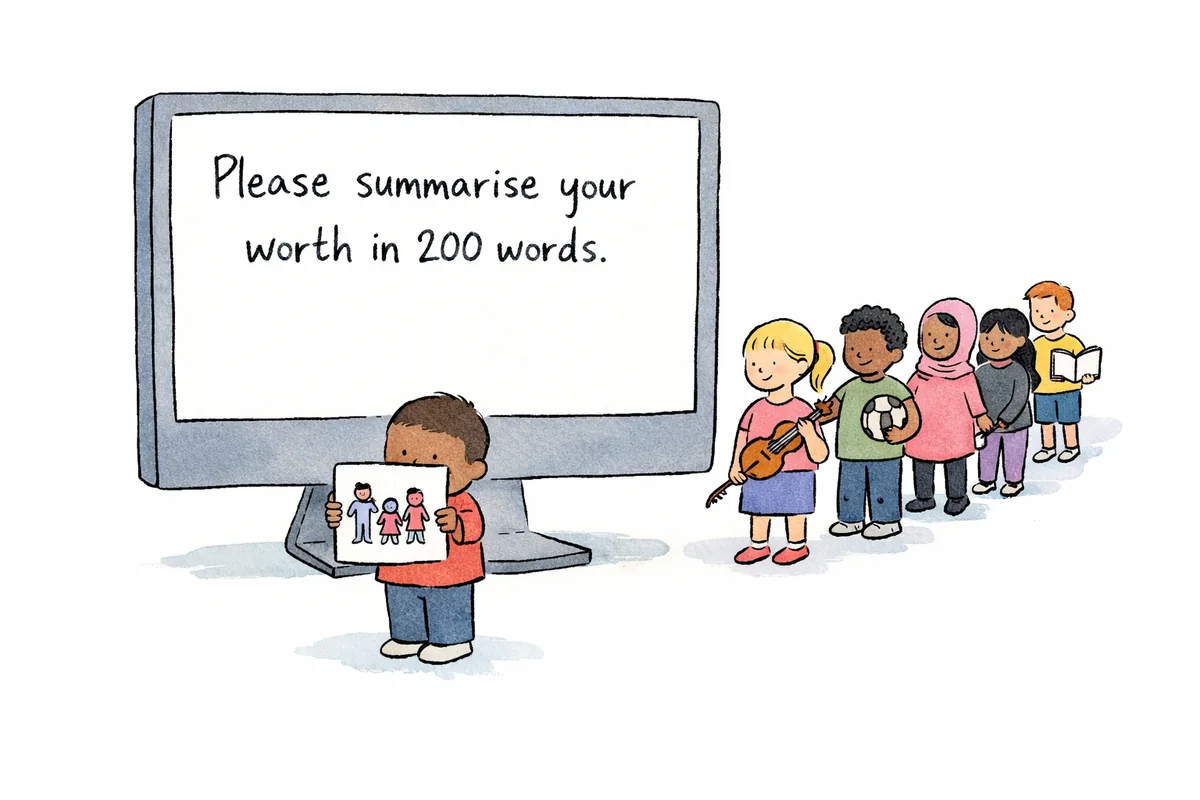
Here’s where it gets interesting. Because buried in Young’s 1958 novel, in the middle of his satire about a dystopian meritocracy, there is a document. He calls it the Chelsea Manifesto. It’s written by his fictional revolutionaries, the people who rise up against the meritocratic elite. And what they call for isn’t a different sorting system, or a fairer set of exams, or better redistribution. What they call for is this: a society that values people not only by their intelligence and their education, their occupation and their power, but by their kindliness and their courage, their imagination and their sensitivity, their sympathy and generosity [9].
Kindliness. He wrote that in 1958. Sixty-seven years ago, a satirist imagined that the antidote to meritocracy wasn’t a better version of the same game. It was a completely different set of values. And the first one he reached for was kindness.
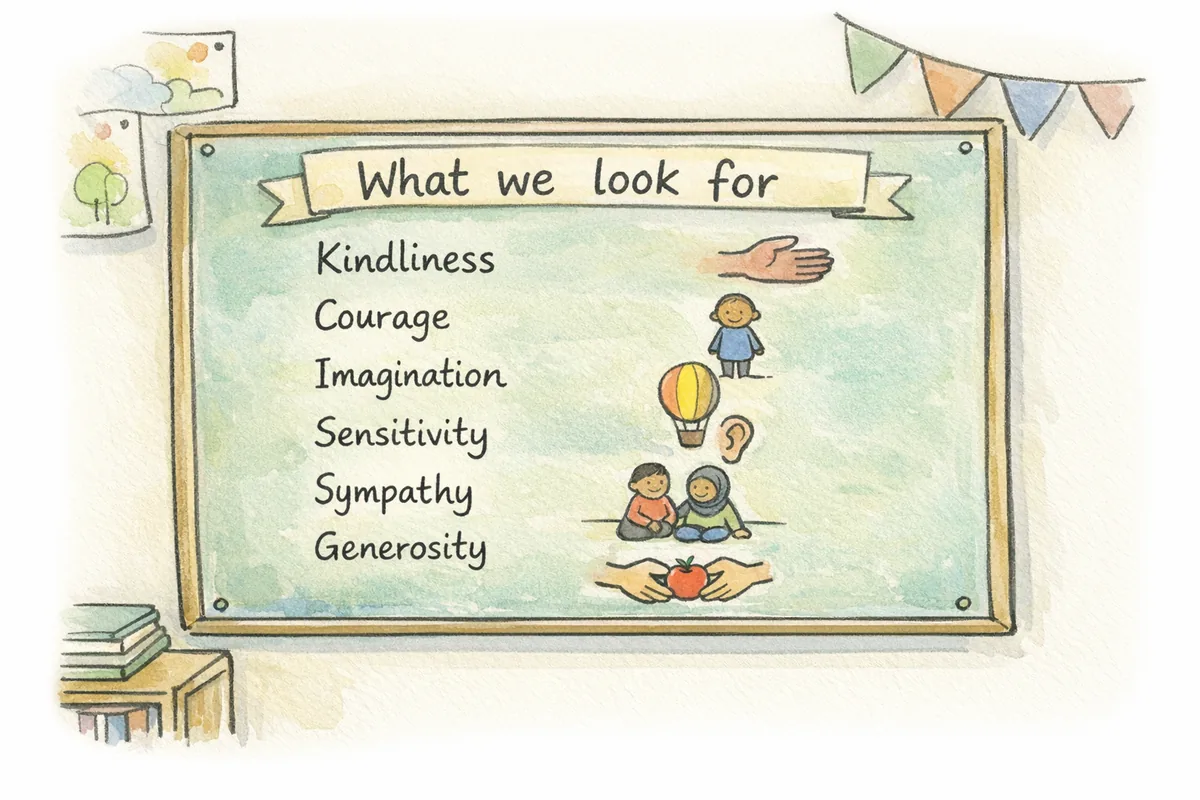
I know this sounds like a greeting card. I know it sounds naive. I know that “be kind” is the sort of thing people put on Instagram over a sunset and then go back to their lives. But I don’t think it’s naive at all. I think it’s the most radical political position available.
Because meritocracy depends on one central belief: that success is the point of life. That achievement is how you earn your place. That your value is your productivity. And kindness, genuine kindness, the kind you practise in your home, with your children, with the people around you, is a direct refusal of that belief. If you raise children who don’t define themselves by achievement, who genuinely care about the people around them, who measure their day by whether they were decent rather than whether they won, you are building a tiny revolution. One kitchen table at a time.
The difficulty, and this is the real difficulty, is the world. Because the world will try to suck the kindness out of them. School will rank them. Employers will measure them. Social media will compare them. And the challenge isn’t being kind in a kind world. The challenge is staying kind in a world that rewards something else entirely. Not letting it get you down. Not letting the cynicism win.
Michael Pollan, in his work on psychedelics, keeps coming back to one idea: ego dissolution. In How to Change Your Mind [10] (2018) and his latest book A World Appears [11] (2026), he describes what happens when people take psilocybin under guided conditions. The experience people report, consistently, is the temporary collapse of the self that separates them from everyone else. The boundaries dissolve. The sense of being a discrete, competitive individual falls away, and what replaces it is connection. To other people, to the natural world, to something larger. As Pollan told Rolling Stone, psychedelics “smudge the windshield of experience” [11], revealing the underlying mediation of reality by consciousness. And according to the research he cites, a psychedelic experience significantly increases the likelihood that a person will recognise consciousness in other beings [11].
That is literally the opposite of what meritocracy builds. Meritocracy says: you are your achievements. The psychedelic experience says: you are not separate at all. And you don’t have to take mushrooms to recognise the truth in that (though Pollan makes a compelling case). Eckhart Tolle arrives at the same place without any substances at all. His argument in The Power of Now [22] is that we are not our thoughts, not our achievements, not the voice in our head that tells us we’re not enough. The ego, as Tolle describes it, constructs an identity from our social status, job, possessions, education, and beliefs [23], and then convinces us that this constructed identity is who we actually are. Meritocracy feeds that ego perfectly: it tells you that your credentials are your worth. Tolle says the opposite. You are the awareness behind the credentials. You exist whether you pass or fail. The practice of presence, of simply being in the moment without needing to prove anything, is a quiet but total rejection of the meritocratic self.
So you have Pollan reaching ego dissolution through psychedelics, Tolle reaching it through presence and meditation, and both arriving at the same conclusion: that the relentless identification with achievement is making us ill, and that connection to other people and to the world around us is what actually matters. More people are turning to these practices. Meditation, consciousness work, psychedelic-assisted therapy. I don’t think that’s a coincidence. I think people are quietly, individually, reaching for something that meritocracy cannot provide: the feeling that they are enough, exactly as they are, without having to earn it.
What we’re actually teaching
So if individuals are reaching for something different, the obvious next question is what to do about it collectively. How do we change a system this big? And the honest answer is that I don’t think we change it from the top. I don’t think a clever policy paper or a well-meaning minister is going to fix this, because the people most invested in the meritocratic story are also the ones with the power to write the policies. The change has to come from somewhere else. From kitchen tables and classrooms and the ordinary daily decisions about what we celebrate in our children and what we don’t.
Sandel’s proposed solutions to the tyranny of merit are interesting but slightly underwhelming compared to his diagnosis. He talks about dignifying work, rethinking university admissions (he’s even floated a lottery system for qualified applicants at elite universities [6]), taxing speculation. All sensible. All unlikely to be implemented by the people who benefit most from the current system.
But I think the more honest answer is that there is no systemic solution that doesn’t start with a shift in values. Systems follow culture, not the other way around. The welfare state didn’t emerge from policy papers. It emerged from a generation that had lived through shared suffering and decided solidarity meant something.
So maybe the question isn’t “how do we fix meritocracy?” Maybe the question is: what are we actually teaching our children? Not in the classroom. At home. In the way we talk about other people. In the way we respond when they fail. In whether we celebrate their kindness as enthusiastically as we celebrate their grades.
Beau called himself a realist. And he is one. His analysis of meritocracy was spot on: it can’t sustain itself, because success breeds advantage, and advantage breeds inequality, and within a generation the level playing field is a memory. He’s right about the mechanics.
But I think there’s something he didn’t say. Which is that the answer to a broken system isn’t just a better system. It’s a different set of values. Not what can I achieve, but how can I be decent. Not what am I worth, but who am I to the people around me.
He wants to be an actor. And honestly, I think he could be the kind of actor who connects people in the way that good film does. I watched Hamnet recently and I cannot stop thinking about it. The way it landed in people, the way they came out of cinemas changed by it. That is what art does when it works. It pulls you out of yourself for two hours and reminds you that other people are real, that grief and love and tenderness are not abstractions. There’s no algorithm for that.
He is eighteen, and I think his generation has grown up watching everything through the lens of the news cycle and the algorithm, and the algorithm rewards cynicism because cynicism gets clicks. So a bit of weariness has crept in earlier than it should. But underneath that he is one of the kindest, most sensitive, most generous-spirited people I have ever known. And I think that combination, the clarity, the creativity and the kindness, is exactly what the next generation is going to need.
And while I was thinking about all of this, I was also sitting at my kitchen table in Frome, using AI to teach my daughter chemistry because the system doesn’t have the resources to give her what she needs. I could see that as competing in a meritocratic race. But I choose to see it differently. I’m not teaching her to win. I’m teaching her that her brain works beautifully, just differently. That understanding the world is worth doing for its own sake, not for a number on a certificate.
Because here’s the thing about learning that meritocracy gets completely wrong. The meritocratic view of education is instrumental: you learn to get a credential, to get a job, to succeed. Learning is a rung on a ladder. But that’s not why learning matters. Learning matters because understanding the world makes you more able to be of use in it. You learn so you can help. You learn so you can contribute. You learn because it makes you a better neighbour, a better parent, a better citizen. Not to climb, but to serve. If we taught children that, if we genuinely valued learning for its own sake and for the benefit of other people rather than as a mechanism for sorting winners from losers, we’d be building a completely different kind of society.
And the most important thing my daughter can do with her life isn’t succeed. It’s be kind to the people around her and refuse to accept that her worth is something she has to earn.
Michael Young saw this in 1958. He put kindliness first on his revolutionary manifesto. My son worked it out over a pint in Frome. Maybe it’s time the rest of us listened.
A note: The opinions about kindness, mushrooms, and kitchen-table revolutions are entirely my own. The facts are drawn from the sources below, and all books mentioned are worth reading.
References
- Young, M. (1958). The Rise of the Meritocracy 1870-2033: An Essay on Education and Equality. London: Thames and Hudson. Wikipedia overview
- Young, M. (2001). “Down with Meritocracy.” The Guardian, 29 June 2001. theguardian.com
- Michael Young, Baron Young of Dartington (1915-2002). Biographical details. Wikipedia
- Sandel, M. (2020). The Tyranny of Merit: What’s Become of the Common Good? New York: Farrar, Straus and Giroux. Macmillan
- Sandel, M. (2012). What Money Can’t Buy: The Moral Limits of Markets. New York: Farrar, Straus and Giroux.
- Lenfield, S. (2020). Review of The Tyranny of Merit. Harvard Magazine. harvardmagazine.com
- Patrick, W. Summary and notes on The Tyranny of Merit (including Clinton/Obama “smart” usage statistics). willpatrick.co.uk
- Blair, T. Labour Party Conference speech, 28 September 1999 (50% university target). Cited in House of Lords Economic Affairs Committee report. parliament.uk
- Citizen Network. Review of The Rise of the Meritocracy, including the Chelsea Manifesto. citizen-network.org
- Pollan, M. (2018). How to Change Your Mind: What the New Science of Psychedelics Teaches Us About Consciousness, Dying, Addiction, Depression, and Transcendence. New York: Penguin Press. michaelpollan.com
- Pollan, M. (2026). A World Appears: A Journey into Consciousness. Interview with Rolling Stone, February 2026. rollingstone.com
- Bulathwela, S. et al. (2024). “Artificial Intelligence Alone Will Not Democratise Education: On Educational Inequality, Techno-Solutionism and Inclusive Tools.” Sustainability, 16(2), 781. mdpi.com
- Frontiers in Computer Science (2026). “AI and the digital divide in education.” frontiersin.org
- Birch, P. et al. (2025). “Disabling AI: power, exclusion, and disability.” British Journal of Sociology of Education. tandfonline.com
- Review: “One Year On: Michael Sandel’s Tyranny of Merit.” Political Quarterly / PMC. pmc.ncbi.nlm.nih.gov
- Gutkin, L. (2020). “The Insufferable Hubris of the Well-Credentialed.” The Chronicle of Higher Education. chronicle.com
- Goodwin, M. and Heath, O. (2016). “Brexit vote explained: poverty, low skills and lack of opportunities.” Joseph Rowntree Foundation. jrf.org.uk
- Ferretti, T. et al. (2021). “Uncovering the local factors that helped shape the Brexit referendum.” LSE European Politics and Policy (EUROPP) Blog. blogs.lse.ac.uk
- Jennings, W. and Stoker, G. (2018). “Brexit and public opinion: cities and towns — the geography of discontent.” UK in a Changing Europe. ukandeu.ac.uk
- PBS NewsHour (2012). “‘What Money Can’t Buy’ and What it Shouldn’t Buy.” Interview with Michael Sandel. pbs.org
- Sandel, M. (2012). Excerpt from What Money Can’t Buy. MSNBC. msnbc.com
- Tolle, E. (1997). The Power of Now: A Guide to Spiritual Enlightenment. Namaste Publishing. Wikipedia overview
- Shortform (2021). “Eckhart Tolle: How the Ego Clouds Your Reality.” Summary of ego and identity in The Power of Now. shortform.com
- History & Policy (2016). “University fees in historical perspective.” historyandpolicy.org
- House of Commons Library (2026). “Higher education tuition fees in England.” commonslibrary.parliament.uk
- Sutton Trust (2024). “Reforming Student Maintenance.” Analysis by London Economics on graduate debt by family income. suttontrust.com
- Written evidence to the House of Commons Education Committee on student loans, including Dr Andrew McGettigan’s “tax on social mobility” analysis. committees.parliament.uk
- Callender, C. and Mason, G. (2022). “Undergraduate Student Funding in England: The Challenges Ahead for Equity.” In Higher Education Funding and Access in International Perspective. Springer. springer.com
- Sherwell, P. (2022). “There’s a progressive argument to be made for tuition fees.” The Spectator. spectator.co.uk
- Institute for Fiscal Studies (2022). “Changes to university fees are set to penalise lower-earning graduates.” ifs.org.uk
- Marginson, S. (2024). “Higher education and public good in England.” Higher Education. Springer. Research on the shift from 90% public funding under Robbins to marketisation. springer.com
- Marginson, S. (2023). “Let’s bring the public good back onto the higher education policy agenda in England.” Wonkhe. Including Robbins quotes on debt and earning power. wonkhe.com
- Marginson, S. (2023). “Has the public good of higher education been emptied out? The case of England.” Higher Education. Springer. On post-Browne loss of public good language. springer.com
- Loach, K. and Squires, H. (2026). “How we made I, Daniel Blake.” The Guardian, 13 April 2026. theguardian.com