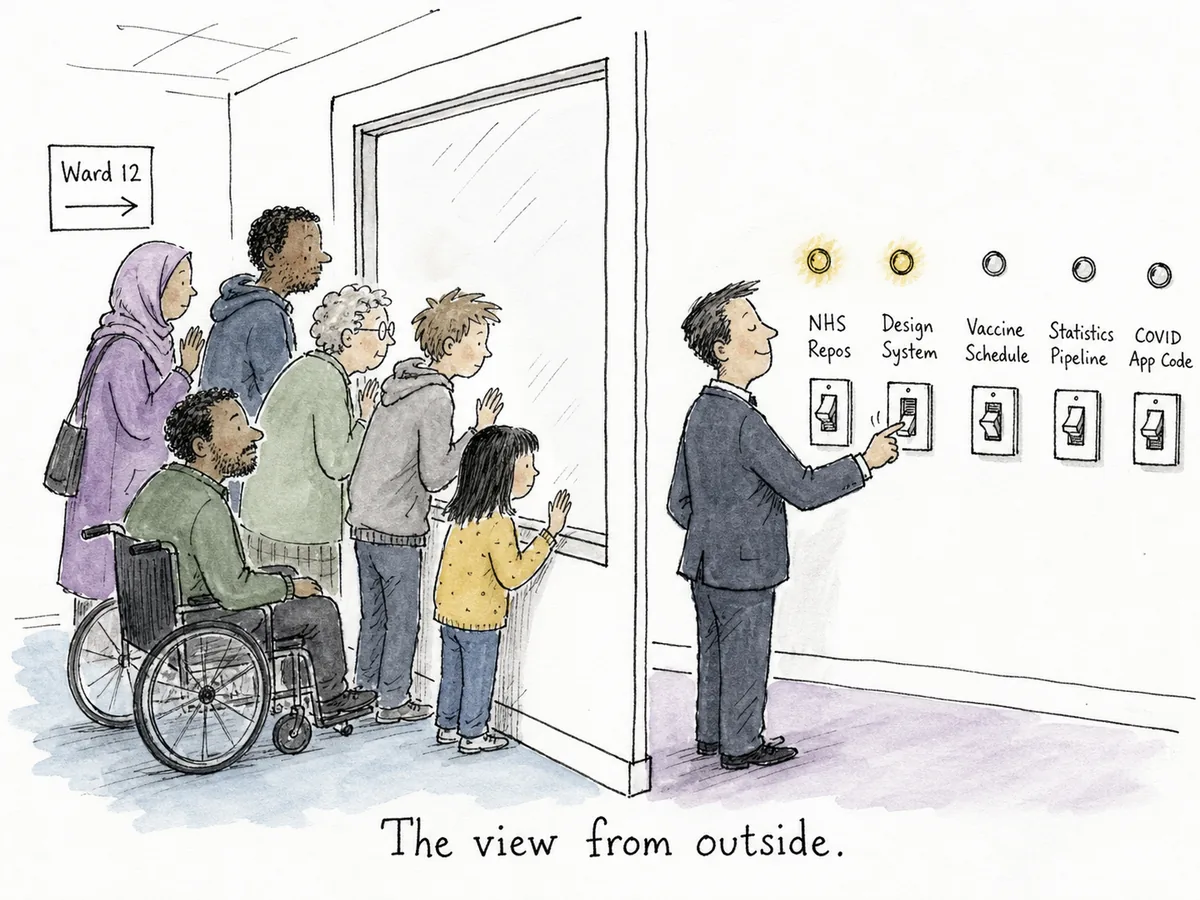
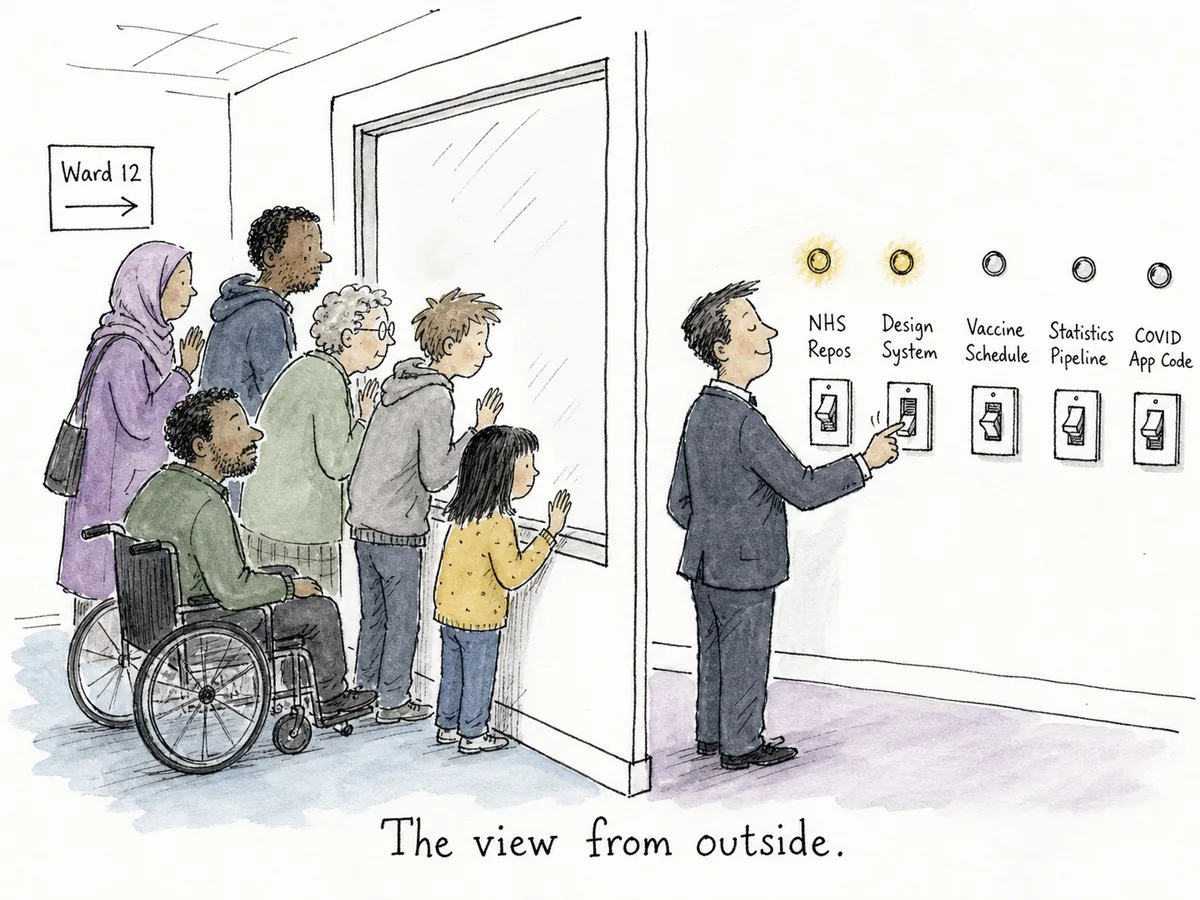
On Monday 11 May 2026, hundreds of NHS computer code projects will go dark. Not deleted. Just hidden. The repositories will still exist, the same engineers will still maintain them, but the public will no longer be able to see them.
The deadline is in seven days. Teams that want to apply for an exemption have until close of play tomorrow to make their case to the Engineering Board. Most won’t make it.
The reason given, in an internal memo dated 29 April 2026 and leaked to the former head of open technology at NHSX, is that an artificial intelligence model called Mythos can read code very fast.1 Mythos was announced by an American AI company called Anthropic about a week before the memo was issued.2
I want to talk about this. Not because I expect you to care about NHS code repositories specifically, but because what this story is actually about is much bigger than that. It’s about whether the public is allowed to see what’s being built with public money. And the timing, which I’ll get to, is suspicious enough that I think it’s worth a few minutes of your day.
What’s actually happening, in plain English
Open source code is code that anyone can read. The author publishes it on a website like GitHub, and anyone in the world can look at it, copy it, learn from it, or check whether it does what its authors say it does.
The NHS publishes hundreds of code projects this way. Most of it is genuinely boring: design templates for NHS websites, code that publishes statistics, tools that help with vaccination schedules, the standard way the NHS labels and structures its own data. Some of it is more interesting: research code, tools developed during the pandemic, frontends for patient services. None of it, on the public’s view, is the kind of secret that would let a hacker bring down a hospital.
For more than a decade, UK government policy has been that code paid for with public money should be available for the public to see. This isn’t an opinion that a couple of tech enthusiasts hold. It’s written into the Technology Code of Practice3, the government Service Manual4, the NHS Service Standard5, and the Department of Health’s Data Saves Lives6 strategy.
The reasons for this policy are simple. Public money funded the work, so the public has a right to see it. Other NHS teams, other government departments, other countries can reuse the code, which saves money. And, crucially, the code being public is one of the few ways that ordinary people, journalists, and MPs can actually check what the NHS has built and how. Without it, everything is “trust us, it works.”

What was issued on 29 April was an internal memo, formally numbered SDLC-8, telling every NHS England engineering team that all public code repositories must go private by Monday 11 May 2026. Teams must declare any need for an exemption to the Engineering mailbox by close of play 6 May. The memo overrides every one of the policies I just mentioned by internal decree.
The story they’re telling
The reason given in the memo is rapid advancements in AI models capable of large-scale code ingestion, inference, and reasoning. The memo specifically names Mythos, an AI model from Anthropic that the company announced in April 2026 with much fanfare and a partner programme called Project Glasswing2.
Anthropic’s own framing is that Mythos is so good at finding software vulnerabilities that the company isn’t releasing it to the general public. They’re partnering with major tech firms (Amazon, Google, Microsoft, Apple, JPMorgan, the Linux Foundation, and around 40 others) to use it defensively, and they’re giving away $100 million in usage credits and $4 million in cash to open source security organisations.
The press coverage was breathless. The cybersecurity industry obsessed. The American security writer Bruce Schneier, who is generally considered one of the most measured voices in the field, said in his initial commentary7: “This is very much a PR play by Anthropic, and it worked. Lots of reporters are breathlessly repeating Anthropic’s talking points, without engaging with them critically.”
Whether or not Mythos is genuinely as scary as Anthropic says, this is what NHS England has cited as the reason for closing its repositories.
Why the Mythos story doesn’t hold up
I am not a cybersecurity expert. I am, however, capable of reading. So is Terence Eden, the former head of open technology at NHSX, who wrote about this in late April. His first post8 on the Mythos question, written before the SDLC-8 memo dropped, made the points that any honest analysis would make.
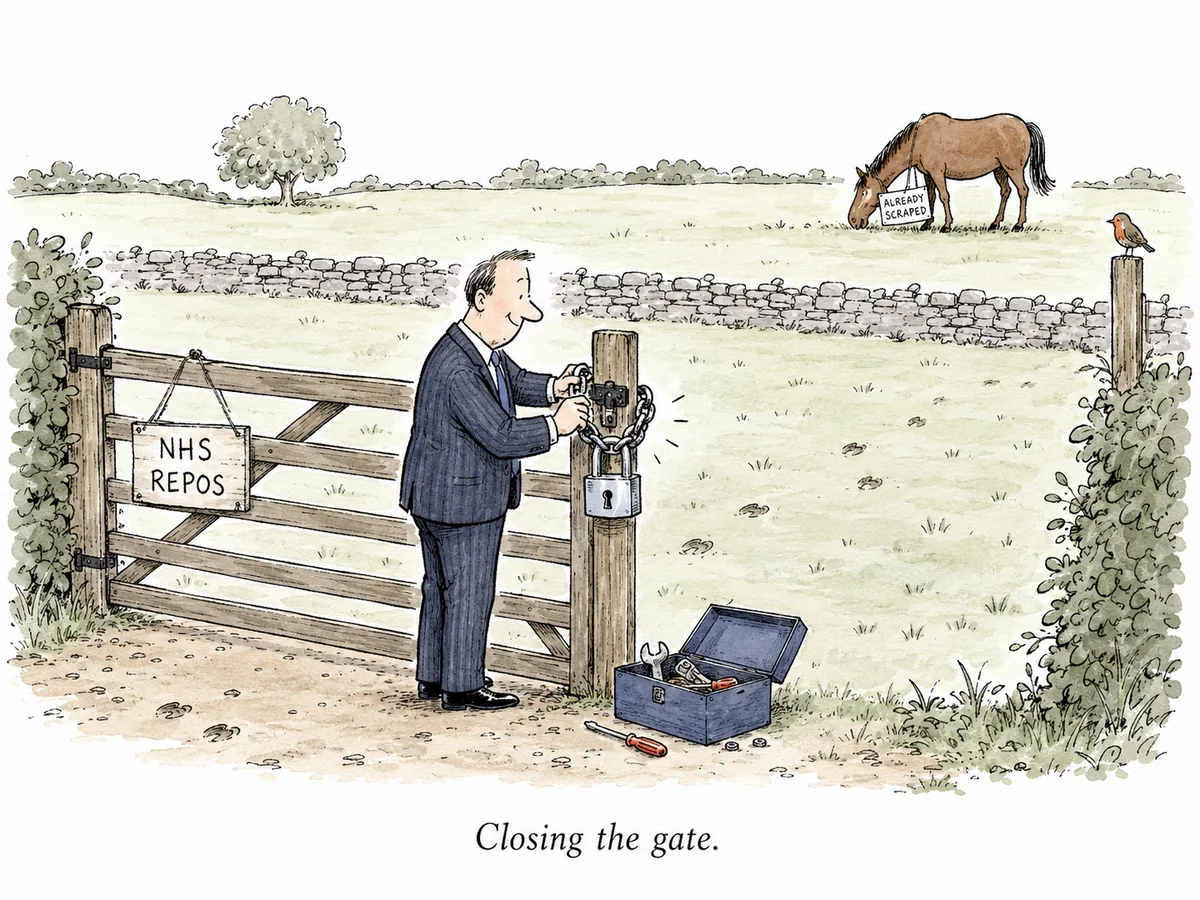
The code has already been read. Anthropic, which trained Mythos, has been hoovering up open source code for years. So has every other AI company. So have hundreds of digital archives and individual hoarders. If Mythos can find vulnerabilities in the NHS code by reading it, Mythos has already read it. Closing the door now does nothing about a horse that left the field years ago.
The code being closed source is not actually safer. The same AI tools work just as well on closed source software. They can analyse the binaries that run on a server. They can probe a live website. The premise that “if our code is private, AI can’t find bugs in it” is, on its face, not how any of this works.
Neither the UK’s AI Safety Institute9 nor the NCSC10 has recommended that organisations close their open source code in response to Mythos. NHS England has done it on its own initiative, citing a threat that the country’s actual security experts have not endorsed.
The biggest piece of evidence sits in living memory. The NHS COVID Contact Tracing app, the most scrutinised piece of NHS software in living memory, used by tens of millions of people, the target of every hostile cyber actor on the planet, was open sourced the day it launched. It produced exactly zero security incidents from the code being public. NHS England’s own engineers know this because they made that decision deliberately at the time.
Eden has filed a Freedom of Information request11 asking NHSE for the technical reasoning behind SDLC-8. We will see what comes back.
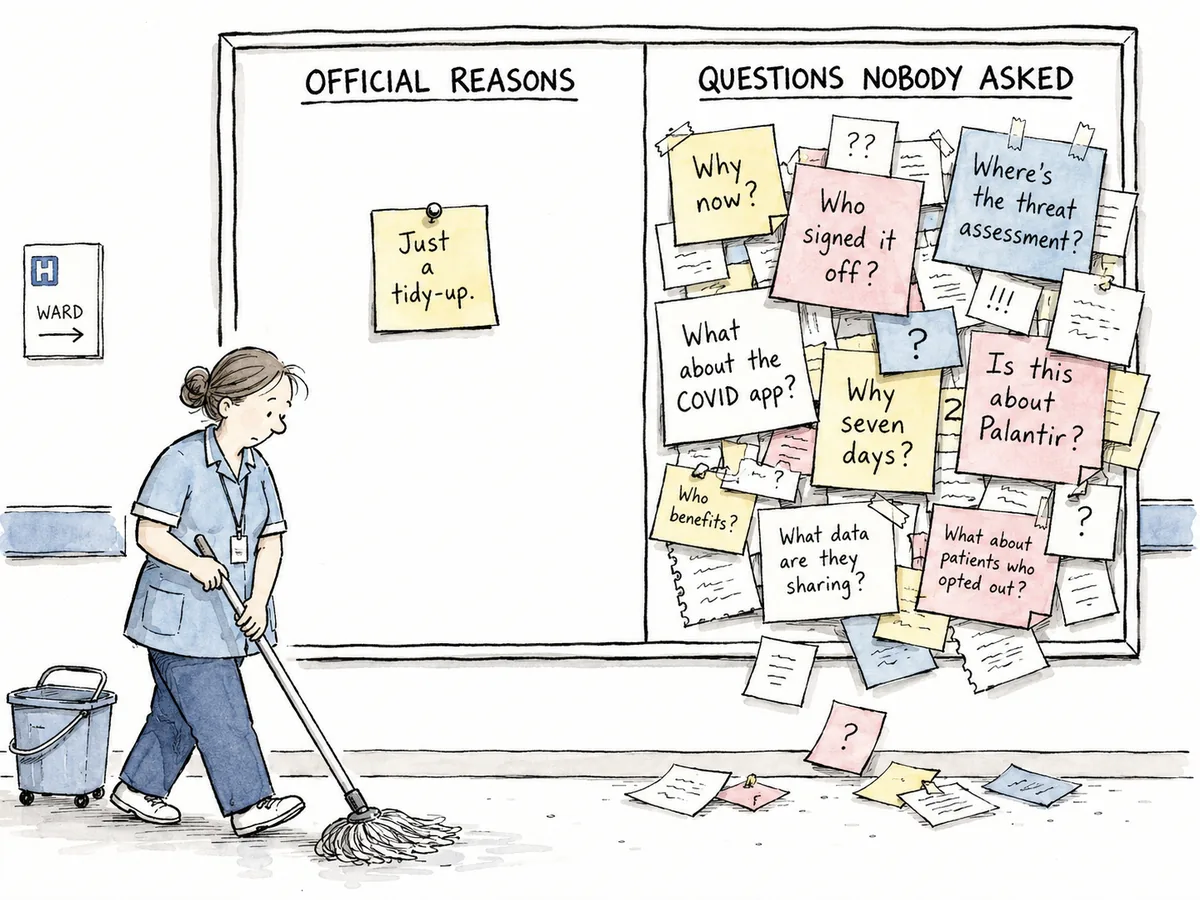
In the meantime, the simplest version of where we are: the official reason makes no technical sense, contradicts the country’s actual security expertise, and overrides at least five existing pieces of UK government policy on the open web. So the question isn’t “is Mythos really that scary?” The question is what story actually fits the facts.
The story that actually fits
On 22 December 2025, Digital Health News reported that NHS England had quietly deleted its open source policy pages12 from its website. No announcement. No consultation. The pages just disappeared. The clinician Marcus Baw, who has been writing about NHS digital policy for years, raised the alarm.
NHS England’s official line was that the deletion was a routine clean-up exercise from the 2021 reorganisation when NHSX was folded into NHSE. A different NHSE source told the same journalist the real reasons were “security concerns and because NHSE does not believe it has the capacity to maintain” open source software. Note the date: 22 December 2025. Mythos didn’t exist yet. It would be announced four months later.
The same week the policy pages came down, three other things happened. The Guardian published an investigation into UK Palantir contracts after MPs raised security concerns. Health Service Journal reported that Palantir’s £330 million NHS Federated Data Platform was reaching only a handful of trusts. And Health Service Journal reported that an AI tool inside that same platform was at the centre of a regulatory row.
I want to be careful here. I cannot prove these are connected. I have no document showing “we are removing the open source policy because the Palantir contract is in trouble.” That kind of paper trail rarely exists, and when it does, it doesn’t survive long.
What I can say is that the December 2025 retreat from open source policy preceded Mythos by four months. Mythos is the public justification for what NHS England is doing in May 2026. It is not the reason the direction of travel changed. The direction had already changed, in the same week as a Palantir story.
And Mythos arrived just in time to provide an excuse that sounded better than “we don’t think we can keep up the policy.”
Why this connects to Palantir
I have written a few times about Palantir. The first time was the Seeing Stones piece13, on how a CIA-funded surveillance company ended up running the NHS’s data. The second was Land and Expand14, on how the same company moved from the NHS into the Financial Conduct Authority. The third was The Man Who Sold England’s Data15, on the man doing all the dinners and handshakes that made it happen. If any of this is new to you, those pieces are the background.
The Federated Data Platform is the thing in the NHS that Palantir runs. It is a £330 million contract, signed in November 2023, designed to pull NHS data from across hospitals and other services into one system that helps with things like waiting lists, theatre scheduling, and discharge planning. The contract is controversial for many reasons: the company’s other clients (US Immigration and Customs Enforcement, the Pentagon, the Israeli Defence Forces, various intelligence agencies), the contract structure (which Liberal Democrat MP Martin Wrigley described in Parliament as “a permanent lock-in” with “no software, not one line”16 remaining with the NHS at the end), and the question of whether NHS data opt-outs even apply to it.
Palantir’s own code was never on NHS GitHub. It was never going to be. Palantir is a private US company and its software is proprietary. You can’t see it.
What was on NHS GitHub was the surrounding infrastructure: the data pipelines feeding the FDP, the integration code, the ways the NHS has had to bend its own systems to plug into Palantir’s. That code is what tells you, if you read it carefully, what’s actually being shared, with whom, and how. It’s the wiring diagram.
Closing the repos doesn’t change the data Palantir gets. It changes what the public can see about how the wiring works.
The Palantir contract is at its weakest point right now
This bit matters because it explains why the timing isn’t just suspicious in the abstract. It’s suspicious in a very specific way.
The Federated Data Platform is in trouble. By February 2025, NHS England was claiming 96 trusts (about 40%) had “signed up” to the platform. When Corporate Watch FOI’d them17, it turned out that only 34 trusts (about 15%) were actually using it. The other 62 had just “signalled their intent.”
The reason most trusts haven’t adopted it is not technical mystery. The trusts have explained, repeatedly and on the record. Leeds Teaching Hospitals wrote to NHS England saying: “From the descriptions we have of these FDP products we believe we would lose functionality rather than gain it by adopting them.” Greater Manchester’s health authority wrote that there was nothing in the FDP that “exceeds the NHS Greater Manchester local capability.” NHS staff at multiple trusts have refused to use the system on ethical grounds, given Palantir’s other clients.
The British Medical Association passed a motion against the FDP at its 2025 AGM. In February 202618 it went further and told doctors to limit their engagement with the platform, citing concerns about Palantir’s role in providing software to ICE.
The Good Law Project’s “Say No to Palantir” campaign has had around 50,000 patients19 write to their local trust boards opposing the platform. A coalition of public interest groups, including the Good Law Project, Privacy International, Just Treatment, Corporate Watch, and Amnesty International, published a briefing through Medact20 in March 2026 urging trust boards not to adopt.
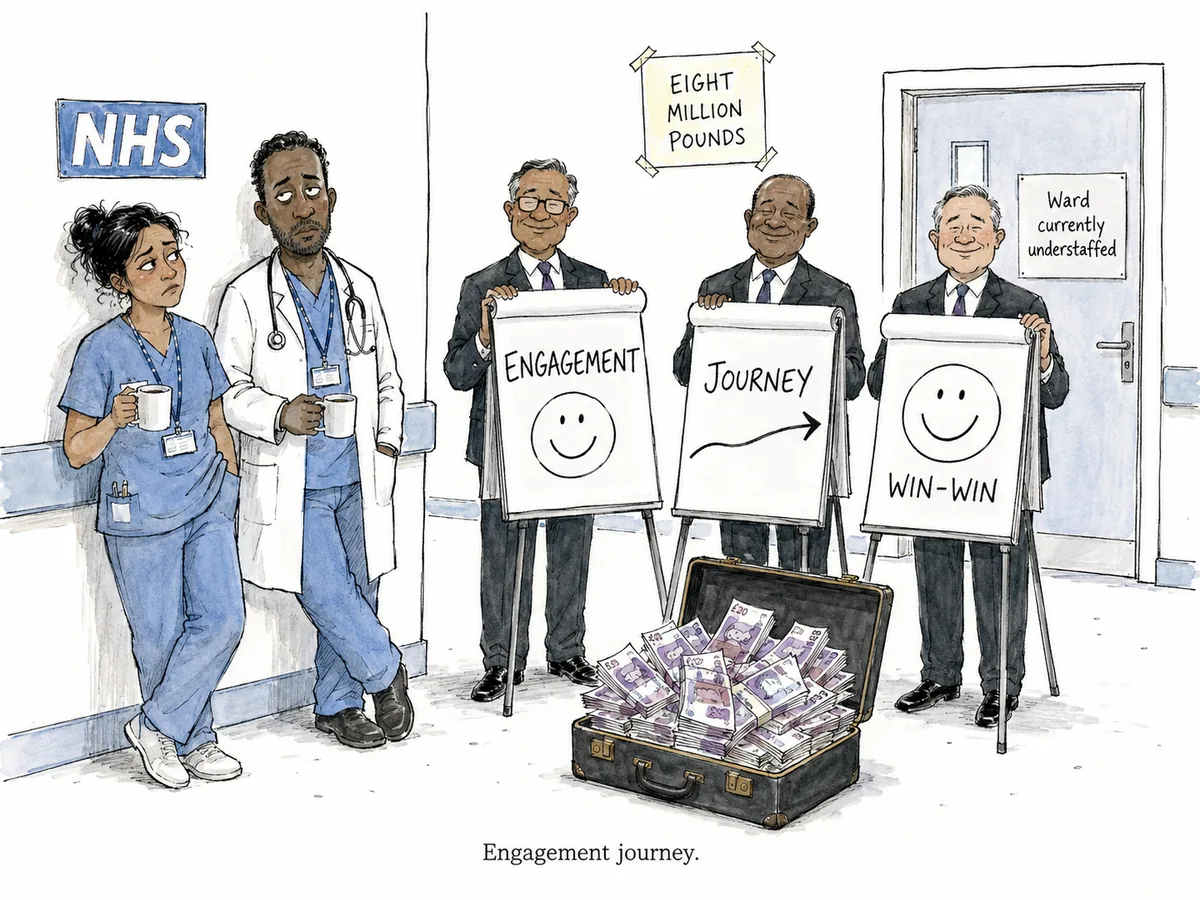
The Department of Health quietly gave KPMG an £8 million contract to “promote adoption” of the platform. Take a moment with that. Eight million pounds of consultancy money to convince frontline NHS staff to use software the NHS has already paid £330 million for.
And the break clause in the Palantir contract is live. Health Minister Zubir Ahmed has confirmed that the option to terminate the seven-year contract in early 2027 is, as he put it, “being weighed up as a possible option.”21
So a contract that was sold to the public as transformative is, in fact, being rejected by the people who use it, the people whose data goes into it, and the trusts being told to adopt it. The political pressure is at its highest point ever. The break clause is being seriously considered. And right at this moment, the public’s main tool for scrutinising the NHS data architecture, the open source repositories, is being switched off.
I am not going to sit here and tell you that’s definitely the reason. I genuinely don’t know what the reason is. What I’d say is: if you wanted to reduce public scrutiny of a specific contract at a specific moment, this is what doing that would look like.
And there’s the small matter of NHS England being abolished
Speaking of timing. On 13 March 2025, in a speech in the House of Commons22, the Health Secretary Wes Streeting announced that NHS England, the arms-length body that has run the NHS in England since 2013, would be abolished. The workforce is being halved from around 13,000 to 6,500. Functions are being absorbed back into the Department of Health and Social Care, which Streeting runs directly. The Institute for Government23 has been tracking the chaos of the transition for over a year.
What this means in practice is that political accountability for NHS data decisions, including everything Palantir does, is shifting from an arms-length body to a politician. Wes Streeting personally, in due course, becomes the joint data controller for everything in the FDP. Decisions that used to sit with NHS England’s board now sit with the Secretary of State.
This is the institutional context in which a memo overriding fifteen years of open source policy gets issued with seven days’ notice. NHS England is half-shut. Its leadership has been replaced. Its workforce is being cut. The Engineering Board issuing SDLC-8 is doing so during the most disorganised period in NHS England’s existence.
If you wanted to make a major policy change with as little scrutiny as possible, this is when you’d do it.
Why this matters even if you don’t care about code
Most people don’t care about code. Most people shouldn’t have to. The reason this matters to people who don’t write software for a living is that open source is one of the few mechanisms that lets ordinary people see what’s been built with their money.
If a small charity wants to know how the NHS records something. If a journalist wants to check whether a contract is actually doing what was promised. If an MP’s office wants to understand whether a system exists at all. If a researcher wants to study the digital infrastructure of British healthcare. If another country wants to learn from what works. All of that has, until now, been possible because the code was visible.
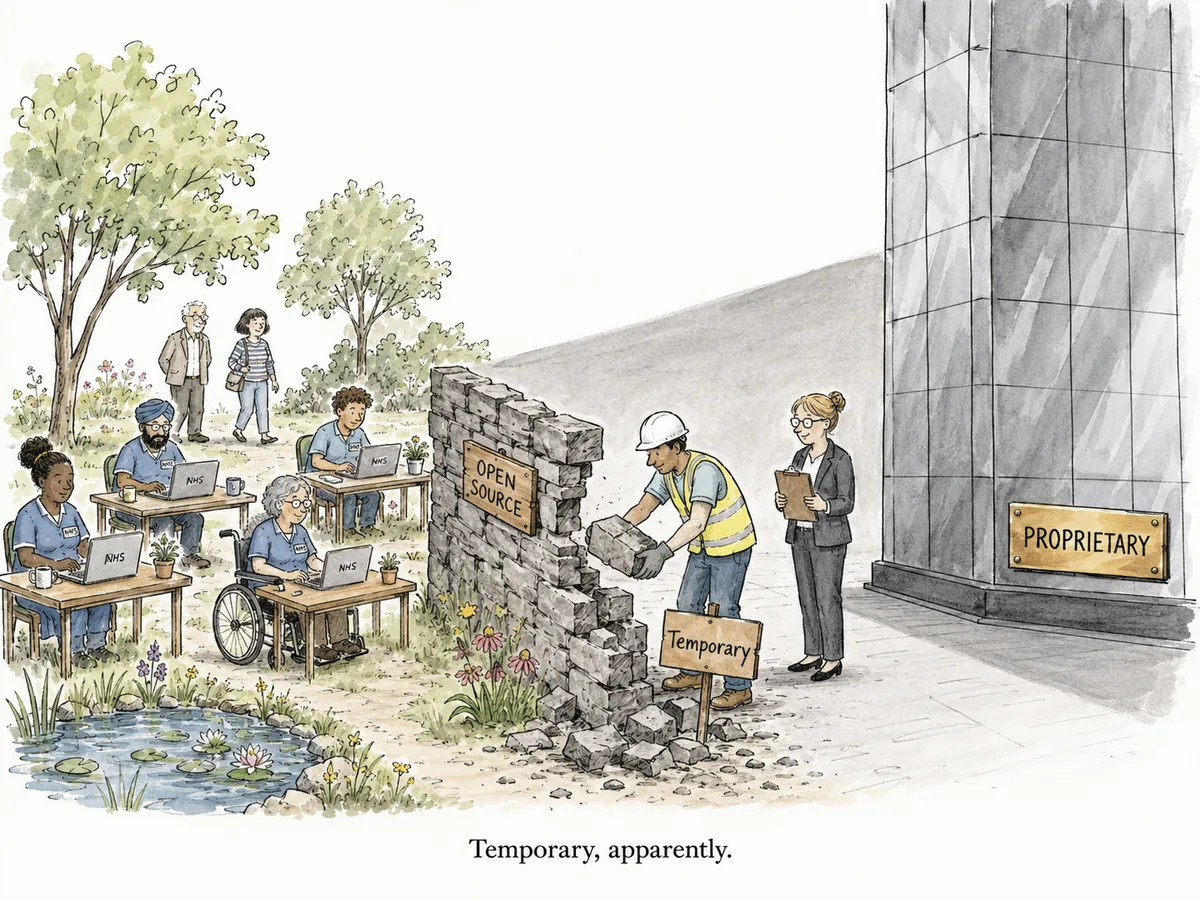
When you turn it off, you don’t just affect developers. You blind everyone who funds the NHS. You also break the mechanism that prevents lock-in to a single supplier, because once nobody outside the NHS knows how the integration works, replacing the supplier becomes an act of archaeology rather than engineering.
The Palantir contract is the textbook case for why open source matters in public infrastructure. Martin Wrigley made the point in Parliament in April: “All the specially written software and intellectual property rights belong to the supplier. The contract delivers no software, not one line, just a subscribed service; a permanent lock-in; a single point of failure.” The opposite of that, structurally, is open source. NHS open source has been one of the few practical bulwarks against the kind of contract that leaves the NHS owning nothing at the end. That bulwark is what’s being switched off on Monday.
What’s going right (because there’s quite a lot)
I always promise to leave readers with something to be hopeful about, and on this one there’s a lot to be hopeful about.
The trusts have already been refusing the FDP. This is the most important thing in the story and it should be celebrated. Greater Manchester. Leeds. Guy’s and St Thomas’. UCLH. Royal Free. Sheffield Teaching Hospitals. Nottingham. Birmingham. Frimley. The biggest and best-resourced digital teams in the NHS have looked at the platform, looked at the company, looked at the contract, and said no. They are why the contract is in trouble. Their refusal has done more to protect the NHS data architecture than any minister.
NHS staff are leaking. The SDLC-8 memo got to Eden because multiple people inside NHS England independently sent it to him. That’s not one disgruntled engineer. That’s a workforce. The institution is half-shut down, but the conscience of the people inside it is wide awake.
The doctors are organising. The BMA’s February 2026 motion telling doctors to limit FDP engagement is a serious institutional act. So is the Medact briefing. So is the open letter. So is the Hansard debate.
The patients are organising. Fifty thousand letters to trust boards is a real number. The Good Law Project’s “Say No to Palantir” campaign has built a coalition with Foxglove, Privacy International, Just Treatment, Corporate Watch, the United Tech and Allied Workers Union, Amnesty International and Keep Our NHS Public.
The break clause is live. The Health Minister has confirmed it. Whether the government activates it is up to the political pressure between now and early 2027, and the political pressure is what gets generated by exactly this sort of public attention.
The code is backed up. Eden and a network of volunteers have already mirrored every NHS open source repository. The licences allow it. If the originals go private on Monday, the public version persists somewhere on the open internet.
And the petition exists. keepthingsopen.com is the campaign asking NHS England to reverse SDLC-8.
Useful resources
- Keep Things Open: petition asking NHS England to reverse SDLC-8
- Write To Them: easy way to email your MP, no envelope required
- Good Law Project: behind the Say No to Palantir campaign
- Foxglove: legal charity working on data sovereignty
- Medact briefing on Palantir and the NHS: the document being sent to trust boards
- Eden’s FOI request: track the response from NHS England here
What you can do today
If you have ten minutes:
Sign the keepthingsopen.com petition. Email your MP through writetothem.com and tell them that you don’t want your NHS code closed off, especially given who’s now sitting inside it. Forward this article, or one of Eden’s two24 on the same subject, to anyone you know who works in tech, government, or healthcare. They will recognise what’s happening.
If you have an hour, read the Palantir series on this site, beginning with The Seeing Stones13. The pieces about the FCA and Louis Mosley sit alongside it. None of this story is in isolation. It is a piece of a much bigger picture about what’s happened to British public infrastructure in the last few years.
If you have actual power inside the NHS or DHSC and you’re reading this: you can refuse. The trusts already are. The doctors already are. The data analysts already are. You’re allowed to be one of them.
Closing
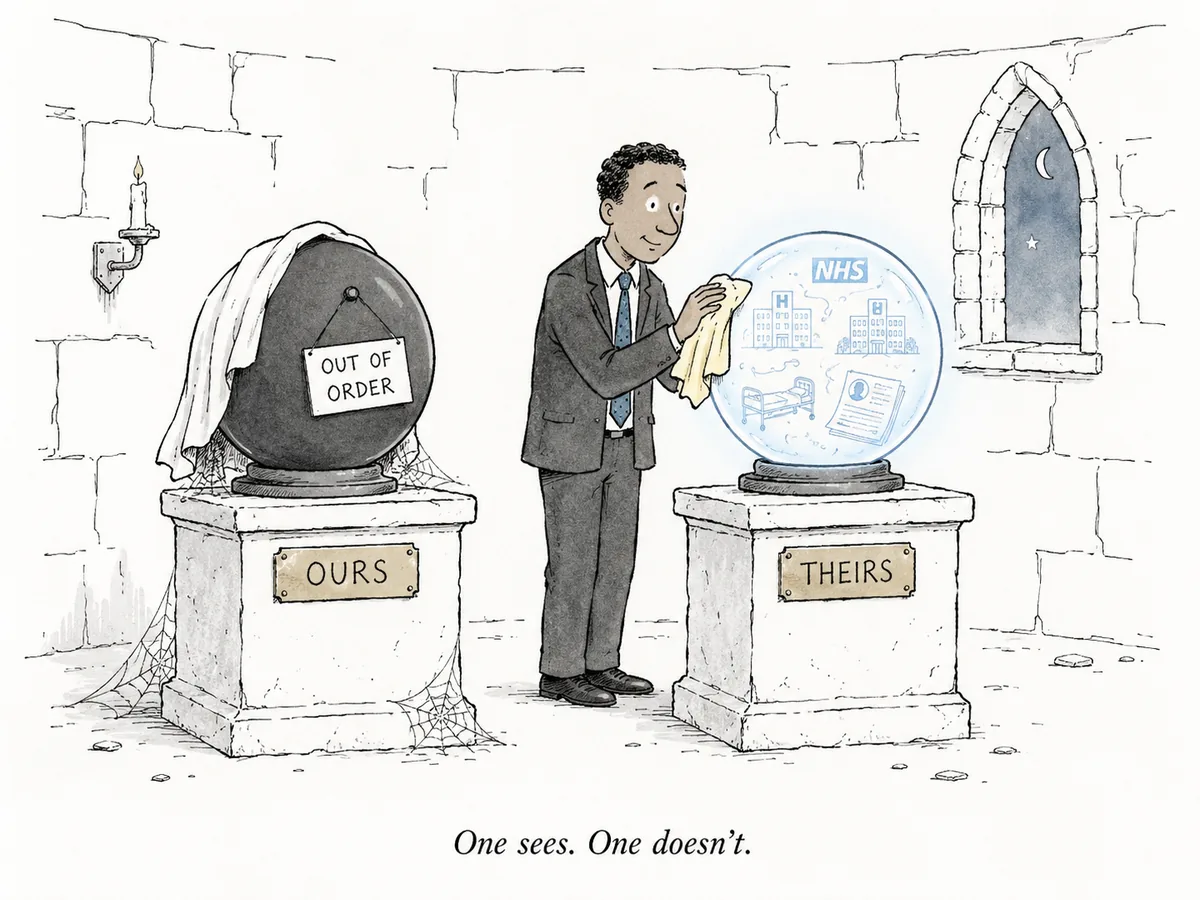
The reason Palantir is called Palantir is that the founders are Lord of the Rings fans. In Tolkien, a palantir is a seeing stone, an object that lets its holder see distant places and watch from afar. The dark joke of the company name has been pointed out for years: a surveillance company named after a magical surveillance object. Their seeing stones watch us.
What’s been happening, less remarked on, is that the public had its own seeing stone. The open source policy was a way for ordinary people to look back. To see how the systems we paid for actually worked. To check the wiring. To watch the watchers, in a small but real way.
On Monday, the public seeing stone goes dark. Theirs stays on. That isn’t, in my view, an accident of timing. And it certainly isn’t temporary in any meaningful sense, regardless of what the press release says, because the policies it overrides are not coming back without a fight.
The fight, fortunately, is already happening. It’s happening in the trusts that refuse to plug in. In the doctors saying no. In the engineers leaking memos. In the patients writing letters. In the MPs reading Hansard speeches. In a former NHS open source lead with an FOI form and a website. In the people who have already mirrored every single repository before the deadline.
The view from outside might be about to go dark. The people inside aren’t going anywhere.
References
- Terence Eden’s blog: NHS Goes To War Against Open Source, with leaked SDLC-8 memo image, 1 May 2026. https://shkspr.mobi/blog/2026/05/nhs-goes-to-war-against-open-source/
- Anthropic: Project Glasswing, official launch page, April 2026. https://www.anthropic.com/glasswing
- Gov.uk: Technology Code of Practice, point 3 “Be open and use open source”. https://www.gov.uk/guidance/the-technology-code-of-practice
- Gov.uk Service Manual: Making source code open and reusable. https://www.gov.uk/service-manual/technology/making-source-code-open-and-reusable
- NHS Service Manual: Service Standard point 12, Make new source code open. https://service-manual.nhs.uk/standards-and-technology/service-standard-points/12-make-new-source-code-open
- Department of Health and Social Care: Data Saves Lives strategy, commitment 601. https://www.gov.uk/government/publications/data-saves-lives-reshaping-health-and-social-care-with-data/data-saves-lives-reshaping-health-and-social-care-with-data
- Bruce Schneier: On Anthropic’s Mythos Preview and Project Glasswing, 13 April 2026. https://www.schneier.com/blog/archives/2026/04/on-anthropics-mythos-preview-and-project-glasswing.html
- Terence Eden’s blog: Does Mythos mean you need to shut down your Open Source repositories?, 24 April 2026. https://shkspr.mobi/blog/2026/04/does-mythos-mean-you-need-to-shut-down-your-open-source-repos/
- UK AI Safety Institute: Evaluation of Claude Mythos Preview’s cyber capabilities, April 2026. https://www.aisi.gov.uk/blog/our-evaluation-of-claude-mythos-previews-cyber-capabilities
- NCSC: Why cyber defenders need to be ready for frontier AI, 2026. https://www.ncsc.gov.uk/blogs/why-cyber-defenders-need-to-be-ready-for-frontier-ai
- WhatDoTheyKnow: Eden FOI request to NHS England re SDLC-8 guidance. https://www.whatdotheyknow.com/request/information_relating_to_guidance_2
- Digital Health News: NHS England quietly removes open source policy web pages, 22 December 2025. https://www.digitalhealth.net/2025/12/nhs-england-quietly-removes-open-source-policy-web-pages/
- chloegeorge.co.uk: The Seeing Stones: How a CIA-Funded Surveillance Company Ended Up Running the NHS, March 2026. https://chloegeorge.co.uk/palantir-nhs-seeing-stones/
- chloegeorge.co.uk: Land and Expand: How Palantir Swam Into the FCA’s Data Lake, March 2026. https://chloegeorge.co.uk/palantir-fca-data-lake/
- chloegeorge.co.uk: The Man Who Sold England’s Data (And Got a Seat on the Board), April 2026. https://chloegeorge.co.uk/louis-mosley-palantir-uk/
- Hansard: NHS Federated Data Platform debate, 16 April 2026, including Martin Wrigley MP intervention. https://hansard.parliament.uk/commons/2026-04-16/debates/2FDCA71C-D0C1-4738-BEE8-A4BDA311DB99/NHSFederatedDataPlatform
- Corporate Watch: FOI requests reveal Palantir’s NHS FDP rollout failures, August 2025. https://corporatewatch.org/foi-requests-reveal-palantirs-nhs-fdp-rollout-failures/
- Digital Health News: BMA calls for NHS doctors to reject using the FDP, February 2026. https://www.digitalhealth.net/2026/02/bma-calls-for-nhs-doctors-to-reject-using-the-fdp/
- The Lowdown NHS: Palantir, the controversy, the contracts and the campaign, April 2026. https://lowdownnhs.info/topics/accountablility/palantir-the-controversy-the-contracts-and-the-campaign/
- Medact: Briefing on Palantir Technologies and NHS Data Systems, March 2026. https://www.medact.org/2026/resources/briefings/briefing-palantir-fdp/
- TechRadar: Palantir could be forced to exit NHS after pushback from staff, MPs, unions and pressure groups, April 2026. https://www.techradar.com/pro/security/nhs-users-report-that-it-is-awful-to-use-palantir-could-be-forced-to-exit-nhs-after-pushback-from-staff-mps-unions-and-pressure-groups-over-federated-data-platform
- Gov.uk: NHS England, Health and Social Care Secretary’s statement, 13 March 2025. https://www.gov.uk/government/speeches/nhs-england-health-and-social-care-secretarys-statement
- Institute for Government: One year on from the decision to abolish NHS England, 26 March 2026. https://www.instituteforgovernment.org.uk/comment/one-year-abolish-nhs-england
- Terence Eden’s blog: collected coverage on the NHS open source closure. https://shkspr.mobi/blog/tag/open-source/