This piece exists because of a Telegraph article I didn’t read.
Last week, Matthew Lesh, who runs public policy at the Institute of Economic Affairs, published a piece in the Telegraph headlined “In defence of Palantir”1. The standfirst read: “The American company provides an invaluable service to the British taxpayer.” The photo caption ran: “It’s hard to avoid the reality that the opponents of Palantir would prefer that patients die rather than use the best available piece of software.”
I don’t have a Telegraph subscription. For reasons I won’t bore you with, but which you can probably guess. The headline and the standfirst and the photo caption were enough. Three sentences of free-tier journalism told me the entire argument: critics of Palantir are letting people die, the American company is doing British taxpayers a service, and anyone who disagrees is, by implication, in bad faith.
That is a strong claim. It rests, almost entirely, on one figure. So I went looking for that figure.
If you’ve read anything in defence of Palantir’s NHS contract in the last year, you’ll have noticed it doing all the heavy lifting: 110,000 additional operations. Sometimes paired with a 6.8% lift in cancer diagnoses and a 15.3% reduction in discharge delays. The number is the load-bearing wall of the whole pro-Palantir argument. Pull it out and the rest of the building wobbles.
So let’s pull it out.
This piece is about three things. Where the 110,000 figure actually comes from, how the £1 contract that started this story became a £330 million one, and why £8.5 million of taxpayer money has been spent paying KPMG to convince NHS trusts to use software those trusts had already publicly said was worse than what they had. There’s a brief detour through US extraterritorial law and a CEO who has openly daydreamed about drone-spraying his critics with fentanyl. Stay with me.
The 110,000 figure is supplier marketing, not evidence
The first thing to know about the 110,000 figure is that it comes from Palantir. It is repeated by NHS England, repeated by Telegraph columnists, repeated until it sounds like a fact. The most recent public source for it is Louis Mosley, executive vice-chair of Palantir UK2 (a man I’ve written about at length elsewhere3), defending the contract against the break clause being triggered. He is not what you’d call a neutral party on whether his own company’s software works.
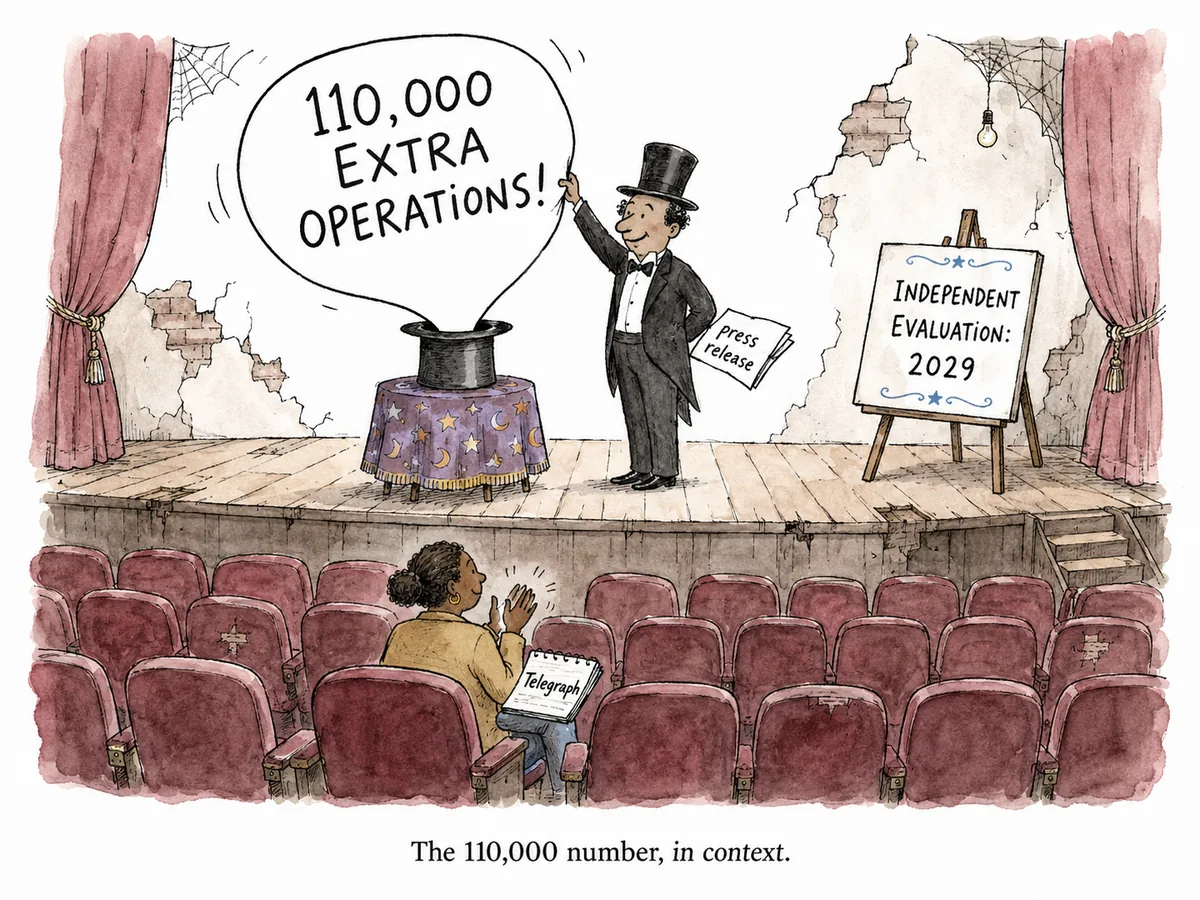
An actual independent evaluation hasn’t started reporting yet. NHS England awarded Imperial College Projects a £700,000 contract in February 2026 to evaluate the Federated Data Platform.4 It is a three-year study. Findings expected in 2029. So when someone tells you Palantir is delivering for the NHS, what they mean is “Palantir says Palantir is delivering for the NHS, and the body assessing whether that’s true won’t tell us until 2029. Two years after the contract has to be renewed or scrapped.”
The cancer figure is even slipperier. It is not a 6.8% increase in cancers diagnosed. In Palantir’s own wording, it is “a 6.8% increase in the number of people finding out whether or not they have cancer within 28 days of referral”.5 That’s a workflow metric, the NHS Faster Diagnosis Standard6, which tracks whether patients are diagnosed or have cancer ruled out within 28 days of urgent referral. The fact that over 90% of those referred turn out not to have cancer7 tells you what kind of metric it really is. It tells you people are getting a yes-or-no faster. It doesn’t tell you anyone got treatment they wouldn’t have got, or lived who would otherwise have died. The slide from “more 28-day notifications” to “more cancer diagnoses” to “patients will die without Palantir” is an extraordinary distance for a single number to travel.
One study has been waved around as evidence the FDP works. It was published by the BMJ in March 20268, looked at theatre scheduling at one hospital, Chelsea and Westminster, and found that operating theatres got busier after the new system came in. NHS England describes it as the independent evidence the FDP is delivering. Several things are worth knowing about it.
The hospital where it took place is the hospital where Palantir’s scheduling tool was originally built. The study was paid for by that same hospital. Two of the ten authors work for that same hospital. None of this is hidden. The paper says all of it on its first page.
It gets less comfortable from there. The chair of the hospital throughout the period of the study, Matthew Swindells, was also working for Palantir as a paid adviser through Peter Mandelson’s lobbying firm, Global Counsel9. Dr Justin Whatling, who sat on the innovation board of the hospital’s official charity, was simultaneously Palantir’s UK head of healthcare10. So the people running the hospital that built the product, paid for the study, and supplied the data were also working for Palantir. None of those Palantir connections appear in the study’s conflict-of-interest section.
The study itself can’t actually tell us whether the new system did anything. Here’s why.
In December 2021, a Covid wave hit. NHS staff got sick in huge numbers, operations got cancelled across the country, and performance crashed. By January 2022, the wave was fading and the NHS was starting to recover. That same month, Chelsea and Westminster switched on the Palantir scheduling tool. Over the following months, performance got better. The study attributes that improvement to the tool.
But the NHS was getting better anyway. Everywhere. It was bouncing back from Covid, not because of any new software. The authors of the study admit this in their own paper. They can’t separate what the tool did from what the recovery did. Their study had no comparison group, no other hospital to check against.
A month after the paper came out, the BMJ published a separate analysis. This one did have a comparison group. It compared Chelsea and Westminster with trusts in the same region that hadn’t adopted Palantir’s system. They followed the same recovery curve. As Lib Dem MP Martin Wrigley summarised it on the floor of the Commons11, the BMJ analysis “shows the benefits to be exaggerated and untrue”. The Chelsea and Westminster recovery wasn’t a Palantir effect. It was just the recovery.
Cancellations are worth a note too. The whole point of better surgical scheduling is supposed to be fewer same-day cancellations. The study found cancellation rates didn’t fall. By its own data, the weekly median was 5.2% before the tool was introduced, and 5.2% after.
So the evidence base, fairly stated, is this. One study at one hospital, funded by the hospital, conducted by a team that included two of the hospital’s employees, in a setting whose senior leadership was simultaneously working for Palantir, with the authors themselves admitting they can’t separate the tool’s effect from a Covid recovery. One BMJ follow-up that added a comparison and found no Palantir-specific effect. And one genuinely independent evaluation, by a different Imperial team, that won’t report until 2029. That is what £330 million is buying.
How £1 became £330 million
The £1 contract is a beautiful piece of corporate strategy if you don’t think about it too hard, and a master class in how to capture a public institution if you do.
The official story is that in March 2020, in the chaos of the first COVID lockdown, the NHS needed a data platform fast and a public-spirited American company stepped up for the price of a Freddo. Palantir charged just £1 for use of its Foundry software. There was no competitive tender12 because of emergency procurement rules.
The actual story, published by the Bureau of Investigative Journalism in 202113, is that internal UK government documents disclosed under FOI showed Palantir had been “wooing” NHS chiefs since summer 2019. By January 2020, before COVID was on anyone’s radar, Palantir’s London team were already working on a product “exclusively focused” on the UK’s healthcare market. That isn’t an emergency response. That’s an opportunity that arrived right on cue. I traced this whole story earlier this year in The Seeing Stones14.
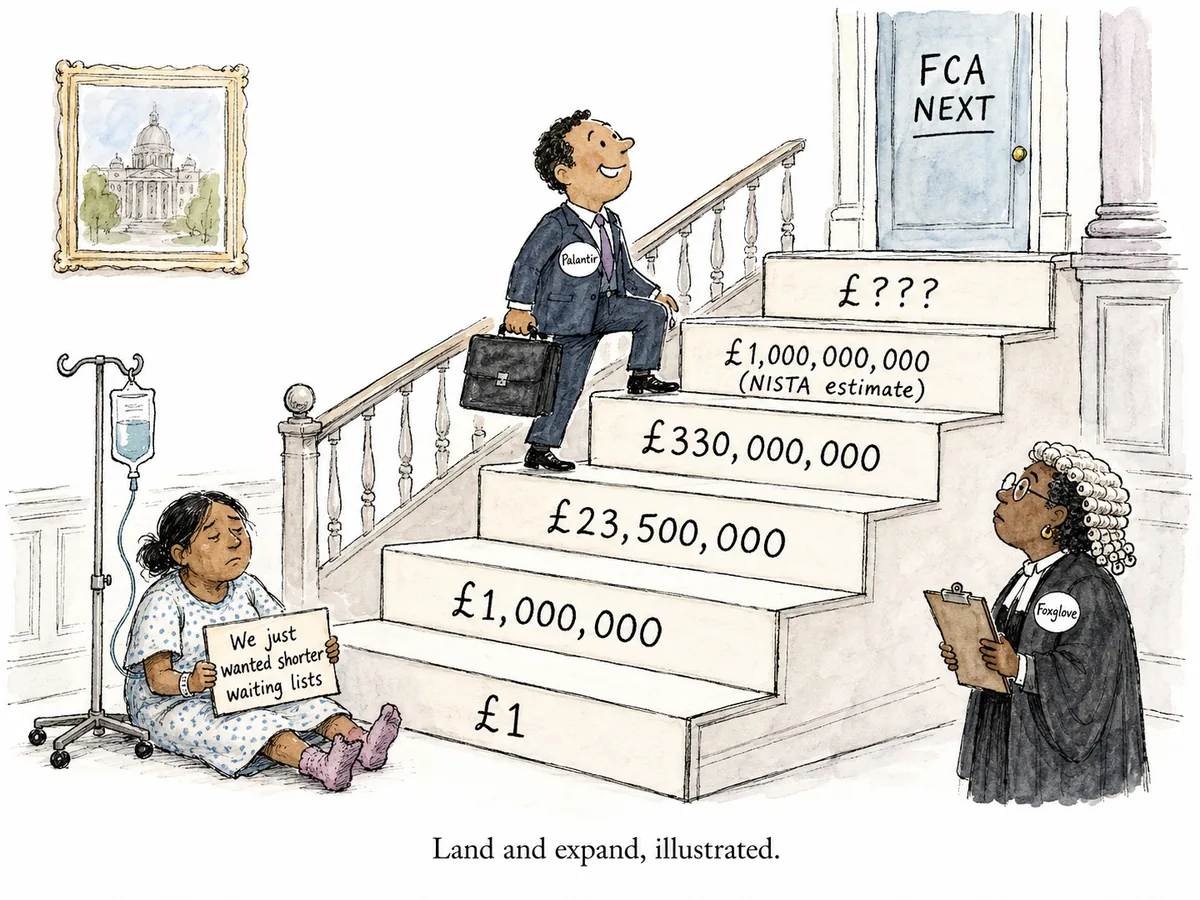
The £1 ran for three months. Then it was extended for £1 million. Then it became a £23.5 million two-year contract15 in December 2020, awarded under the G-Cloud framework which doesn’t require a published tender. The campaigning group Foxglove had to threaten legal action just to make the government publish that contract.
By November 2023, the £1 had become £330 million for the Federated Data Platform. The contract was published in late December 2023 with three-quarters of its 586 pages redacted, including most sections on data protection.16 The Good Law Project is suing over the redactions.
This pattern has a name in tech procurement. It’s called land and expand. Get in cheap. Get embedded. Renegotiate from a position of strength because you’re now the incumbent. Rinse, repeat, charge a premium. It’s a perfectly fine sales strategy if you’re selling pizzas. It’s a different thing entirely if you’re selling software that processes the medical records of 56 million people.
The £8.5 million sales operation
This is the bit that should make every taxpayer pause for a moment.
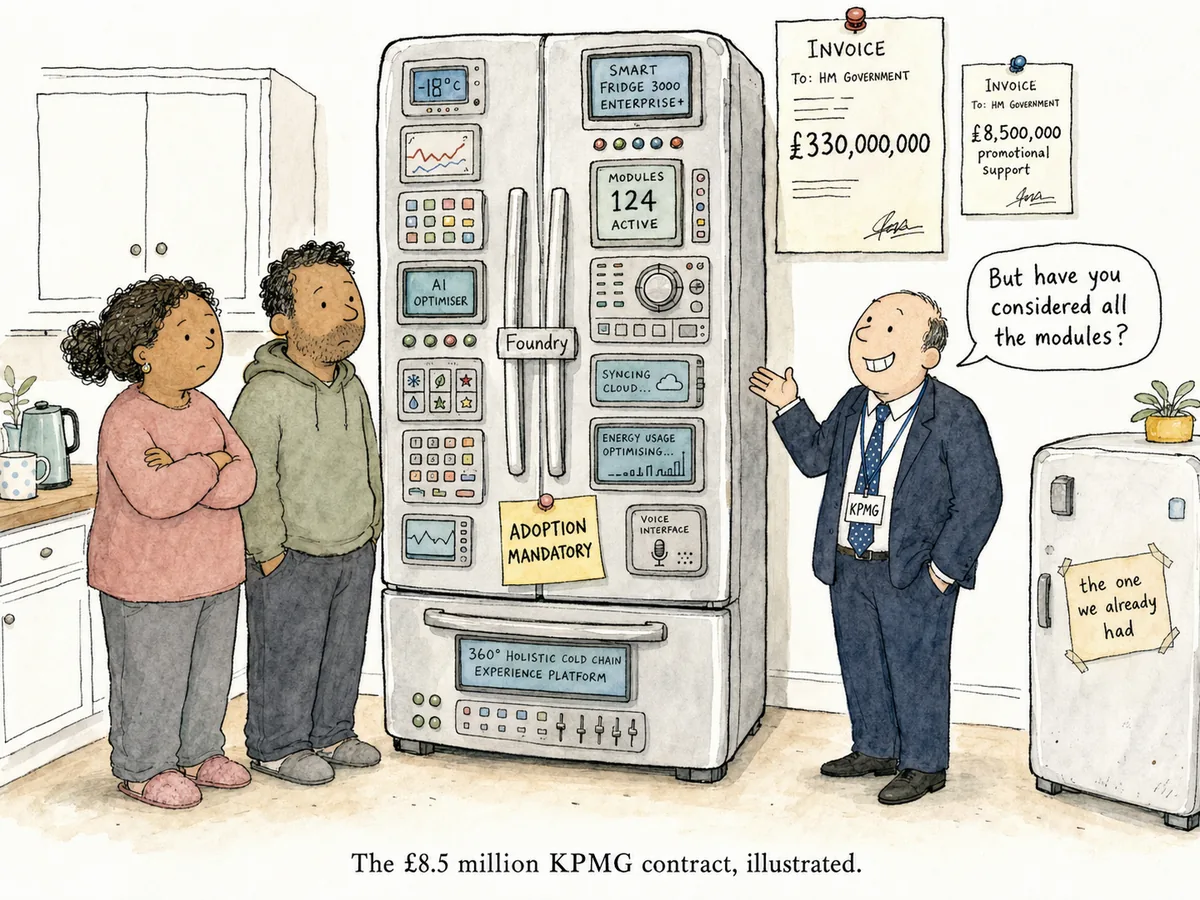
In April 2024, NHS England awarded an £8.5 million contract to KPMG to “promote the adoption” of the Federated Data Platform17 across NHS trusts. Those are the actual words in the procurement documents. Promote. The. Adoption.
Why did promotion need to be paid for? Because trusts kept saying no. Greater Manchester’s health authority said in writing that there were “no products designed or produced by Palantir Technologies Inc. as part of the FDP programme that exceed the NHS Greater Manchester local capability.”18 Translation: it isn’t as good as what we already have.
Leeds Teaching Hospitals, which oversees seven hospitals and treats 1.5 million patients a year, told NHS England in writing that adopting Palantir’s tools would mean they “would lose functionality rather than gain it by adopting them.” Berkshire Healthcare just said “no plans to join the FDP programme.” As of August 2025, only 34 trusts, just under 15%, were actively using the platform16.
So here is the situation, plainly stated. The government bought £330 million of software. Trusts said it was worse than what they had. The government then spent another £8.5 million paying a Big Four consultancy to convince trusts to use the worse software. In October 2025 the medium-term planning framework was changed to mandate FDP sign-up across acute, community and mental health services, and to demand that existing local data systems be removed.11 Refusal is being engineered out of the system.
I think about this in domestic terms. It is like buying a fridge, your spouse pointing out that the fridge is worse than the one you already have, you then hiring a third party to come round and explain to your spouse why actually the fridge is great, and finally, when your spouse is still unconvinced, banning them from saying anything negative about the fridge. The fridge cost more than the house.
“But surely we can’t unwind it now?”
I had this question myself. With only 15% of trusts actively using the FDP, how locked in can we really be? Quite a few people I respect think we are already past the point of no return. I don’t think they are right.
The break clause is real. A senior government source told the Financial Times in March 2026 that “we are confident we could do it if we wanted to.”2 At Digital Health Rewired the same month, Will Monaghan, group chief digital information officer at University Hospitals of Leicester and University Hospitals of Northamptonshire, said that if the NHS walked away from Palantir, trusts could “lift and shift” onto another platform, though it would be “incredibly disruptive”2. It would not be impossible. The break clause activates in February 2027.
The honest answer about lock-in goes like this. The technical lock-in for the 15% of trusts using the FDP is reversible. The architectural lock-in is harder. The way the NHS labels, defines, and connects its own data has been built around Palantir’s software. To swap it out you don’t just install a different programme. You have to rebuild the underlying language the NHS uses to talk about itself.
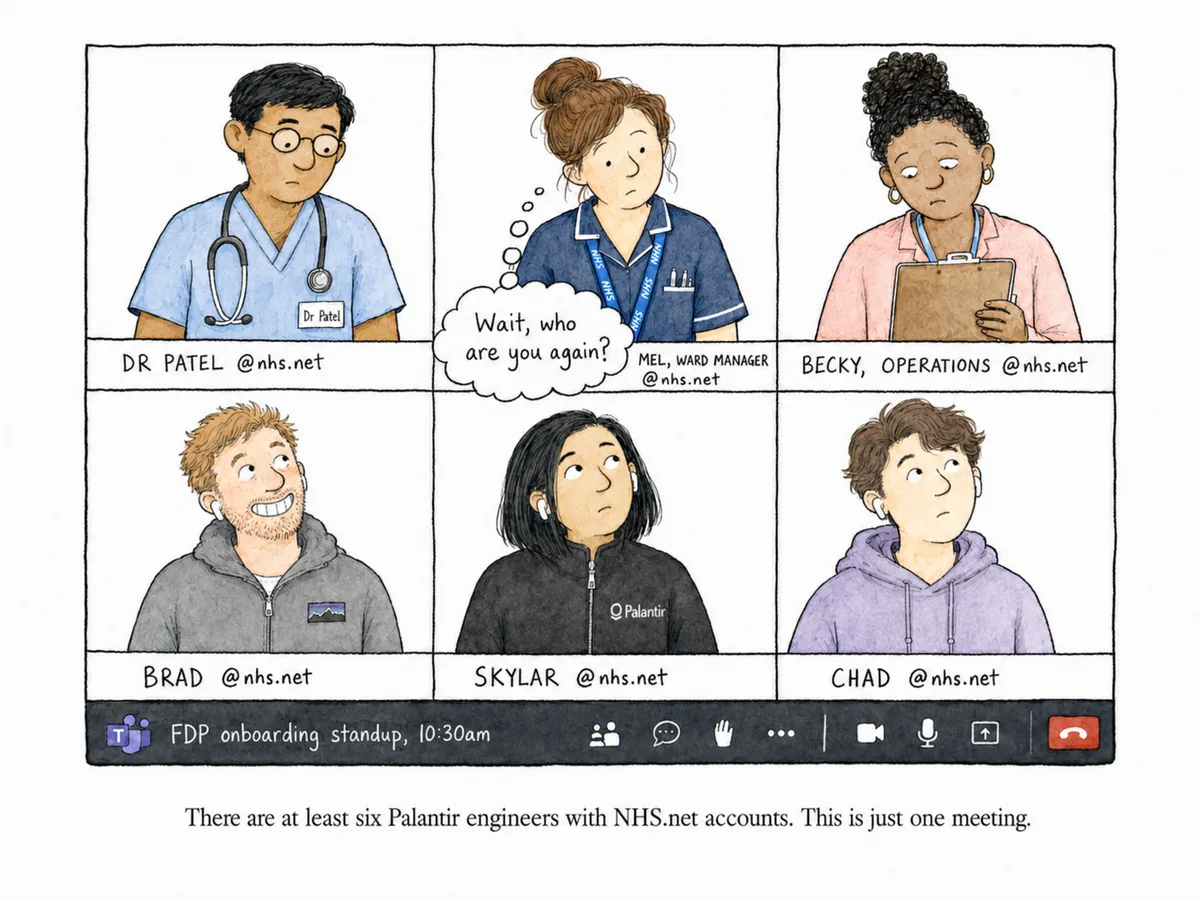
Then there is the ecosystem lock-in, which is a different kind of problem entirely. At least six Palantir engineers have been issued NHS.net email accounts5, which give them access to a directory containing the names, roles, workplaces, email addresses, and mobile numbers of up to 1.5 million NHS staff. They have access to NHS SharePoint and to internal Microsoft Teams groups. Some NHS staff have reported joining virtual meetings without realising other participants were Palantir employees, because @nhs.net email addresses made them look like internal colleagues. One resident doctor told the Guardian that he didn’t want his personal email and phone accessible to someone who “might next month be working on systems for drone strikes”. Once Palantir staff are embedded inside the NHS’s own directory, file-sharing system, and meeting rooms, removing the company stops being a procurement decision and starts being an HR exercise.
And the wider lock-in, where Palantir is also embedded in the MoD via a £240 million contract, AWE Nuclear Security Technologies via a £15 million contract, and is piloting at the FCA19, is a lock-in at the level of the British state.
So no, we are not too embedded for the FDP. We are getting more embedded every month, and the policy direction is to make adoption mandatory. Which means now is the moment to act. Not 2028.
The CLOUD Act question nobody in government wants to answer
This is the bit defenders of the contract really don’t like talking about.
The US CLOUD Act20, passed in 2018, allows US authorities to compel American companies to hand over data they hold, regardless of where in the world it is physically stored. Contractual assurances about UK data sovereignty don’t override US extraterritorial law. They can’t. They aren’t enforceable in a US court.
This is not a fringe concern. Marietje Schaake, former MEP and one of Europe’s most respected technology policy thinkers, has flagged the CLOUD Act and the Foreign Intelligence Surveillance Act as giving “law enforcement and intelligence the right to access data anywhere in the world if held by a US company”.21 The Swiss army rejected Palantir on broadly these grounds, citing concerns in an official report about “the possibility that sensitive data could be accessed by the US government and intelligence services”22. And in March 2026, two senior systems engineers working with the UK Ministry of Defence told the investigative outlet The Nerve that Palantir poses “a national security threat to the UK”. One of them, with an intelligence background, said Palantir probably now has “a complete profile on the whole UK population. At the very least I’d call that a security risk.”22
When defence minister Luke Pollard told the Commons that all data used in Palantir software “remains under the ownership of the MoD”, he was telling the technical truth about ownership and missing the point about access. UK ownership doesn’t prevent US access. That is the whole architectural problem the engineers are flagging. Contractual reassurance does nothing to solve it.
The CEO daydreaming about drone-spraying his critics
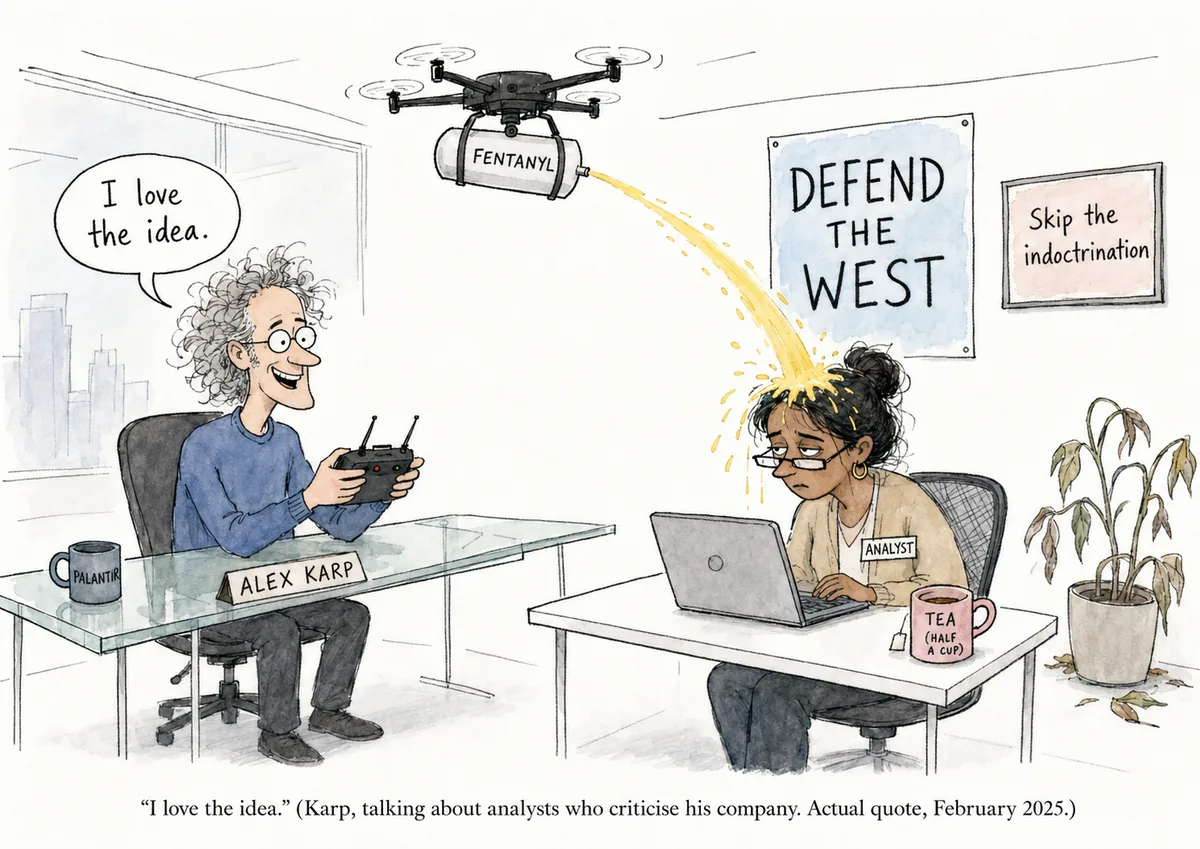
Some of you will think this section is a reach. I want to address that.
It would be easy to dismiss Alex Karp’s public statements as performance, the kind of provocative-billionaire schtick that gets attention but shouldn’t be taken seriously. I don’t think that holds, because the statements are too consistent and they map too closely to the company’s actual behaviour.
In February 2025, during a talk promoting his book, Karp said: “I love the idea of getting a drone and having light fentanyl-laced urine spraying on analysts that tried to screw us.”23 That’s the CEO of the company processing British medical records talking about how he’d like to use drones against critics. In 2026, Palantir summarised one of the arguments in Karp’s book The Technological Republic as “The postwar neutering of Germany and Japan must be undone”23. The company’s 22-point manifesto24 calls openly for the return of national service, frames AI weapons as inevitable, and rejects what it calls “the shallow temptation of a vacant and hollow pluralism.” Karp’s recruitment programme pays 22 hand-picked teenagers about $5,400 a month to skip college and study “Western civilization” at Palantir, and tells British and American school leavers to “Skip the debt. Skip the indoctrination.”25 Karp himself told the New York Times in 2024 that he and his company hold “a consistently pro-Western view, that the West has a superior way of living and organizing itself”23. The Western civilization curriculum is the political view made into a recruitment pipeline.
This is not a software vendor. It is a political project that happens to sell software. You don’t have to think Karp is a Bond villain to think the company should not be the operating system for British healthcare.
What we can do
The good news, and there is good news, is that the fight is not over and a lot of people are now in it.
38 Degrees has gathered over 229,000 signatures on petitions26 calling on the government to terminate Palantir contracts. The British Medical Association passed a motion at its 2025 AGM opposing the FDP rollout, and in February 2026 told doctors to limit their engagement with the platform. The Good Law Project is suing over the redacted contract. Foxglove is running the Say No to Palantir campaign. A serious cross-party debate in the Commons on 16 April 202611 went well beyond the usual handful of campaigners and into the genuine middle of British politics.
Useful resources
- Good Law Project: leading the legal challenge over the contract redactions
- Foxglove: the No Palantir in the NHS campaign and a clear explainer
- Medact briefing: the most thorough single document on why this matters, written for trust boards
- Write to your MP: the break clause is a political decision and your MP’s view counts
- NHS data opt-out: limited in effect, but still worth doing
The 110,000 figure isn’t a fact. It is a press release. The independent evaluation won’t tell us anything until 2029. The £1 was a wedge. The £8.5 million paid to KPMG is a quiet confession that the product can’t sell itself. The CLOUD Act exposure is real. The CEO is the CEO. NHS England, the body parroting the figures, is being abolished.
February 2027 is coming. We have time to get this right. We just have to be loud enough that the people deciding hear us over the lobbying.
References
- The Telegraph: Matthew Lesh, “In defence of Palantir”, 4 May 2026. https://www.telegraph.co.uk/news/2026/05/04/in-defence-of-palantir-peter-thiel-left-nhs-digital-health/
- Digital Health News: “Government considers use of break clause in Palantir NHS contract”, March 2026. https://www.digitalhealth.net/2026/03/government-considers-use-of-break-clause-in-palantir-nhs-contract/
- chloegeorge.co.uk: “Louis Mosley: The man who sold England’s data”. https://chloegeorge.co.uk/louis-mosley-palantir-uk/
- Digital Health News: “Imperial College Projects awarded contract to evaluate FDP”, February 2026. https://www.digitalhealth.net/2026/02/imperial-college-projects-awarded-contract-to-evaluate-fdp/
- Digital Health News: “Palantir staff being issued NHS email accounts sparks concerns”, April 2026. https://www.digitalhealth.net/2026/04/palantir-staff-being-issued-nhs-email-accounts-sparks-concerns/
- NHS England: Faster Diagnosis Standard. https://www.england.nhs.uk/cancer/faster-diagnosis/
- PubMed Central: Study showing the proportion of urgent cancer referrals that are non-cancerous. https://pmc.ncbi.nlm.nih.gov/articles/PMC11323589/
- BMJ Health & Care Informatics: Lammila-Escalera et al., evaluation of FDP scheduling tool at Chelsea and Westminster, March 2026. https://informatics.bmj.com/content/33/1/e101949
- The Lowdown: “Palantir, the controversy, the contracts and the campaign against the FDP”. https://lowdownnhs.info/topics/accountablility/palantir-the-controversy-the-contracts-and-the-campaign/
- NICE: Board members listing (Justin Whatling). https://www.nice.org.uk/about-us/our-board/board-members
- Hansard: NHS Federated Data Platform debate, 16 April 2026. https://hansard.parliament.uk/commons/2026-04-16/debates/2FDCA71C-D0C1-4738-BEE8-A4BDA311DB99/NHSFederatedDataPlatform
- CNBC: Reporting on the £1 NHS Covid-19 data store contract, June 2020. https://www.cnbc.com/2020/06/08/palantir-nhs-covid-19-data.html
- Bureau of Investigative Journalism: “Revealed: data giant given emergency Covid contract had been wooing NHS for months”, February 2021. https://www.thebureauinvestigates.com/stories/2021-02-24/revealed-data-giant-given-emergency-covid-contract-had-been-wooing-nhs-for-months
- chloegeorge.co.uk: “The Seeing Stones”. https://chloegeorge.co.uk/palantir-nhs-seeing-stones/
- Computer Weekly: Reporting on the £23.5 million Palantir NHS data store contract. https://www.computerweekly.com/news/252496953/Palantir-once-more-in-sights-of-civil-libertarians-over-NHS-Covid-data-store
- Corporate Watch: “FOI requests reveal Palantir’s NHS FDP rollout failures”. https://corporatewatch.org/foi-requests-reveal-palantirs-nhs-fdp-rollout-failures/
- Digital Health News: “NHSE awards £8.5m contract to KPMG to promote adoption of FDP”, April 2024. https://www.digitalhealth.net/2024/04/nhse-awards-8-5m-contract-to-kpmg-to-promote-adoption-of-fdp/
- The Register: Reporting on NHS Greater Manchester FDP rollout, May 2025. https://www.theregister.com/2025/05/16/nhs_hospitals_palantir/
- chloegeorge.co.uk: “Land and Expand: Palantir at the FCA”. https://chloegeorge.co.uk/palantir-fca-data-lake/
- US Department of Justice: CLOUD Act resources page. https://www.justice.gov/criminal-oia/cloud-act-resources
- Medact: Briefing on Palantir and the NHS Federated Data Platform. https://www.medact.org/2026/resources/briefings/briefing-palantir-fdp/
- The Nerve: “MoD sources warn Palantir’s role at heart of government is a threat to UK’s security”, March 2026. https://www.thenerve.news/p/palantir-technologies-uk-mod-sources-government-data-insights-security-state-secrets
- Wikipedia: Alex Karp entry, including New York Times 2024 interview. https://en.wikipedia.org/wiki/Alex_Karp
- Al Jazeera: “Technofascism? Why Palantir’s pro-West ‘manifesto’ has critics alarmed”, April 2026. https://www.aljazeera.com/news/2026/4/21/technofacism-why-palantirs-pro-west-manifesto-has-critics-alarmed
- Fortune: Reporting on Palantir’s Meritocracy Fellowship, November 2025. https://fortune.com/2025/11/05/palantir-colleges-no-longer-reliable-training-ground-gen-z-hire-22-high-school-students-fellowship/
- Business Chief: Reporting on petition signatures against Palantir UK contracts. https://businesschief.com/news/palantir-faces-backlash-over-600m-uk-government-contracts